 My grandfather believed that control was the only real safety.
He said this to me when I was twelve, sitting across from him in his study on the third floor of the Hale house, where he went every morning to look at numbers and where I was allowed to come on Saturdays if I was quiet and didn’t touch the globe. He said it without preamble, the way he said most of the things that mattered — not as a lesson, but as a transmission, one person passing information to another person who might need it.
“Money doesn’t make you safe, Evie. Control does.”
I wrote it in the margin of my homework that afternoon, in the careful handwriting I was working on, and I looked at it for a long time before I erased it.
I was not ready for that particular piece of information to be visible to anyone who might look at my homework.
This caution, at twelve, probably tells you something.
Robert Hale died in April.
He was eighty-one years old and he had known for two years that he was dying, which meant he had spent two years doing what my grandfather always did with information he had: organizing it. His affairs were exceptionally well-ordered. His attorney, Nora Whitman, had been with him for twenty-two years and understood the difference between what the documents said and what he had intended, and she called me the week after the funeral to begin the process.
The inheritance was $3 million, held in my name.
My grandfather had left money to my parents and to my brother Grant as well, in amounts that were calibrated with the precision of a man who understood his family’s relationship with money. Their amounts were generous. They were also structured differently — through the estate, with conditions, in ways that required time and documentation and the involvement of people whose job was to slow things down.
Mine was in my name alone.
He had called me the November before he died, when the cold had come early and I could see the lake from my bedroom window going gray and still.
“I’m leaving you money,” he said. “I want you to understand what that means and what it doesn’t mean.”
“Okay,” I said.
“It means you have options,” he said. “It doesn’t mean you have protection. Options are not the same as protection.”
“What’s the difference?” I said.
“Protection is what you do with the options,” he said. “Before anyone tells you what to do with them.”
I was seventeen and I was listening.
“Nora will explain the trust structure when the time comes,” he said. “You should go to her as soon as you legally can. Don’t wait to be told to.”
“Will my parents try to tell me to?” I said.
He was quiet for a moment.
“Your parents love you,” he said. “And your parents have financial needs that influence their decisions about people they love. These two things coexist in the same person. You should know that clearly.”
“I know,” I said.
“Good,” he said.
He died three months later.
I went to Nora’s office two hours before my eighteenth birthday party.
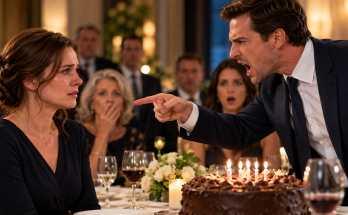
The Graystone Hotel ballroom had crystal chandeliers and two hundred guests and a cake that had been designed by someone whose name my mother mentioned twice, as if the name confirmed the appropriateness of the event.
I wore a black dress that my mother had considered too severe for the occasion and that I had chosen specifically because it was not what the occasion expected.
My father raised a crystal glass and said I was finally ready to become a woman.
Everyone clapped.
I smiled.
The trust had been executed at five o’clock. Nora had slid the papers across the polished table and said you’re sure? in the voice she used when she was doing her due diligence, and I had said yes, and we had signed, and by seven o’clock the $3 million was inside the Hale Education and Independence Trust with an independent trustee and terms that governed distribution for tuition, housing, medical needs, and future investments.
My parents could not access the principal.
Only the trustee and I could authorize distributions under the agreed terms.
This is what Nora had told my mother, who had apparently called in the hours between my appointment and the party. My mother’s response had been that I was being dramatic. My father’s response, when he heard at the party, was to squeeze my shoulder a little too firmly while we posed for photographs and say: sweetheart, you’ve been watching too many legal dramas.
My mother tilted her champagne glass and said Nora should know better than to encourage unnecessary worry.
Grant said nothing.
He stood across the room and looked at me with the expression of someone who has just understood that a door they had assumed was open is closed, and who is processing the implications.
Grant was twenty-four.
Grant had, for the past two years, been developing a business idea that required capital and had been having conversations with our father about sources of that capital, and I was aware of these conversations because Grant was not as careful as he thought he was about who was in earshot.
The party continued.
The cake was served.
My father made a speech about family loyalty, which was the subject he always returned to when he was positioning for something.
My mother cried the tears she had learned to cry on occasions that required them.
Grant left before midnight with his girlfriend Paige, who was wearing my grandmother’s diamond bracelet without having asked, which was something I noticed and filed.
At 1:10 in the morning, I came out of the elevator and found my father in the hotel corridor with his phone pressed to his ear.
“She moved it,” he said. “All of it. No, I can’t change it now. It’s locked.”
He turned.
He saw me.
His expression reorganized itself from concern to composure with the speed of someone who has practiced this particular transition.
“Go get some rest, Evelyn,” he said.
I went to my room.
I did not sleep for several hours.
Not from fear — from something more like the specific wakefulness of someone who has done a thing they knew they were going to do and is now on the other side of having done it, and the other side is both a relief and a beginning.
The breakfast room the next morning.
No coffee. No smiles. No servants, which was itself information — my parents had dismissed the hotel staff from the room, which meant the conversation was intended to be private.
My mother’s eyes were red in the way they went red not from crying but from not having slept.
My father stood at the head of the table.
He said: “Since you clearly don’t trust this family, perhaps it’s time for you to start making your own arrangements.”
I sat down.
I poured myself coffee from the carafe on the sideboard.
I took a sip.
“I’ve been making my own arrangements,” I said. “Since yesterday at five o’clock.”
My father looked at me.
“Evelyn,” my mother said. Her voice had the quality it used when she was going to be reasonable at me. “What you did last night was—”
“Legal,” I said. “And planned. And something Grandfather specifically suggested.”
“Your grandfather,” my father said, “was a man who saw problems where there were none.”
“Grandfather built three companies from nothing,” I said. “He was not a man who failed to understand the problems in front of him.”
“He didn’t trust your father,” my mother said. “That was his limitation.”
I looked at her.
“He trusted me,” I said. “He called me in November and told me what to do. He told me to go to Nora as soon as I was legally able. He told me not to wait to be told to.” I set down my coffee cup. “I did exactly what he asked.”
“He was an old man with old fears,” my father said.
“He was right,” I said.
The room was quiet.
“I heard you last night,” I said. “In the corridor. She moved it. All of it. I can’t change it now. It’s locked.” I looked at my father. “Who were you talking to?”
He didn’t answer.
“Grant,” I said. Not a question.
My mother looked at her hands.
My father said: “Grant has a business opportunity that requires—”
“That requires my inheritance,” I said.
“That requires seed capital,” he said. “Which we had discussed as a family—”
“I had not discussed it,” I said. “Grant discussed it with you. You discussed it between yourselves. At no point was I part of a conversation about my grandfather’s money being used for Grant’s business.”
“You’re eighteen,” my father said. “We’re your parents.”
“Yes,” I said. “You’re my parents. You’re not my financial managers. You’re not the trustee of my inheritance. You’re not signatories on any account that contains my money.” I met his eyes. “That’s not an accident.”
I want to tell you what happened next, because the next part is not what you might expect.
My father did not escalate.
He was a man who understood leverage, and he understood that he had none in this particular conversation, and men who understand leverage do not waste energy on situations where they have none.
He sat down.
He looked at the table for a moment.
Then he looked at me.
“You’re going to need us,” he said.
“Maybe,” I said.
“You’re eighteen. You’ve never lived independently. You have no income, no credit history, no—”
“I have a trust that covers tuition, housing, and living expenses for the duration of a degree program,” I said. “And after that, investment provisions. I’ve read the documents.”
“You’ll need advice,” he said.
“I have Nora,” I said.
“Nora was your grandfather’s attorney. She’s not—”
“She’s mine now,” I said. “She agreed.”
My mother made a sound.
“Evelyn,” she said. “This family has resources. Relationships. Your grandfather’s animosity toward your father didn’t have to become yours.”
“It’s not animosity,” I said. “I don’t have animosity toward either of you. I have information. Grandfather gave it to me, and I used it, and the trust exists. That’s the situation.” I looked at her. “I’m not asking you to like it.”
“What are you asking?” my father said.
I thought about this.
“I’m asking that we understand each other,” I said. “Clearly. You wanted access to my inheritance for a purpose I was not part of deciding. The structure prevents that. I’m not going to pretend that’s not what happened, and I’m not going to apologize for doing what I did, and I’d like us to proceed with that clarity rather than without it.”
My mother looked at my father.
My father looked at me.
“Clear,” he said. The word had edges, but it was honest.
“Good,” I said.
Grant called at eleven.
I was in my hotel room, reading, when my phone lit up with his name. I answered.
“You knew,” he said.
“I had a reasonable inference,” I said.
“Since when?”
“Since December,” I said. “You’re not careful about who’s in the next room.”
He was quiet.
“I wasn’t trying to steal from you,” he said.
“I know,” I said. “That’s not what it was. It was everyone agreeing on a use for my money without involving me, under the assumption that I would go along once presented with it. Which might have worked if Grandfather hadn’t warned me.”
“He never liked Dad,” Grant said.
“He understood Dad,” I said. “There’s a difference.”
“He left me less,” Grant said.
“Yes,” I said. “He did.”
“You don’t think that’s unfair?”
“I think he made different decisions about different people based on what he understood about them,” I said. “You could argue with that. I’m not sure it was unfair.”
Grant was quiet again.
“The business,” he said. “It’s actually a good idea.”
“Then find investors,” I said. “That’s what investors are for.”
“It’s easier with family money,” he said.
“Easier for whom?” I said.
He didn’t answer.
“Grant,” I said. “I love you. I’m not going to hold last night against you. But I’m also not going to fund something I had no part in deciding, and I’d like us to be clear about that.”
“Clear,” he said. The same word my father had used, with less edge.
“Good,” I said.
I left Chicago for Boston in August.
The trust covered my tuition at the school I had chosen, my apartment — a small one, the kind you choose because it’s yours rather than because it’s impressive — and my living expenses within the terms Grandfather and Nora had structured.
I called Nora once a month.
She sent quarterly reports, which I read.
My grandfather had been right about all of it: that the money was not the safety, that control was the safety, that options required protection before anyone could tell me what to do with them.
What he had not told me, because perhaps he did not know or perhaps he thought I needed to discover it myself, was what the protection would cost.
Not financially. The cost was different.
My mother called occasionally, in the careful way of someone who was performing relationship maintenance rather than feeling it. My father called less. Grant called when he had news about the business, which he had eventually funded through a legitimate investor after eight months and which was, as he had said, a good idea — it had been profitable in its first full year.
I went home for Christmas.
The table was set. The food was the food it had always been. My mother had the tree decorated as she always decorated it.
We were a family that had understood each other.
We were not a family that had resolved anything.
But we were honest, in the way that families are honest when the leverage is gone and what remains is just people who share history and are deciding what to make of it.
I sat at the table and I passed the potatoes and I answered questions about school and I listened to Grant describe the business with the enthusiasm of someone who had done something himself and knew it.
After dinner, my father sat beside me on the porch.
It was cold. I had my grandfather’s old coat on, the one from his study.
“He loved you,” my father said.
“I know,” I said.
“More than he loved me,” he said. “I’m aware of that.”
I looked at the yard.
“He understood me,” I said. “Maybe that’s not the same as love. But it felt like it.”
My father was quiet.
“He was right about the trust,” he said.
I looked at him.
“I was going to ask you,” he said. “At breakfast the next morning. Before you got downstairs. We had a plan.” He looked at the yard. “He knew us better than we knew ourselves.”
“Yes,” I said.
“I don’t know if that’s something to admire or resent,” he said.
“You can probably do both,” I said.
He looked at me.
“You’re very like him,” he said.
“I know,” I said.
“I mean it as a compliment,” he said.
“I know,” I said. “I’m taking it as one.”
We sat on the porch in the cold.
The winter was doing what winter did, and inside the house my mother was washing dishes and Grant was explaining something to Paige, who was still wearing jewelry that wasn’t hers, and the tree was lit in the living room window.
I was nineteen.
I had a trust and a lawyer I talked to once a month and a small apartment in Boston that was mine.
I had control.
My grandfather had told me what control was, and he had been right, and the rightness of it had cost something that I was still calculating — not in money, but in the specific currency of a family that had understood each other and was now negotiating what understanding looked like after everything had been said clearly.
I thought it was worth it.
I thought it was exactly the trade he had intended.
Money doesn’t make you safe, Evie. Control does.
I was safe.
THE END