
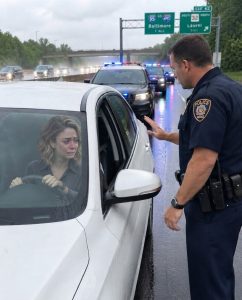
 My parents reported my fully paid-off car as stolen after I refused to hand my sister $15,000. They w3rned the police that I was unstable, confrontational, and likely to flee.
But when one of the officers stepped into my headlights, I recognized him immediately.
It was Caleb—my fiancé.
My parents believed the sirens, patrol cars, and flashing lights would frighten me into surrendering the money.
They had no idea that a credit alert already waiting on my phone was about to uncover more than $302,000 in fraud.
I was driving home from work along Interstate 25 when police vehicles suddenly surrounded my white Honda Civic.
One cruiser blocked the lane in front of me.
Another stopped directly behind my car.
Red and blue lights flashed through the windows, filling the interior with shifting color.
Then a command came through a loudspeaker.
“Turn off the engine. Throw the keys out of the window and keep your hands visible.”
I followed every instruction.
My keys struck the pavement as cold air entered through the open window.
The officers remained positioned behind their vehicles, watching me as though I might become dangerous at any moment.
I was twenty-nine years old.
I worked as a senior data analyst.
I had never been arrested, charged with a crime, or even received a speeding ticket.
Yet someone had persuaded the police that I was driving a stolen vehicle and might attempt to escape.
Then an officer slowly approached through the beam of my headlights.
I knew him immediately.
Caleb Hayes—the man I was supposed to marry.
“She is my fiancée,” Caleb announced so the surrounding body cameras would capture every word. “Lower the response while we verify the registration and title.”
He approached my window and crouched beside the door.
His eyes quickly checked my face, my hands, and the empty passenger seat.
Then he asked the question that told me he already suspected the answer.
“Emma, what did your family do?”
Caleb knew my parents better than most people.
He had watched them appear affectionate in family photographs while privately relying on guilt, intimidation, and silence whenever anyone challenged them.
He also knew how my older sister, Lauren, had always been treated as the family’s most precious responsibility.
I had a different role.
Whenever someone needed money, I became the account they expected to use.
“Your licence plate was flagged about ten minutes ago,” Caleb explained. “The caller said the vehicle had been stolen and warned that the driver might become aggressive or try to flee.”
“Who called?”
His expression became tense.
“Your father.”
When I was eighteen, Dad had co-signed the original loan because I had no credit history.
But I had made every payment myself.
I paid for the insurance, repairs, registration, and maintenance.
Three years earlier, I made the final payment, and the title was transferred entirely into my name.
My father had taken an old connection to the original loan and turned it into a weapon.
“Why would he do this?” Caleb asked.
I looked at the clock on the dashboard.
It was 8:14 p.m.
“Because I refused to give Lauren fifteen thousand dollars.”
Two nights earlier, my mother had ordered me to attend dinner at their house.
The dining table looked as if it had been arranged for a magazine photograph.
Lauren was already crying when I arrived. Her husband sat beside her, staring at a plate he had not touched.
Dad occupied his usual seat at the head of the table.
“Your sister needs help,” he said.
“How much?”
“Fifteen thousand dollars.”
Mom glanced deliberately at my engagement ring.
“Your family should be more important than an expensive wedding, Emma.”
I explained that Caleb and I had saved that money for our ceremony and the deposit on our first home.
I would not sacrifice our future to solve another emergency for Lauren—especially when nobody would explain what the money was actually for.
Dad slowly stood.
“You do not refuse this family without consequences.”
I expected angry messages.
Weeks of silence.
Perhaps another campaign of emotional pressure.
I never imagined he would report my car as stolen.
Once the officers confirmed that the vehicle legally belonged to me, the false alert was removed.
My hands were shaking so badly that another officer drove the Honda to my apartment while Caleb took me home.
The moment the apartment door closed behind us, my phone vibrated.
A notification from my credit-monitoring service appeared.
Someone had just submitted a short-term loan application using my identity.
The amount requested was exactly $15,000.
Caleb read the message over my shoulder.
“Freeze your credit immediately.”
I accessed reports from all three credit bureaus.
When the records loaded, my stomach dropped.
Three unfamiliar accounts appeared under my name.
A property-secured credit line.
A business loan.
And a private refinancing agreement.
Together, the accounts carried an unpaid balance of $302,487.
Every one of them listed my parents’ house in Colorado Springs as the associated address.
Before I could fully process the discovery, my father called.
Caleb activated the recording function on his phone and motioned for me to answer.
Dad did not ask whether I was safe.
He did not mention the police stop or apologize for frightening me.
“Transfer the fifteen thousand,” he said, “and we can correct tonight’s misunderstanding.”
“You falsely reported my car as stolen.”
“You left me no other option.”
“What about the loans taken out in my name?”
Silence followed.
An innocent person would have immediately asked which loans I meant.
My father said nothing.
When his voice returned, it was colder.
“You are tired and confused. Do not make accusations when you have no evidence.”
Then he ended the call.
I did not cry.
I saved the recording.
Because Caleb was engaged to me, he contacted his supervisor and formally removed himself from the investigation. He refused to give my father’s attorney any opportunity to claim that our relationship had influenced the case.
Before midnight, a fraud detective had received everything.
The credit-monitoring alert.
The recorded phone call.
The legal title proving the Honda belonged to me.
And the body-camera footage from the traffic stop.
At nine the following morning, a bank investigator asked me to attend a private meeting.
My family was already seated inside the conference room when I arrived.
Lauren sat beside our parents with swollen eyes.
Dad wore his finest suit—the one he always selected when he wanted to appear respectable and beyond suspicion.
Mom held her handbag tightly in both hands.
My father smiled when I entered.
“My daughter is under considerable stress because of her upcoming wedding,” he told the investigator in a warm, measured voice. “She has misunderstood a private financial arrangement between relatives.”
The investigator did not respond.
She placed a thick file on the table.
My father’s smile weakened.
Inside were several loan applications bearing my name.
There was also a notarized power-of-attorney document claiming that I had granted Dad authority over my finances.
I had never seen it before.
Beside it was a deed connected to my parents’ property.
The investigator placed a blank page in front of me.
“Please write your full legal signature.”
I signed my name.
She positioned it next to the signature on the supposed power of attorney.
The difference was obvious.
The signatures were not remotely similar.
The false version did not even imitate the way I formed my letters.
My mother slowly turned toward Dad.
“Richard,” she whispered.
He leaned forward.
“She gave us permission years ago. She was young. She simply does not remember signing it.”
At that moment, the conference-room door opened.
A detective entered carrying another collection of financial records.
The bank investigator turned the file to its final page and slid it toward me.
“Before we discuss the forged documents and fraudulent accounts,” she said, “you need to know who legally owns the house where your parents are currently living.”
Every trace of color disappeared from my father’s face.