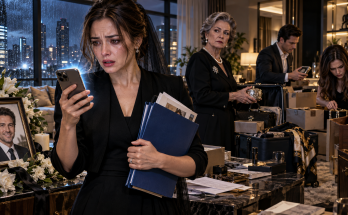
The first thing I noticed when I returned from my husband’s funeral was that the lamp in our living room was on.
I stood outside the condo door with my key between two fingers, staring at the thin strip of yellow light beneath it. I had switched everything off before leaving that morning. I remembered doing it because David used to tease me about wasting electricity, even when he was the one who forgot lamps in empty rooms. Eleven months of cancer had taken away his strength, his appetite, and eventually his ability to walk through our home without assistance. It had not taken away that habit.
For a few seconds I wondered whether grief had confused me. The funeral had been a blur of black coats, wet September air, flowers, sympathetic hands, and people telling me David was finally at peace. I had nodded until my neck hurt. I had thanked people whose names I could barely remember. I had watched the cemetery workers lower the man I had loved for nine years into the ground.
Now someone was inside our home.
I unlocked the door quietly.
Voices came from the dining room.
Not burglars.
Family.
That realization should have calmed me. It did the opposite.
I stepped inside and saw an unfamiliar suitcase beside the entry table. Then another. Two cardboard boxes were stacked near the coat closet. David’s charcoal wool coat—the one he had worn on our first winter trip together—had been taken from its hanger and folded across the lid of an open suitcase.
“Hello?”
The voices stopped.
Eleanor Hayes appeared first. My mother-in-law was still wearing the dark navy dress she had worn at the cemetery, but the expression she had presented to mourners was gone. There were no wet eyes now, no trembling mouth. She looked brisk and alert, almost energized.
“Sarah,” she said. “We didn’t expect you back yet.”
The sentence landed strangely.
“This is my home. Where else would I go?”
Behind her, David’s younger brother Marcus emerged from the office carrying a stack of folders. Chloe, David’s cousin, stood near the dining table with one of my husband’s watches in her hand. Two nephews were removing books from shelves. An uncle I had spoken to perhaps five times during my marriage was examining the painting above our fireplace.
For several seconds I could not make my mind accept what my eyes were showing me.
“What are you doing?”
Nobody answered immediately.
Marcus placed the folders on the table with excessive care. “We thought it would be easier to sort things today.”
“Sort what things?”
Eleanor stepped toward me. “David’s belongings.”
I looked past her.
A row of his watches lay on a towel. His camera was beside them. Someone had disconnected his laptop. Drawers in the entertainment cabinet stood open. A box on the floor contained framed photographs that had been on our bedroom shelves that morning.
The room smelled faintly of lilies from the funeral arrangements they had carried upstairs.
“You came here from the cemetery,” I said.
Eleanor pressed her lips together. “We’re trying to spare you.”
“From what?”
“Having to do this later.”
I took off neither my coat nor my shoes. “Put everything back.”
Chloe gave Marcus a quick glance.
Eleanor’s tone remained patient. “Sarah, nobody is stealing anything.”
“I didn’t use the word stealing.”
Her expression tightened.
I walked past her toward David’s office. The room had been disturbed badly enough that my skin prickled. His desk drawers were open. Files had been pulled from the cabinet. A small wooden tray where he kept cuff links was empty. Somebody had moved the photograph of the two of us that normally stood beside his computer.
Yesterday morning, I had sat in that chair with David’s hand on my wrist while his breathing became shallower.
Now his relatives were searching his desk.
“What exactly are you looking for?”
Marcus followed me. “Nothing specific.”
“Then why are you going through financial files?”
He folded his arms. “Mom asked us to organize the estate.”
“The estate has an attorney.”
That stopped him for half a second.
I had not actually spoken with an estate attorney. David had told me there were documents I would need after his death, but the final weeks had been dominated by medication schedules, hospice visits, oxygen levels, and the terrible daily mathematics of whether he could eat half a bowl of soup. Paperwork had seemed abstract beside the fact that my husband was dying.
Marcus recovered quickly. “An attorney doesn’t know what belongs to the family.”
I looked at him.
“David’s family,” he clarified.
The distinction was deliberate.
From the doorway Eleanor said, “Nobody is questioning what you meant to him.”
“That sounds exactly like what you’re doing.”
She sighed as though I were exhausting her. “You’re grieving.”
“So are you, supposedly.”
Marcus’s head snapped toward me.
I regretted the cruelty as soon as I said it, but Eleanor did not look wounded. She only became colder.
“You were David’s wife for nine years,” she said. “I was his mother for forty.”
I felt something settle inside me.
Not rage. Not yet.
Clarity.
The funeral had ended less than three hours earlier, and she was already measuring claims.
I returned to the dining room. On the table was a sheet of legal paper covered with handwriting. At the top somebody had written a heading about property distribution. Beneath it were items from the condo—David’s watch collection, his laptop, his camera equipment, an antique fountain pen that had belonged to his father, investment paperwork, even our espresso machine.
“Our espresso machine?”
Chloe looked embarrassed.
Marcus said, “That’s obviously not important.”
“It’s on your list.”
“That can be removed.”
I picked up the page.
Beside several items were initials.
M.H.
C.H.
E.H.
They had already assigned possessions to one another.
“You divided my husband’s things while I was burying him.”
Eleanor’s composure cracked slightly. “Those things came from his family.”
“The laptop?”
No answer.
“The camera I gave him for his thirty-eighth birthday?”
Silence.
“The espresso machine we bought together?”
Eleanor reached for the list. “You’re making this uglier than it needs to be.”
I moved it out of reach.
She lowered her voice. “There are matters you may not understand.”
“Then explain them.”
“The Hayes family has always handled property within the family.”
“I am family.”
Her eyes held mine.
The pause lasted perhaps two seconds.
It was enough.
I understood what she meant before she said another word.
I had been David’s wife while he was alive. Now that he was dead, they believed I had reverted to being an outsider.
Chloe put down the watch. One nephew suddenly became fascinated by a cardboard box. Marcus stared toward the window.
Eleanor alone did not look away.
“Certain assets,” she said, “were never intended to leave the Hayes line.”
I stared at her. “You’re talking as if David and I divorced.”
“You know that isn’t what I mean.”
“No, Eleanor. I don’t.”
Her nostrils flared.
I heard David’s voice in my memory, quiet and almost amused: When Mom lowers her voice, that’s when she’s angriest.
He had warned me about her temperament throughout our marriage. Never dramatically. David did very little dramatically. He used humor to soften difficult truths. When Eleanor criticized our decision not to have children, he changed the subject. When she demanded information about his investments, he told her finances bored him. When she complained that I did not “understand family tradition,” he squeezed my knee beneath the table.
I had assumed he was maintaining peace.
Now I wondered whether he had been containing something much larger.
“Everyone stops packing,” I said.
Marcus gave a short laugh. “Sarah.”
“Now.”
“This isn’t solely your decision.”
“This is my home.”
Eleanor’s expression shifted.
There it was again—that almost imperceptible confidence.
“You may want to speak with someone before assuming that.”
I stared at her.
“What does that mean?”
She stepped toward the window and looked over Lincoln Park, where evening traffic glowed between the buildings.
“This condo was connected to David’s family long before he married you.”
“That doesn’t answer me.”
“It belonged to David.”
“He was my husband.”
“Yes.”
The way she said the word made my stomach tighten.
Marcus picked up his phone. “We don’t need to do this tonight.”
Eleanor ignored him.
“David died without children,” she said. “There are questions about how certain property should be handled.”
The room became unnaturally quiet.
I thought of all the things I did not know. David had managed most of our investment accounts. He had been meticulous about documents. In the final months he had repeatedly asked whether I remembered the password to a secure folder on his computer.
Once, after midnight, I had found him sitting at his desk despite being too weak to stand without help.
“What are you doing?” I had whispered.
“Making sure you don’t have to fight with paperwork after I’m gone.”
I had started crying.
David had closed the laptop and held me until I could breathe again.
At the time, I thought he meant insurance forms.
Now Eleanor was standing inside our home suggesting that I might not own it.
“You came here knowing I would be at the cemetery longer,” I said.
Nobody answered.
“You brought suitcases.”
Marcus shifted his weight.
“You opened drawers. You made an inventory. You assigned his possessions to yourselves.”
“Sarah—”
“You didn’t come to help me.”
Eleanor’s face hardened completely.
“Then perhaps we should stop pretending.”
For the first time that afternoon, she sounded like herself.
“David made emotional decisions where you were concerned.”
I almost laughed. David was the least impulsive person I had ever known.
“He loved you,” she continued. “Nobody denies that. But grief does not change the fact that there are assets with a family history.”
“You mean assets you want.”
Her jaw tightened.
Marcus stepped between us. “Enough.”
“No,” I said. “Not enough.”
I pointed toward the boxes.
“Put every item back exactly where you found it. Then leave.”
Marcus shook his head. “We should wait until the legal situation is clarified.”
“It’s clarified enough for you to stop taking things.”
Chloe suddenly spoke. “Maybe we should go.”
Eleanor turned sharply. “We are not finished.”
Chloe looked uncomfortable. “Aunt Eleanor, she just buried him.”
Something flickered across Eleanor’s face at that. For a moment I saw the grieving mother beneath the controlled exterior. Then it vanished.
She walked toward David’s office.
I blocked the doorway.
“What do you need in there?”
“Documents.”
“What documents?”
“David kept records for his father.”
“My father-in-law died twenty years ago.”
“That doesn’t make the records irrelevant.”
“What records?”
Eleanor did not answer.
From behind us came the sound of paper sliding from a folder.
I turned.
Chloe stood beside the desk holding a thick blue file I had never seen before.
Eleanor’s face changed.
Not dramatically.
But enough.
“Where did you find that?” she asked.
Chloe looked confused. “Bottom drawer.”
Eleanor took a step toward her.
And suddenly I knew the suitcases were not the most important reason they had come.
They had been searching for something.
Something David had hidden in our home.
My phone vibrated inside my purse.
I almost ignored it.
Then it vibrated again.
I pulled it out.
A scheduled message had appeared.
The sender was David.
Click here to continue reading: PART 2: My Dead Husband’s Message Arrived While His Mother Searched Our Home, and One Sentence Changed Everything I Thought I Knew
Hours After I Buried My Husband, His Family Arrived at My Home Acting as Though I Had Already Disappeared
Part 1 of 15