
The richest man in Chicago was walking through the rain like a man who had already died. Andrew Whitman had everything people begged God for — a glass tower with his name on it, a billion-dollar tech company, private cars waiting at every curb, a penthouse above the city lights.
But none of it mattered anymore. Not since the crash. Fifteen months earlier, one violent turn on a wet highway had taken his wife Emily and the unborn daughter they had already named Lily.
Since that night, Andrew had not truly lived. He attended meetings. He signed contracts. He looked people in the eye and answered questions. But inside, he was gone.
That December evening, cold rain fell over downtown Chicago, blurring the holiday lights into soft, broken colors. Andrew walked alone, his expensive wool coat soaked at the shoulders, his polished shoes stepping straight through puddles he did not care to avoid.
His therapist’s words echoed in his head. “You can’t just exist, Andrew. Living and existing are not the same thing.” He almost laughed at that. Living — what did that even mean when the two people who made your future worth reaching had been buried in the same week?
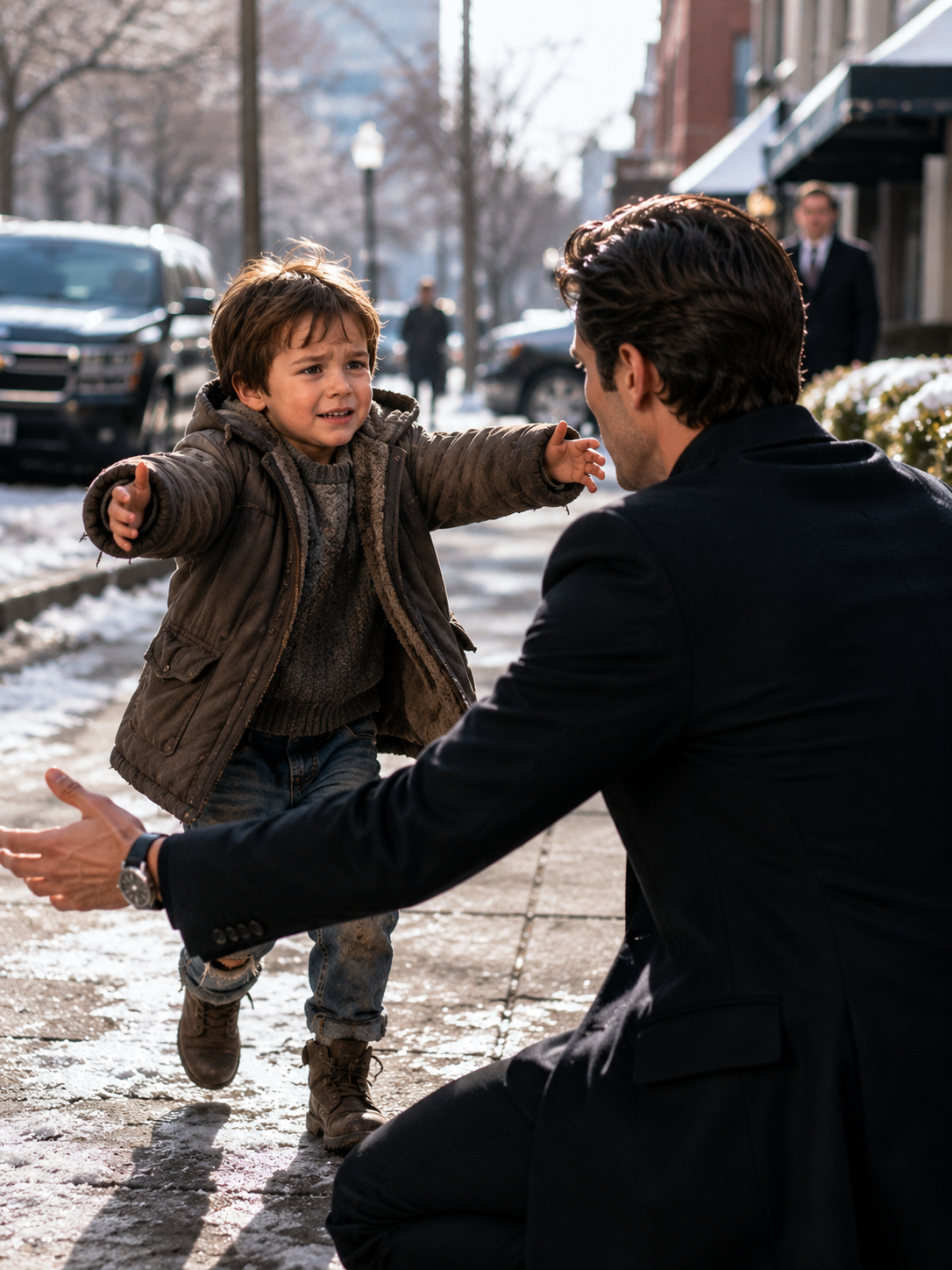
Then through the rain, he heard something. Small footsteps, fast, panicked. A child running like the world behind him had teeth.
Andrew turned just as a trembling boy slammed into him, grabbed his coat, and whispered six words that would tear open his frozen heart. “Please pretend you’re hugging me.”
Andrew froze. For one second, the whole city seemed to go silent around him. The rain kept falling. Cars kept sliding past the curb. Christmas lights blinked across the wet sidewalks, but all Andrew could feel was the small body shaking against him.
The boy could not have been more than eight years old. His hair was dark and messy, plastered to his forehead by the rain. His clothes were thin, worn, and too small in places, as if life had been pulling at him from every direction.
His sneakers were soaked through, one lace dragging in the water. But it was his eyes that stopped Andrew cold — wide with terror, not the fear of a child who might get scolded, but the fear of a child who knew exactly what would happen if he got caught.
“Please,” the boy whispered again, his fingers digging into Andrew’s coat. “Just for a minute, pretend I’m your son.” Andrew looked over the boy’s shoulder. Two men were coming fast down the sidewalk, dark uniforms under heavy jackets, faces red from the cold.
One of them pointed straight at the child. “Ethan. Ethan Miller. Get back here right now.” The boy flinched so hard Andrew felt it through his coat.
Andrew should have stepped away. A reasonable man would have asked questions. A careful man would have waited to understand the situation before getting involved — after all, he was not just anyone. He was Andrew Whitman, and every move he made could become a headline.
But in that moment, he was not thinking like a businessman. He was not thinking like a billionaire. He was thinking like a man who had lost a child before he ever got to hold her — and now a living child was pressed against him, begging not to be taken away.
Something cracked open inside him. Andrew wrapped both arms around Ethan and pulled him close. The boy buried his face against Andrew’s chest, trembling so badly it felt like he might come apart.
“There you are,” Andrew said loudly, his voice suddenly calm, deep, and controlled. “I’ve been looking everywhere for you, son.” The two men slowed, their confidence faltering.
“Sir,” the taller one said, breathing hard, “that boy is with us. He ran off during supervised recreation.” Andrew did not release Ethan. If anything, he held him tighter. “I think you’re mistaken.”
“We know who he is.” “Do you,” Andrew asked. His tone changed, became colder, sharper — the same voice that had ended boardroom fights, silenced hostile investors, and made powerful people reconsider their next sentence.
The guards exchanged a glance. Ethan’s hands tightened around the front of Andrew’s coat. Andrew felt that desperate grip and suddenly understood one thing with absolute certainty — this child had not run toward him. He had run away from something.
The taller guard took another step. “Sir, please don’t make this difficult.” Andrew lifted his chin. “This is my son. Ethan Whitman. And unless you want to explain to my attorneys why two grown men are chasing a terrified child through downtown Chicago, I suggest you step back.”
The name landed like a heavy door closing. Recognition flickered across the guard’s face — the suit, the coat, the watch, the effortless authority. They knew exactly what kind of man they were standing in front of. A man with money. A man with lawyers. A man the world listened to.
The shorter guard swallowed. “There may have been a mistake.” “Yes,” Andrew said. “There may have been.” The men backed away, muttering apologies that dissolved into the rain.
Only when they disappeared around the corner did Ethan finally loosen his grip, though he did not let go completely. “Thank you,” he whispered. Andrew looked down at this soaked, frightened boy who had crashed into his life like a warning from heaven, and knew that for fifteen months he had believed there was nothing left in the world that could make his heart move. He had been wrong.