
The rhythmic beeping of the heart monitor was the only sound tethering me to reality. It sounded too much like a countdown.
I sat in the sterile, aggressively white room of Seattle General Hospital, watching my mother sleep. Her skin, usually the color of warm mahogany, was terrifyingly ashen. She was a Gold Star Widow, a woman who had received a folded flag and a brass bugle’s eulogy twenty years ago when my father’s Black Hawk went down in Kandahar. She had survived that. I couldn’t let a failing mitral valve be the thing that took her down.
I looked down at my hands. They were scarred, calloused from years of gripping a rifle in the Sandbox, and lately, from gripping a soldering iron in my freezing, damp garage. After I was medically discharged—honorable, but carrying a head full of ghosts and a diagnosed case of severe PTSD—I had retreated into obsession. I couldn’t save my spotter, Miller, when a piece of shrapnel severed his femoral artery. The helplessness of watching him bleed out in the dust had clawed at my sanity.
So, I built something to fix it.
I spent four years developing the Aegis Hemostatic Matrix, a localized, rapid-expanding nanoparticle foam designed to seal catastrophic arterial trauma in seconds. For years, I was just a crazy veteran in a faded field jacket, tinkering with chemicals and 3D printers, living off VA disability checks.
Or at least, that’s what Victoria believed when she handed me the divorce papers.
Victoria. Just the thought of my ex-wife made a cold knot tighten in my stomach. She was a woman who measured a man’s worth by the tailored cut of his suit and the commas in his bank account. When my night terrors got worse, she didn’t offer a hand; she offered a psychiatric brochure. When I poured my disability money into patents instead of luxury vacations, she packed her bags. During the divorce, she told the mediator I was financially delusional, a broken soldier playing scientist to avoid getting a real job.
I patted the interior pocket of my worn olive-drab canvas jacket. The stiff, rectangular piece of paper rested securely against my chest. It wasn’t a prototype anymore. It was real. DARPA had validated it. The Department of Defense had bought the exclusive military distribution rights.
The paper in my pocket was a United States Treasury Warrant. Five million dollars. The first installment of a defense acquisition contract that would change battlefield medicine forever. More importantly, it was my mother’s life.
I kissed my mother’s forehead, leaving the quiet rhythm of the hospital behind. The rain outside was a cold drizzle, typical for Seattle, but I barely felt it. I had the money. All I needed was to deposit it, wire the funds to the hospital, and breathe again.
But my designated account, the one tied to my family trust, was held at Vanguard National Bank.
The same branch where Victoria had just been promoted to Managing Director.
I stood across the street from the bank’s towering glass facade, watching the sleek, suited figures move through the revolving doors. My chest tightened, the familiar phantom grip of anxiety squeezing my lungs. I knew exactly what awaited me in that opulent lobby. I knew the gauntlet I had to run.
Taking a slow, jagged breath, I stepped off the curb.
The interior of Vanguard National smelled of polished marble, expensive espresso, and quiet, ruthless authority. The temperature dropped ten degrees the moment I walked in. In my scuffed combat boots and faded military jacket, I was an ugly, rusted gear tossed into a flawlessly oiled machine.
A junior teller eyed me with immediate suspicion, her hand drifting beneath her counter. But I didn’t approach the teller line. I walked straight toward the glass-walled offices at the back.
Victoria was sitting behind a massive mahogany desk, immaculate in a bespoke charcoal blazer. She was reviewing a document on her tablet, her posture screaming untouchable superiority. When she glanced up and saw me standing in her doorway, her perfectly manicured eyebrows knit together in a mixture of disbelief and immediate disgust.
“Daniel,” she sighed, dropping her stylus. She didn’t offer a seat. “If this is about the alimony adjustment, I’ve already told my lawyer—”
“It’s not about you, Victoria,” I said, stepping into the room. The door clicked shut behind me. “I need to make a deposit. A large one. And I need a wire transfer authorized immediately to Seattle General.”
She leaned back in her leather chair, her eyes doing a slow, insulting sweep of my clothes. “We have ATMs for small deposits, Daniel. Or did you finally find a buyer for those scrap-metal toys you were building in your mother’s shed?”
Don’t bite, I told myself. Just get it done.
I reached into my jacket and pulled out the Treasury Warrant. I placed it gently on the center of her desk.
Victoria leaned forward, a condescending smirk playing on her lips. She looked at the paper. Then she froze. Her eyes flicked from the staggering amount—$5,000,000.00—to the official seals of the United States Department of the Treasury, and finally to the payee line: Daniel Vance.
For three seconds, the only sound was the hum of the air conditioning.
Then, the smirk returned, wider and far more venomous. “Are you out of your mind?” she whispered.
“It’s a federal warrant,” I said, keeping my voice perfectly level. “Call the issuing authority. The contact number for the DoD procurement office is on the attached ledger. Verify it.”
Victoria picked up the check between her thumb and forefinger as if it were coated in anthrax. “You always did love your little delusions, Daniel. But faking a federal instrument? This isn’t just pathetic. It’s a felony.”
“Victoria, listen to me,” I said, planting my hands on the edge of her desk. “My mother’s heart is failing. She goes into surgery tomorrow morning, but only if that money clears the trust today. Call the number. Verify the funds. Do whatever compliance check you need, but do it now.”
She looked at me, really looked at me, and I saw the absolute absence of empathy in her eyes. She still saw the broken man waking up screaming in the dark. She didn’t see the man who had pulled himself out of hell.
“You’re sick, Daniel,” she said, her voice dripping with mock pity. “Your PTSD has finally severed your grip on reality. Nobody is writing a broken, unemployed veteran a five-million-dollar check. Especially not the government you leech off of.”
Before I could process the sheer cruelty of her words, Victoria’s hands moved.
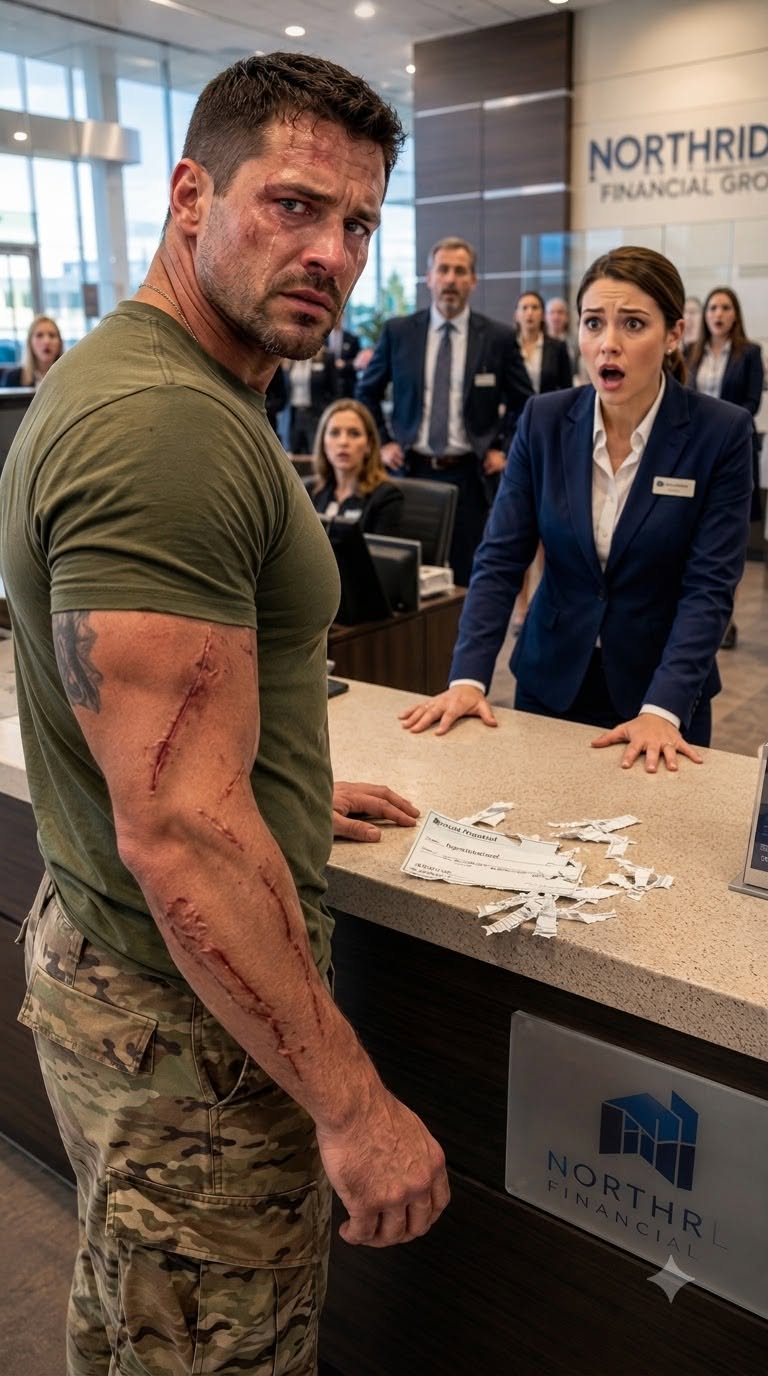
With a sharp, violent flick of her wrists, she tore the United States Treasury Warrant in half.
The sound was louder than a gunshot in my ears.
She placed the two pieces together and tore them again, letting the shredded remnants of my mother’s salvation flutter onto the polished wood of her desk.
“There,” Victoria said, brushing her hands together. “Now stop pretending you’re a savior, and go get the psychiatric help you desperately need.”
My vision swam. A cold, absolute fury, sharper than any combat adrenaline, flooded my veins. “You just destroyed a validated federal instrument.”
Victoria pressed a button under her desk. “I just protected my bank from a fraudulent deposit. Paul,” she called out as her assistant opened the door. “Call building security. Then call the Seattle Police Department. Mr. Vance is attempting to pass forged federal documents.”
Two armed security guards materialized behind Paul, their hands resting cautiously on their duty belts.
“Hands where we can see them, buddy,” the taller guard barked.
I didn’t move. I didn’t raise my hands. I just stared through the glass walls of her office, looking out at the street.
Victoria laughed, a harsh, brittle sound. “What are you looking at, Daniel? Expecting your imaginary friends to come rescue you?”
“No,” I said quietly, hearing the distant, rhythmic thumping of heavy rotors cutting through the Seattle skyline. “I’m expecting the people who wrote the check.”
Outside the floor-to-ceiling windows, the street traffic suddenly ground to a halt as three matte-black, armor-plated SUVs jumped the curb, their red and blue strobe lights igniting the gray morning.
The heavy glass doors of the bank didn’t just open; they were aggressively breached.
Four Military Police officers in full tactical dress swarmed into the lobby. They didn’t shout, they didn’t draw weapons, but their sheer, coordinated presence instantly neutralized the room. The bank’s security guards stepped back, raising their hands defensively, completely out of their depth.
Behind the MPs walked a man who seemed to suck all the oxygen out of the room. He wore a crisp dress uniform, the ribbons on his chest a mosaic of decades spent in the fire. On each shoulder gleamed four silver stars.
General Marcus Sterling, head of the Defense Advanced Research Projects Agency’s medical division.
He marched straight past the frozen tellers, his eyes locking onto me through the glass walls of Victoria’s office. He didn’t wait for an invitation. He pushed the door open, the MPs flanking the entrance.
Victoria stood up so fast her chair hit the back wall. Her face had drained of all color, resembling wet chalk. “Excuse me! You cannot just storm into a private financial institution—”
General Sterling ignored her entirely. He stopped three feet in front of me, his boots clicking sharply on the hardwood floor. He straightened his posture, brought his heels together, and snapped a textbook, razor-sharp salute.
“Sergeant Vance,” General Sterling barked, his voice echoing in the sudden silence of the bank.
I returned the salute, feeling the ghost of my old uniform settle over my shoulders. “General.”
“I apologize for the theatrical arrival, son,” Sterling said, dropping his hand. “The Pentagon procurement office flagged an anomaly. They tracked the routing number of your payment and realized you were physically bringing the warrant to a civilian branch instead of routing it through the federal reserve network. Given the urgency of your mother’s situation, I wanted to personally ensure the red tape was cut. How is Mrs. Vance?”
“Running out of time, sir,” I said.
Victoria made a choking sound. “Wait. General? What is this? This man is my ex-husband. He’s unemployed. He tried to pass a fake check—”
Sterling finally turned his gaze to Victoria. It was the look of a predator assessing a very insignificant insect. He looked down at the shredded pieces of the Treasury Warrant scattered across her desk.
“Did you destroy that document, ma’am?” Sterling’s voice was dangerously quiet.
“It was a forgery!” Victoria practically shrieked, her composed facade shattering. “He’s delusional! He makes things in a garage!”
“What he makes in a garage, ma’am,” Sterling said, stepping toward her desk, “is the Aegis Hemostatic Matrix. A battlefield trauma technology that, in its first classified field test last month, saved the lives of fourteen American soldiers who would have otherwise bled out in the dirt. The United States government just purchased the rights to that ‘forgery’ for twenty-five million dollars. That piece of paper you just destroyed was his initial five-million-dollar disbursement.”
Victoria’s mouth opened, but no sound came out. She looked at me, her eyes wide, frantic, searching for the punchline of a joke that didn’t exist. She remembered waving my prototypes over the garbage can. She remembered telling the judge I was worthless.
The bank’s regional counsel, a sharp-featured woman named Elena, pushed her way through the crowd of gaping employees and stepped into the office. She looked at the torn check, the General, and then at Victoria.
“Ms. Hayes,” Elena said, her voice shaking slightly. “What have you done?”
“I… I was following fraud protocols,” Victoria stammered, stepping back. “He’s my ex-husband, I know his financial history—”
“That is exactly why you are strictly prohibited from handling his accounts,” Elena snapped, pulling out a tablet. “General, Mr. Vance, I represent the regional board. We can issue a provisional line of credit immediately to cover this amount while we reissue—”
“That won’t be necessary,” Sterling interrupted. “My adjutant has already wired the funds directly to Seattle General Hospital’s surgical trust. We don’t leave our own behind. Especially not the widow of a fallen airman.”
I closed my eyes, the crushing weight lifting off my chest for the first time in weeks. She’s safe. Mom is going to be safe.
“However,” Sterling continued, his voice dropping an octave, “we do have another issue.”
An agent in a suit, previously unseen behind the MPs, stepped forward. He flashed an FBI badge at the regional counsel.
“In auditing Sergeant Vance’s financial history to expedite his security clearance for this contract,” the agent said, his eyes fixed dead on Victoria, “we found severe discrepancies regarding his Veterans Affairs disability deposits.”
Victoria grabbed the edge of her desk. “I didn’t… that was a system error.”
“Eighteen months ago,” the agent read from a folder, “someone using your administrative credentials placed a fraudulent ‘suspicious activity’ freeze on Mr. Vance’s primary checking account. This specifically blocked the deposit of his federal VA benefits, leaving him without income for ninety days. You cited ‘suspected narcotic trafficking’ as the reason, with zero evidence.”
Paul, her assistant, backed away from the door, looking at his boss in horror.
“You didn’t just deny him service today, Ms. Hayes,” the FBI agent said, pulling a pair of handcuffs from his belt. “You used your position in a federally insured bank to maliciously intercept and freeze government funds allocated to a wounded veteran. That is wire fraud, abuse of fiduciary power, and a federal felony.”
Victoria looked at me, tears of pure, unadulterated panic spilling over her cheeks. “Daniel. Daniel, please. Tell them! Tell them we had a bad divorce. Tell them I made a mistake!”
I looked at the woman who had kicked me when I was bleeding, who had just tried to rip up my mother’s life out of sheer spite.
“You didn’t make a mistake, Victoria,” I said, my voice empty of anger, empty of everything but pity. “You just finally picked a fight with someone who could fight back.”
The MPs parted as the FBI agent stepped forward, grabbing Victoria’s wrists and violently spinning her around to face the glass wall. The metallic click of the handcuffs echoed through the silent bank.
The chaotic symphony of Victoria being read her Miranda rights, weeping hysterically while being marched through the lobby of her own bank, faded into the background. The tellers who had sneered at my boots now looked at me with a mixture of awe and terror.
General Sterling placed a heavy hand on my shoulder. “Come on, Sergeant. The convoy is waiting outside. We’re taking you to the hospital.”
The ride in the armored SUV was a blur. My mind was racing ahead, calculating the traffic, the distance, praying the wire transfer had cleared the hospital’s archaic bureaucracy in time.
When we breached the doors of Seattle General, Dr. Aris was waiting in the lobby. He didn’t look angry anymore; he looked relieved.
“The funds cleared twenty minutes ago,” Dr. Aris said, shaking my hand vigorously, then nodding respectfully to the General. “We’ve already administered the pre-op anesthesia. We are wheeling her into the OR now.”
“I need to see her,” I said, my chest tightening again.
“You have exactly two minutes,” the doctor warned, leading me down the sterile white corridor that suddenly felt entirely different from this morning.
My mother was on the gurney, her eyes half-closed, a soft, drowsy smile on her face. The heavy anxiety that had aged her ten years in a month was gone.
I leaned down, taking her frail, warm hand in mine.
“Hey, Mom,” I whispered.
“Daniel,” she murmured, her voice slurred from the medication. “Did… did the invention work? Did you fix it?”
Tears, hot and unbidden, finally broke through my defenses, tracking down my face. I squeezed her hand gently. “I fixed it, Mom. The invention worked. You’re going to be okay.”
She smiled, a peaceful, contented expression settling over her features as the nurses began to roll her toward the heavy double doors of the surgical suite. “I always knew you would, my brave boy.”
The doors swung shut, sealing her away. I stood in the empty hallway, the silence pressing in on me. The battle was over. The check was cleared. Victoria was in federal custody. But the real war, the fight for my mother’s beating heart, was just beginning on an operating table fifty feet away.
I slumped into a plastic waiting room chair, burying my face in my hands. General Sterling sat next to me, offering no empty platitudes, just the silent, steadfast presence of a brother-in-arms.
Time lost all meaning. Every tick of the wall clock was a hammer strike against my skull. One hour. Two hours. Three.
Suddenly, the red light above the surgical suite flashed violently. The heavy doors slammed open, and a nurse sprinted out, her face pale, screaming for a crash cart.
I shot up from my chair, my blood turning to ice. Dr. Aris appeared in the doorway, his surgical gown covered in bright, crimson blood. He looked directly at me, his eyes wide with a frantic, terrible desperation.
“Daniel,” he yelled over the blaring alarms. “She’s hemorrhaging! We can’t stop the bleeding!”
“Use it.”
The words tore from my throat before my conscious mind even registered I had spoken. I sprinted toward the surgical doors, my combat boots skidding on the polished linoleum. General Marcus Sterling was right on my heels, already barking rapid-fire orders into his lapel microphone, commanding his military police to secure the immediate perimeter of the surgical wing.
“Sir, you cannot come in here! The sterile field—” Dr. Aris yelled, throwing a bloodied, gloved hand up as if to physically block me. The metallic, copper scent of fresh blood hit me like a physical blow, cutting straight through the heavy odor of hospital antiseptic. It was a smell I knew too well from the dust of Kandahar.
“The bleeding,” I demanded, ignoring protocol, ignoring the horrified gasps of the nursing staff. “Where is the breach? Is it an arterial rupture?”
“The ascending aorta tore along the suture line during the valve bypass,” Dr. Aris stammered, the professional detachment completely stripped from his voice, leaving only raw panic. “The tissue is incredibly friable. Every time we try to place a stitch, the sutures just tear right through the muscle wall. We are losing her volume rapidly, Daniel. We can’t stay ahead of it!”
I didn’t look at the flatlining monitor; the continuous, high-pitched scream of the alarm was enough. I turned to the General.
Sterling didn’t hesitate for a fraction of a second. He moved with the terrifying, precise efficiency of a man who had spent his life making life-or-death decisions under fire. He unclipped a heavy, silver, temperature-controlled canister from his tactical belt—a canister bearing the classified DARPA seal. He stepped forward and shoved the heavy cylinder directly into the center of Dr. Aris’s chest.
“This is the Aegis Matrix,” Sterling commanded, his voice a low, rumbling thunder that completely dominated the chaotic room. He was using his absolute, four-star authority to override the civilian surgeon’s hesitation. “FDA emergency use authorization was granted under military purview just last week. Sergeant Vance invented it. If you cannot suture that tear, you apply this nanoparticle foam directly to the arterial breach. Do it now, Doctor. That is a direct order.”
Dr. Aris looked at the silver canister, weighing it in his bloody hands, then looked past the swinging doors at the chaotic scene around the operating table, and finally locked eyes with me. He nodded once, a sharp, jerky motion, grabbed the canister, and vanished back into the blinding white light of the OR.
The heavy doors swung shut, sealing me out.
The next fifteen minutes were a black hole, a localized warping of time and space. I stood frozen by the stainless steel scrub sink, staring at the sterile white tiles, praying to a God I hadn’t spoken to since I watched my spotter bleed out in the desert dirt. A cold dread coiled in my gut, my palms slick with sweat. Not like this, I begged silently. Not after we fought through the red tape. Not after we finally won.
General Sterling stood beside me, a silent, immovable pillar of strength. He didn’t offer empty platitudes or false hopes. He simply stood shoulder-to-shoulder with me, offering the steadfast presence of a brother-in-arms holding the line in the dark.
Suddenly, the frantic, muffled shouting from behind the glass stopped.
My breath hitched. The high-pitched, continuous tone of the flatline alarm broke. It shifted, hesitating for a agonizing second, before falling into a slow, rhythmic, beautiful beep… beep… beep.
The doors opened slowly. Dr. Aris walked out, pulling off his blood-soaked surgical mask. He looked physically hollowed out, exhausted to his very marrow, yet his eyes were wide with an almost religious awe.
“It sealed it,” the surgeon whispered, looking down at his trembling hands. “Within three seconds of application, the foam expanded, cross-linked with the tissue, and hardened into a flexible seal. The blood pressure stabilized almost instantly. The matrix held the shattered artery together long enough for us to lay a reinforced synthetic graft over the top. She… she’s stable, Daniel. Her heart is beating on its own. She is going to make it.”
I felt as if a fault line had cracked open right through my chest, releasing years of accumulated, toxic pressure. I fell back against the tiled wall and slid down to the cold floor, burying my face in my hands as the adrenaline finally left my body in a rushing, violent wave. General Sterling looked down at me, a proud, quiet smile touching the corners of his mouth.
Six months later.
The ribbon-cutting ceremony for the newly constructed Vance-Miller Institute for Hemostatic Research was held on a crisp, brilliantly clear Seattle morning. The massive, state-of-the-art glass and steel facility stood on the exact plot of commercial land where my damp, freezing, rented garage used to be. The architecture was open and bright, designed to let in as much natural light as possible—a stark contrast to the dark places where my journey had begun.
I stood at the polished oak podium in a tailored, dark navy suit, looking out at the sprawling crowd. There were military brass glittering with medals, top-tier medical researchers, eager investors, and heavily decorated combat medics. But my eyes were fixed exclusively on the front row.
My mother sat there. She looked vibrant, her skin glowing with renewed health, her posture straight and proud. She wore her golden star pin pinned over her heart—a heart that was beating strongly, steadily, flawlessly. Next to her sat General Sterling, looking completely in his element among the civilian elite.
The Aegis Matrix was no longer just a prototype or a closely guarded secret. It was now standard issue in every frontline combat medic’s trauma kit deployed overseas. Furthermore, its civilian counterpart had just received full FDA approval and was rolling out to Level 1 trauma centers nationwide. Using my initial federal disbursements, I had established a twenty-million-dollar foundation specifically designed to cover emergency, life-saving surgeries for uninsured veterans and their immediate families. No one would ever have to stand in a marble bank lobby, begging for their loved one’s life, while a petty bureaucrat held the power of a god over them.
As the applause from my dedication speech washed over the courtyard, I felt a gentle vibration in my breast pocket. It was an encrypted email alert from my legal team at Kensington & Reed.
Victoria Hayes had formally pleaded guilty a week prior. Facing overwhelming federal evidence of wire fraud, malicious abuse of fiduciary duty, and tampering with protected federal veteran benefits, her high-priced defense attorney had aggressively pushed for a plea deal to avoid a devastating public trial. She had been sentenced to five years in a minimum-security federal penitentiary, ordered to pay total financial restitution to the VA, and permanently barred by the SEC from ever holding any financial or fiduciary license for the rest of her life.
The email forwarded a physical letter Victoria had sent to my lawyers from the SeaTac Federal Detention Center.
It wasn’t an apology. I read the scanned pages with a detached, clinical fascination. It was a pathetic, rambling, deeply manipulative plea. She asked if I could use my “newfound government influence” and “connections with the Pentagon” to get her sentence commuted or reduced. She claimed she had acted out of severe emotional distress stemming from our divorce, trying to spin herself as a victim of circumstance rather than the architect of her own malicious downfall.
I deleted the email from my phone. I didn’t type out a threat. I didn’t draft a gloating, victorious message to send to her cell.
Instead, I reached into my jacket and pulled out a physical photograph I had printed earlier that morning. It was a candid picture taken just an hour ago: Me, standing tall and at peace, my arm wrapped securely around my smiling, incredibly healthy mother. General Sterling stood on my other side, snapping a crisp salute toward the camera lens. We looked unbreakable.
I placed the photograph inside a thick, cream-colored envelope addressed directly to Victoria’s inmate number at the federal correctional facility. I didn’t write a letter to accompany it. I only took a heavy black marker and wrote one single sentence across the blank white back of the photograph:
“Real power is used to heal the broken, Victoria, not to trample on the people who bled for you.”
I sealed the envelope, handed it silently to my executive assistant waiting off-stage, and walked away from the podium. I stepped off the raised platform and walked directly into the warm, bright sunlight, heading toward the front row where my mother was waiting, ready to finally live the rest of our lives.
If you want more stories like this, or if you’d like to share your thoughts about what you would have done in my situation, I’d love to hear from you. Your perspective helps these stories reach more people, so don’t be shy about commenting or sharing.