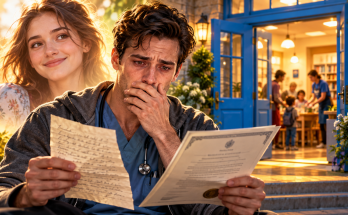
Three months later, the case was still making headlines.
The official had been charged with multiple crimes connected to falsified records, financial fraud, obstruction, and conspiracy.
Several people named in the ledger had been investigated.
Some resigned.
Others hired attorneys.
A few insisted they knew nothing.
The money remained frozen.
The court had appointed an independent administrator to trace every transfer.
For once, nobody in our family controlled the process.
That was a relief.
My father survived his injury.
He pleaded guilty to helping conceal Michael’s disappearance and to falsifying parts of the family records.
He did not go to prison immediately.
The court allowed him to remain in medical care while the case proceeded.
He called me every week.
At first, I didn't answer.
Then one afternoon, I did.
“I’m sorry,” he said.
I sat quietly.
“I know.”
“I don't expect forgiveness.”
“You shouldn't.”
He accepted that.
“I only want you to know that I loved you.”
I closed my eyes.
“I know.”
“And Lily.”
“She knows.”
There was a long silence.
“I was trying to protect you.”
“You protected a lie.”
“Yes.”
“And you taught me that protecting someone meant deciding what they were allowed to know.”
“I know.”
I looked out the window.
“Don't do that again.”
“I won't.”
That was all I could offer him.
My mother changed too.
She moved into a smaller apartment.
She began cooperating fully with the investigators.
She gave them every document she had kept.
Every letter.
Every photograph.
Every bank statement.
She no longer tried to control what happened next.
One evening, she came to see Lily.
They sat together in the garden.
I watched from the kitchen.
My mother held a box.
She gave it to Lily.
Inside were photographs from her childhood.
Birthdays.
School plays.
First bicycle rides.
Christmas mornings.
Nothing about money.
Nothing about Michael.
Just Lily.
My mother had preserved every ordinary moment.
Lily looked through them.
Then she looked up.
“Grandma?”
“Yes?”
“Why did you keep these?”
“Because no matter what happened, you were always my granddaughter.”
Lily nodded.
She didn't forgive her completely.
But she reached across the table and took her hand.
That was enough.
Daniel had a harder time.
He met Michael twice.
The first meeting lasted twenty minutes.
The second lasted three hours.
When he returned, I didn't ask what they discussed.
He told me anyway.
“He remembers my first word.”
I looked at him.
“What was it?”
“Water.”
He smiled sadly.
“He said I used to cry whenever I couldn't see him.”
I waited.
“Do you forgive him?”
Daniel shook his head.
“Not yet.”
I nodded.
“But I don't hate him anymore.”
That was probably the most honest answer any of us could give.
Michael remained in custody.
He pleaded guilty to kidnapping Lily, intimidation, unlawful surveillance, and several other charges.
He also cooperated with prosecutors.
In exchange, some of the financial charges were reduced.
He never asked for the money.
That surprised me.
When I asked him why, he said,
“I spent half my life chasing what I thought was mine.”
He looked at Daniel.
“Then I realized my children deserved a life that wasn't built around my anger.”
Daniel never called him Dad.
Not yet.
Maybe he never would.
That was his choice.
As for Lily, she went back to school.
At first, everyone knew.
Whispers followed her through the hallway.
Some students asked questions.
Others avoided her.
She hated both.
Then one afternoon, she came home and threw her backpack onto the floor.
“I’m done being the girl from the news.”
I looked at her.
“You aren't.”
“I know.”
She took a breath.
“I’m just Lily.”
I smiled.
“Yes.”
She looked at me.
“And you're just Mom.”
“Exactly.”
She laughed.
It was the first completely ordinary laugh I had heard from her in months.
The court eventually determined that the trust contained money derived from multiple sources.
Some was returned to legitimate owners.
Some was surrendered to the government because it could not be traced lawfully.
The remaining funds were divided according to the court’s ruling.
Lily and Daniel received only the portion that could legally be attributed to their inheritance.
It was still substantial.
But neither wanted to spend it immediately.
Daniel created a scholarship fund.
Lily wanted to use part of hers for something simpler.
She wanted to open a small art studio.
“You want to spend inheritance money on paint?”
She shrugged.
“Why not?”
I laughed.
“Fair.”
She chose a building near school.
The first room had terrible lighting.
The second had a leaking roof.
The third was perfect.
We painted the walls ourselves.
Daniel helped install shelves.
My mother brought flowers.
Even my father, still recovering, sent a box of old wooden frames.
Nobody mentioned the money.
We were building something that belonged to the future.
One evening, Lily found me outside the studio.
“Mom?”
“What?”
She held a photograph.
It was the old picture of Michael and my mother.
“You kept this?”
“Yes.”
“Why?”
“I don't know.”
She studied it.
Then she placed it inside a folder.
“I think we should keep the truth.”
I nodded.
“But not the secrets.”
I smiled.
“Agreed.”
Daniel joined us.
He was holding the pendant.
The original had been returned after the court case.
He had repaired the chain.
“I'm going to keep it,” he said.
“Are you sure?”
“Yes.”
“Why?”
He touched the small metal pendant.
“Because it belonged to my mother.”
He looked at Lily.
“And because it reminds me that someone tried to protect me, even if they made terrible choices.”
We stood quietly.
The evening light stretched across the sidewalk.
For years, our family had treated the truth as something dangerous.
Something that had to be hidden.
Locked away.
Destroyed.
But the truth had never disappeared.
It had waited.
In a photograph.
In a key.
In a birth record.
In an old cassette.
In a scar.
In a child's memory.
The final court hearing came six months later.
My mother testified.
My father testified.
Michael testified.
Daniel testified.
I testified.
And Lily did not have to.
The judge ruled that she had been manipulated and falsely accused.
The charges against her were formally dismissed.
When we left the courthouse, she stopped on the steps.
“Mom?”
“Yes?”
“Is it over?”
I looked at her.
“Yes.”
She smiled.
“Really?”
“Yes.”
She took my hand.
Then she looked at Daniel.
“Come on.”
We walked down the steps together.
Behind us was the building where our family had finally told the truth.
Ahead was an ordinary street.
Cars passed.
People talked.
Someone carried a paper bag from a bakery.
Nothing looked different.
But everything was.
Twenty-seven years of secrets had ended.
Michael had lost his freedom.
My father had lost the life he had built on silence.
My mother had lost the illusion that secrecy could protect everyone.
Daniel had gained a family history he never asked for.
Lily had gained the right to know who she was.
And I had learned something I wished I had understood years earlier.
Protecting someone does not mean choosing their truth for them.
Sometimes love means opening the locked drawer.
Sometimes it means handing over the photograph.
Sometimes it means admitting that the story you told for years was wrong.
And sometimes it means standing beside the people you love while they decide what to do with the truth.
That night, Lily and I sat on the porch.
She leaned her head against my shoulder.
“Mom?”
“What?”
“Do you think Grandma is happy?”
I looked toward the garden.
“She is trying.”
“Do you think Grandpa is sorry?”
“Yes.”
“Do you think Michael is sorry?”
I thought for a moment.
“Yes.”
She was quiet.
Then she asked the question I had been expecting.
“Do you think our family will ever be normal?”
I laughed softly.
“Probably not.”
She laughed too.
“But maybe normal isn't the goal.”
“What is?”
I looked at her.
“Honest.”
She nodded.
Inside the house, the phone rang.
For a moment, both of us froze.
Then Lily smiled.
“You answer it.”
“You answer it.”
She shook her head.
“No way.”
I stood.
The old fear was still somewhere inside me.
Maybe it always would be.
But fear no longer controlled the house.
I opened the door.
It was Daniel.
He held two cups of tea.
“Thought you might want one.”
I smiled.
“Come in.”
He stepped inside.
Lily followed.
The three of us sat together in the kitchen.
No police.
No hidden cameras.
No anonymous messages.
No locked rooms.
No secret ledgers.
Just three people trying to build something honest from the pieces left behind.
On the counter sat the old wooden box.
Inside were the photographs, the brass key, and the pieces of a history that had once frightened us.
We didn't destroy them.
We didn't hide them.
We kept them.
Not because the past deserved control over us.
Because we finally understood it.
And that was where the story truly ended—not with the arrest, the money, the courtroom, or the revelation of who had driven the car.
It ended with Lily knowing the truth.
With Daniel knowing his name.
With my mother finally admitting what she had done.
With my father accepting the consequences.
With Michael facing the life he had spent twenty-seven years avoiding.
And with our family, for the first time, choosing honesty over silence.
The secrets had taken nearly three decades to surface.
But once they did, they no longer belonged to the people who had buried them.
They belonged to the truth.
The End
Read more original stories on Feel Every Story.
The Police Said My Daughter Drove the Car, but One Detail About Her Locked Bedroom Made Their Entire Story Impossible
Part 15 of 15