By early spring, the tension surrounding the old property documents had begun to fade. I had kept the records, obtained professional guidance, and made it clear to my parents that any future discussion involving my home would begin with me. Nobody had challenged the arrangement since, and for the first time, I felt that the subject could remain settled without requiring me to revisit it every week.
Then Dad called to tell me that the extended family was planning a reunion.
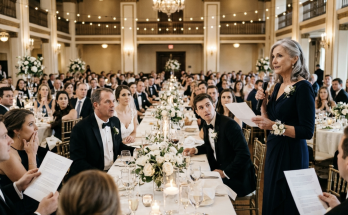
It would be held at my parents' house, with relatives arriving from different towns for an afternoon of food, photographs, and catching up. Dad asked whether Lily and I would like to attend. He made a point of telling me that there was no pressure if we preferred to spend the day at home.
I appreciated that he asked, but I also knew that family gatherings could bring back the old expectations. There would be relatives who knew only fragments of what had happened, people who believed that disagreements should be forgotten for the sake of appearances, and others who might assume that my return meant everything was back to normal.
I told Dad I would think about it.
That evening, I asked Lily what she thought. She was sitting on the living-room floor, coloring a picture of the garden. Bunny rested beside her, and the framed blue house Chloe had drawn hung on the wall above her.
“Will Aunt Chloe be there?” she asked.
“Probably.”
“Will Grandma and Grandpa be there?”
“Yes.”
She considered this, then returned to her coloring.
“Can we go home if I get tired?”
“Absolutely.”
“Even if everyone wants us to stay?”
“Even then.”
She smiled. “Then I want to go.”
Her answer settled the question for me. I was willing to attend because I wanted Lily to have the opportunity to enjoy her relatives, not because I needed to prove that I had forgiven anyone. We would stay as long as the visit felt comfortable, and we would leave when we were ready.
On the day of the reunion, I dressed Lily in a yellow cardigan and a simple blue skirt. She carried Bunny in her bag and brought the heart-shaped stone she had found in the garden, explaining that she wanted to show Grandma how pretty it looked beside the birdhouse.
We arrived shortly after noon. Cars lined the street, and voices drifted through the open windows. Dad greeted us at the door, introduced us to relatives who had not seen Lily in months, and made sure we had a place to sit.
At first, everything went smoothly. Lily was delighted to discover a table filled with desserts, and Chloe helped her choose a small piece of cake. Mom moved between the kitchen and the dining room, welcoming guests and keeping the food organized.
I spoke with cousins, answered questions about work, and listened to stories about relatives I had not seen in years. It felt good to participate without constantly monitoring the room for signs of conflict.
Then one of my aunts approached me while I was pouring a drink.
“I hear things have been difficult between you and your mother,” she said.
I kept my expression neutral. “We've had some disagreements.”
She lowered her voice. “Well, you know how mothers are. They don't always express themselves perfectly. But family is family, and eventually you have to let these things go.”
I recognized the familiar pressure immediately. The conversation was not about what had happened or whether it had been fair. It was about making the discomfort disappear.
“I agree that family matters,” I said. “But letting go doesn't mean pretending something was acceptable.”
My aunt looked surprised. “I'm sure your mother never meant to hurt you.”
“I understand that she may not have intended the consequences. But I still have to protect my daughter and myself.”
She pursed her lips, clearly uncertain what to say next.
“I just don't want everyone to be divided,” she replied.
“Neither do I. But unity cannot depend on one person staying quiet whenever something is wrong.”
I excused myself and returned to the garden, where Lily was showing Chloe her heart-shaped stone. I felt no need to explain the conversation to anyone else. I had answered honestly, and that was enough.
A little later, another relative asked whether I had considered allowing Chloe to stay with me during a difficult period in her life. The question came from someone who had not heard the full story and assumed that sharing a home was a simple solution to financial hardship.
I took a breath before responding.
“Chloe has her own place now, and she's working toward greater financial stability. I support her progress, but I won't make housing decisions based on pressure from relatives.”
The relative began to explain that families sometimes had to make sacrifices.
“I understand,” I said. “But the sacrifices need to be voluntary and fair. I am responsible for my daughter and my household, and that has to come first.”
This time, I did not feel the need to soften the answer.
When I returned to the garden, Chloe was waiting near the fence. She had overheard part of the conversation.
“I'm sorry people keep asking you to solve my problems,” she said.
“You don't have to apologize for every question someone asks.”
“I know. But I understand why it bothers you.”
She glanced toward the house, where our relatives were laughing around the dining table.
“I used to think it was normal for everyone to expect you to handle things. I didn't realize how unfair that was until I had to manage my own life.”
“How are things going?” I asked.
She smiled slightly. “Better. I'm keeping up with my bills, and I've started saving for emergencies. It's not a huge amount, but it's mine, and I'm proud of it.”
“You should be.”
“I used to think asking for help was the same as being loved,” she admitted. “Now I'm trying to understand that being loved doesn't mean someone has to keep rescuing me.”
I looked at my sister and saw the effort behind her words. Her life had not become perfect, and she still faced difficult days. But she was beginning to take responsibility for her own future rather than expecting me to absorb the consequences.
“I'm glad you're learning that,” I said.
She nodded. “I don't expect you to help me financially again. If I ever need advice, I'll ask, and I'll respect it if you don't have an answer.”
“That sounds reasonable.”
We stood together for a moment, watching Lily arrange her stones beside the flowerpots. Then Chloe offered to take her to the dessert table.
Lily looked at me for permission. I smiled and nodded, and she went with her aunt.
Later, Dad gathered everyone for a family photograph. Relatives moved into position on the front steps, children wriggled impatiently, and someone joked that it would take a miracle to get everyone looking in the same direction.
Lily stood between me and Dad, holding Bunny. Mom was on the other side of Chloe. For a brief moment, I wondered whether standing together in a photograph would make people assume that all our problems had been solved.
Then I reminded myself that a photograph was only a record of a moment. It could not dictate what we believed, what we forgave, or what boundaries we maintained.
When the camera was ready, Lily raised Bunny's paw as if the stuffed animal were waving.
Everyone laughed.
The photograph was taken, and we moved on.
A little later, Mom approached me near the kitchen.
“I heard what your aunt said to you,” she began.
I waited.
“I told her that she shouldn't pressure you about your decisions.”
I looked at her, surprised.
Mom continued, “I explained that what happened between us was not something she understood completely, and that it wasn't her place to tell you how quickly you should forgive.”
I felt a quiet wave of relief.
“Thank you,” I said.
“I should have done that a long time ago.”
“Yes,” I replied. “You should have.”
She nodded without becoming defensive.
“I don't want you to feel that you have to defend yourself every time we gather,” she said. “I can't promise that everyone will understand, but I can at least stop adding to the pressure.”
“That would make a difference.”
She glanced toward the garden. “Lily seems happy today.”
“She is.”
“I want her to keep feeling that way around us.”
“Then we need to keep making sure she feels safe, even when conversations are difficult.”
Mom agreed.
For the rest of the afternoon, I noticed small changes. When a relative asked whether Lily would stay overnight at Grandma's house sometime, Mom looked at me before answering. When Lily said she wanted to go home before dinner, Mom did not plead with her to stay. And when Dad offered to pack some leftovers for us, he asked whether we wanted them instead of simply filling containers and handing them over.
These were ordinary gestures, but they showed that the adults around me were beginning to understand the difference between affection and entitlement.
We left before sunset. Lily was tired, and I was ready to return to the quiet of our home. Dad walked us to the car and hugged Lily goodbye. Mom thanked us for coming, and Chloe promised to send me a photograph she had taken of Lily holding her heart-shaped stone.
On the drive home, Lily rested her head against the seat.
“Mom, was today good?”
“Yes. I think it was.”
“Even when people asked you questions?”
“Even then.”
She looked out at the passing trees.
“You didn't have to be quiet.”
“No,” I said. “I didn't.”
She seemed satisfied with that answer.
At home, I helped her change into pajamas, placed Bunny beside her pillow, and tucked her beneath the blanket. Before leaving the room, I noticed that she had put the heart-shaped stone on her bedside table.
“Why did you bring it home?” I asked.
“So I can remember that things can be pretty even when they're not perfect.”
I smiled and kissed her forehead.
“That is a good thing to remember.”
After she fell asleep, I went downstairs and sat by the kitchen window. The garden was quiet, and the blue birdhouse stood beneath the branches, waiting for another morning.
I thought about the reunion and the conversations I had managed without losing my temper or surrendering my boundaries. I had not needed to convince every relative that I was right. I had not needed to explain every painful detail. And I had not needed to turn my family's gathering into a trial where everyone voted on whether my decisions were acceptable.
I had simply lived according to what I knew was right for Lily and me.
For years, I had carried the responsibility of keeping everyone comfortable. I had tried to prevent arguments, soothe resentment, and make sure no one felt abandoned. In doing so, I had sometimes abandoned my own needs.
That responsibility was no longer mine to carry alone.
The family might continue to disagree with me. Some relatives might never understand why I refused certain requests or why I needed boundaries that seemed unnecessary to them. But I had finally accepted that their understanding was not a prerequisite for my independence.
I could be kind without being compliant. I could be generous without being obligated. I could attend a family reunion, enjoy the good moments, and still leave when I was ready.
And I could love my family without allowing them to decide what that love required.
That evening, I turned off the kitchen light and went upstairs. Lily was sleeping peacefully, her bedroom door open just a little.
I paused in the hallway, listening to the quiet house.
For the first time, I felt no need to rehearse tomorrow's conversations or prepare defenses against problems that had not yet happened. I could let the day end without worrying that someone else's disappointment would become my responsibility.
I had finally stopped carrying everyone else's expectations as if they were my own.
And in the space that remained, I found something I had been missing for years: the freedom to live my life without asking permission.
Click here to continue reading: PART 15: The Blue Birdhouse, the Open Door, and the Promise I Finally Kept to Myself
My Daughter Was Still Wearing Her Hospital Bracelet When My Mother Made Her Own Home Feel Like a Stranger’s Door
Part 14 of 15