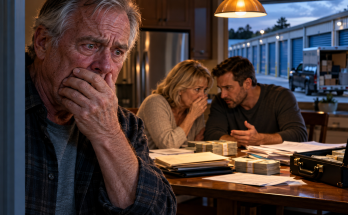
The next morning, I woke before Mom.
I hadn't meant to.
I had been lying in bed, listening to the quiet house, when I realized I was waiting for a sound that would never come again.
Dad's boots on the kitchen floor.
The cupboard opening.
His chair scraping against the tiles.
He used to make coffee before anyone else woke up.
Sometimes I would come downstairs and find him reading the newspaper, his watch resting against the edge of the table.
Now the chair was empty.
I went downstairs anyway.
The watch was beside his reading glasses.
Mom had left both there the night before.
I touched the velvet box but didn't open it.
For the first time, I understood that the watch hadn't simply belonged to Dad.
He had made it responsible for something.
For forty-five years, it had carried a message nobody knew was there.
And somehow, that small piece of folded paper had become the only way we could begin understanding a part of his life he had never explained.
I made coffee.
Then I sat in his chair.
It felt wrong at first.
I had avoided sitting there since the funeral.
Mom had too.
But I wanted to understand what it might have felt like for him to sit at that table during the final months of his life.
Scott had told me about the afternoon when Dad was holding an old envelope.
Six months before he died.
Dad had looked frightened.
That detail wouldn't leave me alone.
My father had never been the sort of man who showed fear easily.
He worried about money.
He worried about our safety.
But even when things went wrong, he usually found something practical to do.
A leaking pipe could be repaired.
A broken car could be fixed.
An overdue bill could be paid in installments.
He understood those problems.
What he couldn't fix was whatever happened at the mill.
I kept imagining him looking down at the envelope.
Wondering whether he had waited too long.
Wondering whether Mom would understand.
Wondering what Scott and I would think when we learned that our father had once made a decision he regretted.
I looked toward the doorway.
Mom appeared a few minutes later.
She stopped when she saw me in Dad's chair.
I started to stand.
She shook her head.
"Stay there."
I hesitated.
"Are you sure?"
She nodded.
"He would have liked seeing somebody use it."
I sat back down.
She poured herself coffee.
For a while, we didn't speak.
Then she asked whether I had been thinking about the ledger.
I told her I had.
She sat across from me.
"I dreamed about the mill."
I looked up.
"What happened?"
"Nothing much. I was walking through the building, looking for Harold."
She wrapped both hands around her mug.
"I kept hearing his voice, but every room was empty."
I didn't know how to answer.
She gave a tired smile.
"I suppose that's what grief does."
I nodded.
I wanted to tell her that I understood.
But the truth was, I couldn't fully understand what it meant to lose the person who had shared almost your entire adult life.
I had lost my father.
She had lost the man she expected to grow old beside.
Then she had learned that he had spent decades keeping something from her.
That was another kind of loss.
I asked whether she was still certain she wanted Mr. Cole to continue.
She looked surprised.
"Of course."
"Even if we find out something difficult?"
She set down her mug.
"Jenny, difficult things have already happened."
I knew she was right.
Daniel was missing.
The ledger had been hidden.
Someone had used her name on a financial document she said she never signed.
And Dad had left instructions that reached us only after his death.
There was no way to return to the time when we knew none of it.
Mom looked at the watch.
"Harold wanted the truth found."
I nodded.
"Then we shouldn't stop because we're afraid of what it might say."
I reached for my coffee.
It had gone cold.
I drank it anyway.
That was something Dad used to do.
Mom noticed.
For the first time that morning, she smiled.
"You're just like him sometimes."
I wanted to believe that was a compliment.
But after everything Scott had told me, I wasn't entirely sure how to feel about it.
I had inherited Dad's stubbornness.
His habit of trying to solve problems.
His belief that you should do what was right even when it was inconvenient.
But I wondered whether I had also inherited his tendency to decide what other people needed to know.
I had nearly kept Scott's confession from Mom because I didn't want to upset her.
Dad had used the same reasoning for forty-five years.
The thought embarrassed me.
I had judged him for something I had almost done myself.
Not on the same scale.
Not with the same consequences.
But the instinct was familiar.
Protect someone.
Keep quiet.
Tell yourself you're doing them a kindness.
I looked at Mom.
"I'm glad I told you what Scott said."
She nodded.
"So am I."
Then she reached across the table and touched my hand.
"You don't have to protect me from everything."
I swallowed.
"I know."
But I wasn't sure I had really known until she said it.
Later that morning, I took Dad's photograph from the folder.
I placed it between us.
Harold Brennan.
Daniel Whitaker.
Robert Vale.
Three men standing outside the steel mill.
Mom looked at Robert.
She remembered that he had once been friendly with Dad.
She remembered Eleanor visiting the house.
She remembered the casserole Eleanor brought when I was born.
Those weren't things a person easily forgot.
I asked whether she had ever heard Dad speak badly about Robert.
She thought about it.
Then she shook her head.
"Not directly."
"What do you mean?"
"He stopped talking about him."
I waited.
She looked at the photograph again.
"At first, Robert was somebody Harold mentioned often. Then, after Daniel disappeared, I hardly heard his name."
I felt something tighten in my chest.
That didn't prove Robert had done anything.
But it was another change connected to the same period.
Mom continued.
"By the time Robert became an important man at the company, Harold never wanted to discuss him."
I asked whether Dad had ever explained why.
"No."
She gave a sad little laugh.
"Your father had a way of ending conversations without raising his voice."
I knew exactly what she meant.
If Dad didn't want to discuss something, he would simply stop answering.
He didn't need to shout.
His silence was enough.
As children, Scott and I usually accepted it.
Mom had accepted it too.
Now I wondered how many times that silence had prevented someone from asking a question that mattered.
I turned the photograph over.
Dad's handwriting was still clear.
The three men had known the truth.
I traced the sentence with my eyes.
I wanted to know whether Robert had been part of exposing the suspicious transactions.
Or whether he had been involved in hiding them.
The photograph couldn't answer that.
Neither could the old letter by itself.
We had a ledger.
We had names.
We had dates.
But we didn't have the explanation.
I thought about Eleanor.
Her face had been circled in red on the smaller photograph.
And the ledger carried Mom's name beside the final payment.
The resemblance between Eleanor and Mom had disturbed me.
But Mom was certain the woman wasn't her.
Mr. Cole had also warned us that a signature could be copied or forged.
I kept coming back to that.
Somebody had written Margaret Brennan.
Somebody had made it appear that Mom was connected to a payment she knew nothing about.
Whether it was a mistake or something deliberate, I couldn't say.
But I understood why Dad had wanted the original records preserved.
A person could deny a conversation.
A memory could fade.
A story could change over forty-five years.
The ledger was still there.
It could be examined.
The writing could be compared.
The transactions could be traced if enough records survived.
I wished Dad had told us where to begin.
Then I realized he had.
The watch.
The locker.
The ledger.
He had given us a path.
He just hadn't given us the ending.
I put the photograph away.
Mom went upstairs to rest.
I stayed at the table with my phone.
Scott hadn't contacted me.
I knew he was ashamed.
He had admitted that much.
But shame wasn't the same as making things right.
He still owed Mom an apology.
Not the kind he usually gave.
Not an excuse followed by a request for forgiveness.
A real apology.
One that acknowledged what he had done without blaming his circumstances.
I wanted him to understand that.
Then I remembered Dad taking him to the diner when he was twenty-one.
Dad had tried to teach him about responsibility.
He had spoken about the mistake that haunted him.
Scott had listened.
He remembered the conversation years later.
But he had still sold the watch.
I wondered whether people could understand a lesson and fail to live by it.
Of course they could.
I had done that myself.
I knew better than to lose my temper with Scott.
I still did.
I knew better than to judge him before hearing what he had to say.
I had nearly refused to listen.
And Dad had known better than to keep important things from Mom.
Yet he had remained silent.
Knowing what was right didn't always mean a person managed to do it.
That was a difficult thing to accept about the people you loved.
I picked up my phone.
I typed a message to Scott.
Then I deleted it.
I tried again.
I wanted to tell him Mom knew what Dad had said about the watch.
I wanted him to understand she was hurt.
But I didn't want to speak for her any more than I already had.
So I put the phone down.
Scott needed to come to Mom himself.
That was his responsibility.
I couldn't do it for him.
The afternoon passed quietly.
I straightened the kitchen.
I put Dad's photograph back into its folder.
I checked that the watch was safe.
Then I sat with Mom while she talked about the years when Dad first worked at North River.
She remembered his long hours.
The bills they struggled to pay.
The way he sometimes fell asleep before dinner.
She remembered how proud he had been when he received his first promotion.
She remembered the used car he drove until it could barely manage another winter.
Those stories reminded me of the father I knew.
The man who worked.
The man who came home.
The man who believed things should be repaired instead of discarded.
I didn't want the ledger to erase him.
Mom didn't either.
But I was beginning to understand that a person could be more complicated than the memories his family kept.
Dad had loved us.
He had worked hard.
He had also carried guilt.
And whatever happened in September 1981 had changed him.
I didn't know how all those things fit together.
Not yet.
That evening, Mom put the kettle on.
I stood beside the sink.
She glanced toward the dresser upstairs, as though she could see the watch through the ceiling.
"Do you think Harold expected us to forgive him?"
I considered the question.
"He asked you to."
She nodded.
"But I wonder whether he believed I would."
I didn't answer immediately.
The note had been full of love.
And regret.
Dad had written it because he knew Mom might be hurt by what she learned.
Maybe he had been afraid she would see him differently.
Maybe he had been afraid she would never understand.
I looked at her.
"Do you think you can?"
She thought about it.
Then she said something I kept remembering afterward.
"I can love him while I'm still angry."
I nodded.
That was enough for me.
We didn't need to settle everything that evening.
We didn't need to decide whether Dad had been brave or frightened.
We didn't need to judge Robert Vale.
We didn't need to invent an explanation for Daniel's disappearance.
We needed the records.
We needed the truth.
And we needed to let the people involved be more than the worst thing we feared they might have done.
Mom poured the tea.
I carried the cups to the table.
Dad's chair was still there.
The watch was upstairs.
And somewhere outside our house, Scott was living with the knowledge that he had ignored his father's final request.
I didn't know whether he would find the courage to face Mom.
But I knew something else.
I couldn't allow my anger at Scott to become more important than the reason Dad had hidden the watch.
The ledger wasn't about forty dollars.
It wasn't even only about our family.
It was connected to a man who had disappeared.
A wife who had waited.
A little girl who had grown up without her father.
Dad had wanted the evidence preserved for a reason.
Whatever his own mistake had been, he had left us a chance to understand what happened.
That was the responsibility I needed to focus on.
Not protecting Dad's reputation at any cost.
Not punishing Scott.
Not finding money.
Just understanding what the records could prove.
I looked at Mom across the table.
She was holding her tea with both hands.
I told her I would stand beside her through whatever Mr. Cole found.
She nodded.
"I know you will."
I believed her.
And for the first time since Ed returned the watch, I stopped thinking of the truth as something that might destroy us.
I began thinking of it as something we owed the people who had been living without answers for forty-five years.
Source: psndaily.xyz
Click here to continue reading: PART 10: The Name on the Final Payment Would Not Leave Me Alone, and Mom’s Memories of Eleanor Vale Made the Mystery More Painful
My Brother Thought Dad’s Old Watch Was Worth Almost Nothing, Until a Stranger Brought It Back With Something Hidden Inside
Part 9 of 15