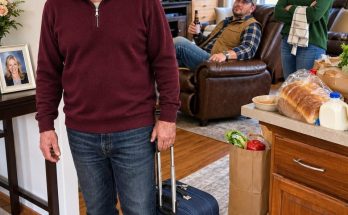
Marlee didn't believe I would go through with it.
I could see that much.
She kept looking from me to Mr. Crenshaw, as though someone would explain that the whole thing had been a misunderstanding.
But the apartment existed.
The rent had been arranged.
And I wasn't changing my mind.
Mr. Crenshaw reached into his jacket pocket.
He took out a small ring of keys.
I watched them catch the morning light.
Such a little thing.
Two keys.
Yet I couldn't remember the last time an object had made me feel so much relief.
He held them out.
"One opens the entrance downstairs. The other is for your apartment."
I accepted them.
"They're yours," he added. "I changed the locks yesterday."
I wrapped my fingers around the ring.
"Thank you."
Marlee stared at him.
"You're actually going to let her live upstairs?"
He nodded.
"That's what we agreed."
"But she's seventy-four."
I felt my cheeks grow warm.
There it was again.
My age.
As though the number itself explained why I should no longer be trusted to decide where I slept.
Mr. Crenshaw adjusted his glasses.
"She's old enough to choose her own address."
He didn't sound angry.
He sounded matter-of-fact.
And somehow that made the words more powerful.
Marlee crossed her arms.
"Well, I hope you know she'll need somebody to help her."
Mr. Crenshaw considered that.
"Everyone needs a hand once in a while."
He looked at me.
"And there are people around here willing to give one."
I wanted to laugh.
I wanted to cry.
Mostly, I wanted to hug the old man.
Instead, I held the keys a little tighter.
He turned toward the trailer.
"Your furniture is already upstairs, Tressie. I put the quilt where you wanted it."
I pictured my bed.
My own quilt.
The familiar fabric I had carried through so many years.
It felt more important than I could explain.
Mr. Crenshaw continued.
"Harold's picture is there, too."
My eyes filled.
He had remembered.
I had asked him to make sure that photograph was somewhere safe.
I hadn't wanted it lost among the furniture.
Some things couldn't be replaced.
His expression softened.
"You're welcome. Though I still don't understand why one woman owns fourteen casserole dishes."
I laughed.
I hadn't meant to.
It came out of me before I could stop it.
For a few seconds, I forgot Marlee's anger.
I forgot the garage.
I even forgot the pink notebook.
I was simply an older woman laughing at a friend who thought she owned too many dishes.
I hadn't felt that light in months.
Hugh remained near his truck.
His shoulders had dropped.
He looked tired.
Then he asked whether we could speak privately.
I nodded.
"Of course."
He glanced toward the porch.
"Over there?"
We walked to the two wooden chairs.
I had sat in those chairs on many evenings, watching the daylight fade.
Sometimes I'd thought about Harold.
Sometimes I'd thought about nothing at all.
Now I sat beside my grown son and wondered how we had reached this point.
Hugh leaned forward.
His hands rested together.
He didn't look at me immediately.
"I had no idea she was keeping those notes," he said.
I believed him.
The shock on his face had been real.
He hadn't known what was in that little book.
At least, not everything.
"I know," I said.
He rubbed his palms together.
"I honestly thought we were doing something good for you."
I waited.
He kept his eyes lowered.
"You'd be close. The children would get to see you all the time. I wouldn't have to worry so much."
I understood his thinking.
Or I wanted to.
He was my only son.
I knew he had responsibilities.
A wife.
Three children.
Work.
Bills.
A household that never seemed to slow down.
But somewhere among those responsibilities, he had confused what was convenient for him with what was right for me.
I spoke carefully.
"Hugh, if you want to help somebody, you need to find out what they actually want."
He looked at me.
"You don't think we were trying to help?"
"I think you were trying to make an arrangement work."
I paused.
"That isn't always the same thing."
He swallowed.
"Mom, I thought you'd enjoy being with the kids."
I looked out toward the driveway.
Augie was standing near the trailer with his dinosaur.
He held it in one hand while he watched the adults.
He was too young to understand the whole conversation.
But he was old enough to notice that something was wrong.
I wished he weren't there for any of it.
"I love being with those children," I said.
Hugh looked relieved.
For a moment.
Then I continued.
"But I want to be their grandmother."
He frowned slightly.
"You are."
"Then let me be one."
I folded my hands.
"I want to see them because we're happy to see each other. I want to make pancakes when they come over. I want to hear about school and play with them when I have the energy."
My voice grew quieter.
"I don't want every weekday of my life assigned to childcare before anyone has even asked me."
Hugh looked away.
I let him think.
Then I said what had been sitting inside me for weeks.
"I don't want to pay rent for the privilege of working without pay."
He flinched.
I wasn't trying to wound him.
But there was no kind way to make the arrangement sound fair.
It wasn't fair.
I had worked for forty years.
I had retired.
And I wanted to be allowed to enjoy that fact.
Hugh took a slow breath.
"I didn't look at it that way."
"I know."
That was part of what hurt.
He hadn't looked closely enough.
He had heard that his mother could live nearby.
He had heard that the children would have familiar care.
He had heard that the household would benefit.
He hadn't stopped to ask what I would be giving up.
After a while, he asked about the rent.
I told him the amount.
"Five hundred and fifty dollars."
He turned toward me.
"That's all?"
"That's what Mr. Crenshaw charges."
Hugh did the arithmetic in his head.
I could see it.
The garage would have cost seven hundred dollars each month.
The apartment above the store cost less.
And it gave me an entire living space.
"That's cheaper than what we offered," he admitted.
"Yes."
He looked down again.
"And nobody expects you to take care of the children?"
"No one has made childcare part of my rent."
He gave a small nod.
There wasn't much else he could say.
After a moment, he asked about the kitchen.
That surprised me.
Of all the things he might have asked, he wanted to know whether I could cook.
"There's a proper kitchen," I told him.
"A stove?"
I smiled.
"Yes, Hugh. A real stove."
He let out a little laugh.
"Good."
It was a small exchange.
But I remembered it.
Because for a few seconds, he was simply my son again.
Concerned about whether his mother had what she needed.
Not whether she'd be available to solve the family's problems.
I reached over and touched his arm.
"You can come see me whenever you like."
He nodded.
"Bring the children," I said.
"I will."
"I'll make breakfast for them sometime."
He smiled faintly.
"Augie would like that."
I thought of the little dinosaur.
I thought of Lily and Ben.
I didn't want my decision to become a wall between us.
I wanted it to become a door.
A door we could open when we wanted to spend time together.
A door I was allowed to close when I needed rest.
Hugh's eyes looked wet.
He kept blinking.
Finally, he spoke.
"I'm sorry, Mom."
For a moment, I couldn't answer.
I had wanted to hear those words.
But I also knew how easy it was to apologize when something painful had already happened.
An apology mattered.
So did what came afterward.
I squeezed his arm.
"Thank you for saying that."
He looked at me.
"I mean it."
"I hope you do."
We sat quietly.
There was no grand moment.
No sudden repair of everything that had gone wrong.
Just two people sitting in the chairs where I had watched so many evenings pass.
My son had heard me.
That was something.
But I wasn't ready to mistake hearing for understanding.
By noon, I was inside the apartment.
It smelled of lemon cleaner.
Fresh coffee.
The familiar scent of my own belongings.
I stood just past the doorway and looked around.
The living room had two windows facing the street.
Light came through them.
The room wasn't large, but it was mine to arrange.
I could put a chair near the window.
I could sit with coffee and watch people go about their day.
In the kitchen, a small white refrigerator stood beside an older stove.
There were cabinets for my dishes.
All fourteen casserole dishes, if I chose.
I smiled at that.
The bedroom had a closet big enough for my clothes.
I didn't have to store things around a lawn mower.
I didn't have to make room for somebody else's garage belongings.
And the bathroom had a window.
I stood there longer than I expected.
A bathroom window.
Such an ordinary detail.
Yet after weeks of thinking about the garage room, it seemed wonderful.
I walked back into the living room.
Harold's Army photograph stood on the mantel.
I approached it.
The frame was familiar beneath my fingertips.
I had looked at that picture during years when I wasn't certain I could keep going.
I had watched Hugh grow up beneath the quiet presence of his father's photograph.
And now it had followed me into another chapter of my life.
Mr. Crenshaw appeared at the doorway.
"Settling in?"
"I think so."
He looked toward the kitchen.
"Made any coffee?"
"There's a fresh pot."
He nodded.
"Then I'll go downstairs and get the pie."
He left before I could protest.
I sat in my chair.
The room was quiet.
Not the lonely kind of quiet.
The kind that leaves space for a person to hear their own thoughts.
I looked at Harold's photograph.
"I finally stood up for myself," I whispered.
My eyes filled again.
But I was smiling.
For so many years, I had believed being a good mother meant always being available.
Always making room.
Always putting something aside for the people I loved.
I hadn't stopped loving anyone.
I hadn't stopped being a mother.
I had simply remembered that I was still a person, too.
Click here to continue reading: PART 4: I Had Barely Settled Into My Own Apartment When a Phone Call and an Envelope Revealed That My Family Still Expected Me to Obey
I Thought My Son Was Offering Me a Safe Place to Grow Old Until I Saw What His Wife Expected in Return
Part 3 of 15