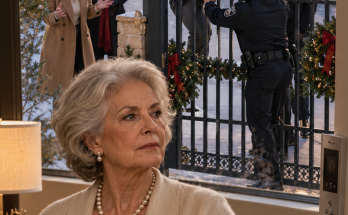
My mother-in-law put  dark makeup on my newborn son’s skin while I slept after childbirth, then shouted: “Everyone come here. This baby doesn’t look like my son”. When the nurse wiped away the pigment, my husband walked in and demanded, “Who did this?” Before I could ask, my mother stepped forward and sla:p:ped me. She leaned close and hissed something I couldn’t make out. I tried to sit up, but a sharp pa:in ripped through my abdomen and drove me back against the pillow. 

Part 1: The Lie They Painted on My Newborn Son

I woke from childbirth to my mother-in-law shouting at the foot of my hospital bed.

“Come look at this baby. He doesn’t look like my son.”

For a moment, the room blurred. I was still weak from labor, my abdomen burning every time I tried to move, and my newborn had been sleeping in the bassinet beside me only minutes earlier.

Then I saw him.

Someone had smeared a dark, oily pigment across his forehead, cheeks, arms, and tiny hands. It streaked the blanket beneath him and clung to the folds of his neck.

“Give him to me,” I said.

My mother-in-law, Lorraine, stepped in front of the bassinet. “Not until Caleb sees what you did.”

My own mother stood near the window, staring at me with an expression I had never seen on her face before. Disgust. Doubt. Shame.

Before I could explain that I had done nothing, she marched to my bed and sla:p:ped me.

The sound cracked through the room.

“You should be ashamed of yourself,” she whispered.

My head snapped sideways. Pa:in rushed through me, followed by the sound of my baby beginning to cr:y. That cr:y tore through every frozen part of me.

I pressed one hand against my incision and reached toward him. “Call a nurse. Now.”

Lorraine grabbed the bassinet rail. “Nobody touches him until my son gets here. He deserves to know the truth.”

The charge nurse arrived before anyone could say another word. She took in the scene—the crying baby, the dark substance on his skin, the red mark on my cheek, and four adults standing around him—and her voice turned sharp.

“Who put this on the infant?”

Lorraine folded her arms. “That is his natural skin tone.”

The nurse did not argue. She pulled on gloves, lifted my son out of the bassinet, and called for a pediatric nurse. After checking his breathing and mouth, she dampened gauze and touched the smallest patch near his ankle.

Black residue came away immediately.

My mother’s face drained of color.

A second swab removed another dark smear. The nurse looked directly at Lorraine. “You applied an unknown substance to a newborn?”

“I was proving a point,” Lorraine said. “She knows why.”

“No,” the nurse replied. “You enda:ngered a child to manufacture an accusation.”

They carried my son a few steps away to clean and examine him. I started crying harder, terri:fied they were taking him from me, until the nurse leaned close.

“He is staying with you. We just need to make sure he is safe.”

Then Caleb walked in.

He had gone to the parking garage for my overnight bag. He stopped in the doorway, looking from me to our crying son, then to the black-stained gauze in the nurse’s hand.

“What happened?”

Lorraine rushed toward him. “Caleb, I knew something was wrong. Look at the baby—”

“Stop.”

He was staring at the nurse now.

She explained what she had seen and what Lorraine had done while I slept. Caleb’s face became so still that I knew he was trying not to break apart.

Then he looked at me.

“Who h:it you?”

My mother lowered her head.

That was answer enough.

Caleb came to my bedside first. He took my shaking hand and asked the nurse whether our son was all right. Only after she assured him that the baby was stable did he turn back toward the women who had hurt us.

“You put something on my son while my wife was unconscious,” he said to Lorraine.

She began to cry. “I was protecting you.”

“And you,” he said, facing my mother, “struck my wife hours after she gave birth.”

Neither woman had an answer.

In the hallway, two hospital security officers appeared.

Lorraine backed toward the door. “You’re choosing her over your own mother?”

Caleb stepped between her and our baby’s bassinet.

“I’m choosing my family over anyone who tries to destroy it.”

As security moved closer, his phone buzzed on the bedside table. He read the message, and all the color left his face.

“What is it?” I asked.

He handed me the screen.

It was from Lorraine.

If you want the truth, check what I left in your house.

Part 2: What His Mother Had Hidden at Our House

I stared through the terminal’s glass wall as Caleb and Lorraine approached the security desk. My husband looked exhausted, but his mother was still dressed in the same burgundy coat she had worn at the hospital, her posture rigid with the certainty of someone who believed she could still command the room.

The officer waited for my response. “Do you want them admitted, Colonel?”

Caleb was still on the phone. “Please,” he said quietly. “Just hear us out.”

I looked at my sleeping son in the stroller beside me, then at the nurse who had helped clean the pigment from his skin. The hospital had already preserved the swabs and blanket as evidence, and I knew one conversation would not undo what had happened.

“Let them through,” I said. “But they do not come near the baby.”

When they reached us, Caleb stopped a few feet away. His eyes moved to our son, then to the fading mark on my cheek. “I’m sorry,” he said.

Lorraine made a frustrated sound. “Caleb, this is not the time for dramatics. We need to discuss the box.”

“You don’t get to tell me what matters anymore,” he said.

For the first time, she looked uncertain.

His sister, Natalie, had sent him photographs from our house while we were still at the hospital. Lorraine had left a plastic storage bin beneath the desk in our nursery, hidden behind a stack of baby blankets. Inside were printed screenshots of my old messages, photos taken through our living-room window, and a notebook tracking every doctor’s appointment I had attended during my pregnancy.

There were also copies of Caleb’s genetic testing paperwork from years before, when he had volunteered for a medical study through work.

“The notebook says she planned to make me doubt you before I signed the birth certificate,” Caleb told her. “Why?”

Lorraine’s face hardened. “Because you have always been too trusting.”

“That isn’t an answer.”
“She was isolating you,” Lorraine snapped, pointing at me. “She convinced you to move across the country. She kept you away from your family. Then she had a baby who—”

“Who is my son,” Caleb cut in. “And you covered him in dye while his mother was unconscious.”

Her voice dropped. “I only needed you to see the possibility.”

“What possibility?”

Lorraine folded her arms again, but the gesture no longer looked confident. It looked desperate. “Your father had dark features in his family. You don’t know what she has been hiding.”

I felt my stomach tighten, not because I doubted myself, but because I finally understood how long she had been building this lie. She had never needed proof. She only needed enough suspicion to turn everyone against me.

My mother had believed her. Relatives had believed her. If Caleb had walked into the hospital before the nurses did, she might have succeeded.

Caleb stepped closer to the stroller, placing one hand protectively on its handle. “The genetic results are in the folder, Mom.”

Lorraine went silent.

He held up a photograph Natalie had taken of one page. “My study showed I carry a rare pigment variation. The pediatrician explained it could appear in our child. You knew that.”

Her eyes flickered toward the ground.

“You knew,” he repeated.

“I knew you would never listen if I just warned you,” she whispered.

“That is because you were wrong.”

The terminal became quiet except for the rolling wheels of luggage and the soft breathing of our son. Then Caleb’s phone rang again, and he glanced down at the screen.

“It’s Detective Morales,” he said.

Lorraine’s face went pale.

Caleb answered, listened for several seconds, and looked straight at his mother.

“The lab identified what you used,” he said. “And the detective says it was not the only thing in that storage bin.”

Part 3: The Notebook She Never Meant Us to Find

Detective Morales asked Caleb to bring the storage bin to the police station instead of opening anything else himself. By the time we returned from the terminal, our son was asleep against my chest, and the house no longer felt like the safe place we had prepared for him.

Natalie met us outside with the bin sealed in a large evidence bag. She looked at her brother, then at me, and her eyes filled with tears.

“I’m sorry,” she said. “I thought Mom was being overprotective. I didn’t know she had been watching you.”

Caleb did not answer immediately. He had spent the drive home staring through the windshield, one hand locked around the steering wheel. I knew he was replaying every time he had brushed aside a cruel comment because it came from his mother.

At the station, Detective Morales opened the bin item by item while an officer photographed everything. There were printed pictures of me leaving prenatal appointments, screenshots of messages between Caleb and me, and a list of dates when Lorraine had watched our house from a parked car down the street.

Then the detective found a folder marked HOSPITAL PLAN.

Caleb’s breath caught.

Inside was a typed document with Lorraine’s handwriting added in the margins. It listed the date she expected me to deliver, which relatives should be called first, and a line that made my hands go cold.

Create doubt before birth certificate is filed. Make Caleb request testing.

My mother had been standing quietly at the back of the room. When Detective Morales read those words aloud, she began to cry.

“She called me before the birth,” Mom said. “She kept saying you were hiding something. She told me I needed to be ready to stand by her.”

I looked at her. “And you did.”

Her tears fell faster. “I did. I was wrong.”

Caleb turned toward my mother, his face hard with a grief that surprised me. “You hit her in a hospital bed.”

“I know,” she whispered.

“No,” he said. “I don’t think you do.”

The detective moved to the next item: a small envelope containing a hospital visitor badge from three weeks earlier. Lorraine had used it to enter the maternity wing during one of my prenatal tests, even though I had told the staff I did not want visitors that day.

“She was there?” I asked.

The detective nodded. “It appears she obtained information about the infant’s projected features from a conversation she overheard outside an exam room.”

Caleb looked at me. “The doctor mentioned the pigment variation.”

I remembered that appointment. The doctor had explained that our baby might inherit a darker complexion than either of us expected because of a rare trait in Caleb’s family. I had thought Lorraine was in the waiting room with Natalie.

She had been listening.

Then Detective Morales held up the final object from the bin.

It was a tiny glass bottle with no label, half-filled with black cosmetic pigment.

“The lab confirmed this is what was placed on your baby,” he said. “It also contains a solvent that can irritate a newborn’s skin.”

My knees weakened. Caleb reached for my elbow before I could lose my balance.

Lorraine had not simply humiliated me. She had chosen a substance that could have harmed our son because she wanted to force Caleb to doubt me.

The detective closed the evidence bag. “There is one more issue. Your mother-in-law did not act alone.”

Caleb’s head lifted sharply. “What do you mean?”

Detective Morales slid a printed phone record across the table.

“Before she came to the hospital, Lorraine made eleven calls to the same person,” he said. “And that person was already inside the maternity ward when the incident happened.”

I looked down at the name.

It was my mother’s.

Part 4: The Call My Mother Could Not Explain

My mother stared at the phone record as though it belonged to someone else.

“I didn’t know what she was going to do,” she said. “She only called because she was worried about the baby.”

Detective Morales did not raise his voice. “Mrs. Ellis, eleven calls in one morning is more than concern. Did Lorraine tell you she intended to place a substance on the child?”

“No,” my mother answered quickly. Then she hesitated. “She said she had found a way to make Caleb see what his wife was hiding.”

The room went silent.

Caleb looked at her with disbelief. “And you still went to the hospital?”

My mother began crying. “I thought I could stop an argument before it got out of hand.”

“You slapped me before you asked a single question,” I said.

Her shoulders collapsed. “I was angry.”

“No,” I replied. “You were ready to believe the worst about me.”

That was what hurt most. Lorraine had created the accusation, but my mother had supplied the willingness to accept it. She had looked at her daughter recovering from childbirth and decided I was guilty because another woman had spoken confidently

Detective Morales explained that both women would be interviewed separately. Lorraine faced an investigation for placing an unsafe substance on a newborn, while my mother’s role would be reviewed alongside the assault report the hospital had filed.

My mother reached for my hand. “Please don’t do this to me.”

I pulled my hand back.

“I didn’t do this to you,” I said. “You did it when you chose to hit me.”

Caleb remained quiet until we left the station. Outside, he stood beside the car with our son’s carrier in one hand and tears in his eyes.

“I let my mother talk about you like you were a problem,” he said. “I told myself it was easier not to argue with her.”

I was too tired to soften the truth for him. “Silence is not neutral when someone is trying to hurt your family.”

He nodded. “I know.”

For the next several weeks, we stayed at Natalie’s house while the police completed their investigation. Caleb changed every lock at our home, installed new cameras, and sent Lorraine a written notice that she was not to contact us or come near our child.

My mother called every day at first. Then she began sending long messages about regret, family, and second chances. I read none of them until one evening, when I opened a voicemail out of exhaustion.

“I know I failed you,” she said, her voice shaking. “But please don’t let them take me away.”

I sat upright.

The next message came from an unknown number. It was a voicemail forwarded from Lorraine’s phone, recorded the night before my delivery.

My mother’s voice was unmistakable.

“If you make Caleb question her, I’ll stand with you,” she said. “He always listens to me.”

Lorraine answered with a cold little laugh. “Then tomorrow, we make sure he sees the baby before she can explain anything.”

I listened twice because I could not make my mind accept it the first time.

My mother had not merely been manipulated.

She had agreed to help.

Caleb found me sitting on the edge of the bed, holding the phone in both hands. When he heard the recording, he closed his eyes.

“What do you want to do?” he asked.

I looked toward the nursery, where our son was sleeping safely behind a locked door.

“I want the truth documented,” I said. “All of it.”

The next morning, Detective Morales called with an update. Lorraine had agreed to speak only if Caleb and I came to the station.

When we arrived, she sat across from us in an interview room with an attorney beside her. She did not look sorry.

She looked angry.

Then she leaned forward, fixed her eyes on me, and said the words that changed everything.

“I did this because that baby was never the real target.”

Part 5: The Family We Chose to Protect

Lorraine sat across from us with her attorney beside her, but there was no remorse in her face.

“I did not care what that baby looked like,” she said. “I cared about getting you out of Caleb’s life.”

My chest tightened. Caleb’s expression changed from anger to something quieter and sadder.

Lorraine continued, “Ever since he married you, he stopped depending on me. You made him think he could have a family that did not include me.”

“You are his mother,” I said. “No one was trying to remove you.”

“No,” she replied. “You were replacing me.”

That was the truth beneath everything. The painted skin, the staged accusation, the photographs, and the notebook had never been about our son’s identity. They were tools Lorraine believed would make Caleb reject me at the exact moment I was too vulnerable to defend myself.

She wanted a frightened, exhausted mother. She wanted a suspicious husband. She wanted control.

My mother had helped because Lorraine had found the weakness she carried: her fear that I had become independent, made choices she did not approve of, and no longer needed her permission.

Caleb leaned forward. “You used my child to punish my wife for having a life with me.”

Lorraine looked at him as though he had betrayed her. “I was trying to save you.”

“No,” he said. “You were trying to own me.”

Her lawyer ended the interview soon after that. There was nothing left to explain.

The hospital report, toxicology results, security footage, phone records, notebook, and voicemail were submitted to investigators. Lorraine accepted a plea agreement related to child endangerment and harassment, which included probation, counseling, and a permanent order forbidding her from contacting our son without our written consent.

My mother faced consequences for striking me and for her role in the planned accusation. She was not sent away, but she received probation and was required to attend counseling. More importantly, she lost access to the version of our relationship where she could wound me and expect forgiveness to arrive before accountability.

For months, she wrote letters.

I did not answer most of them.

Caleb began therapy on his own. He did not ask me to forgive his silence or to pretend that one brave decision had erased every time he had allowed Lorraine to insult me. He understood that protecting a family was not one dramatic promise made in a hospital room.

It was a habit.

It was speaking up before someone could cause harm.

It was believing me the first time.

One afternoon, almost a year after our son was born, my mother asked whether she could meet us at a park. I agreed because I wanted to see whether actions had changed her more than apologies ever had.

She stood several feet away when we arrived. She did not reach for the stroller. She did not ask to hold him. She simply looked at me and said, “I will wait until you decide I am safe to have in his life.”

For the first time, I believed she understood the difference between regret and repair.

I nodded. “That is what you need to do.”

Later, Caleb and I sat on a bench while our son slept beneath a soft blue blanket. He touched his tiny hand and looked at me.

“I used to think family meant tolerating anything because of blood,” he said.

“So did I.”

He looked toward the trees, where my mother stood at a respectful distance. “Now I think it means protecting the people who trust you.”

Our son stirred, then settled again.

The women who had tried to turn his first day into a lie would always be part of our history. But they would not decide his future.

That belonged to us.

And no one would ever be allowed to paint doubt across his life again.

Leave a Reply

Your email address will not be published. Required fields are marked *