
My sister’s scream ended with a sickening, hollow thud that vibrated through the tiny speaker of my phone.
Five hours away, I gripped the steering wheel of my sedan, my knuckles turning white. Maya had cerebral palsy. She was twenty-six, brilliant, infuriatingly stubborn, and navigated the world on forearm crutches. For months, she had fed me a steady diet of fragile excuses.
“The bathroom tiles were wet.”
“Daniel gets a little loud when he drinks, Claire, but it’s just noise.”
But tonight, the noise had finally taken shape. She had called me weeping, whispering from the dark. “He shoved me into the refrigerator.”
Then, the heavy footsteps. Our stepfather’s voice, slurred and rough. “Who the hell are you talking to?”
A crash. Maya gasped. Daniel cursed. Then came that terrible, wet, choking sound.
“He kneed me,” she breathed, the words bubbling with blood. “My nose—”
The phone clattered to the floor. I heard the scuffle, the heavy drag of a boot. I screamed her name, the sound tearing at my own throat. “Maya! Maya, pick up the phone!”
There was a long, agonizing pause. Then, the rustle of fabric. Someone picked up the receiver. It wasn’t Maya.
A heavy exhale of breath hissed through the earpiece, followed by a low, freezing chuckle that made the hairs on my arms stand up.
“Roads are pretty slick tonight,” Daniel’s voice purred into the mic. It wasn’t a drunken slur anymore; it was calculated, ice-cold. “Drive safe, Investigator. It would be a real tragedy if you didn’t make it home to see your sister ‘slip’ again.”
The line went dead.
I didn’t scream. I didn’t cry. A cold dread coiled in my gut, rapidly hardening into something sharp and dangerous. I tossed the phone onto the passenger seat, slammed the transmission into gear, and drove my car into a storm so violent the highway disappeared beneath sheets ofhorizontal rain. Wind shoved my chassis sideways. Lightning fractured the black sky over the sprawling Illinois fields. I kept both hands steady, dialed 911 via Bluetooth, then the county sheriff, and finally, a restricted number I had not called outside of business hours in six years.
By the time I reached the driveway of our childhood home, the ambulance was already gone. The red and blue lights of a single, disinterested county cruiser washed over the white siding of the house.
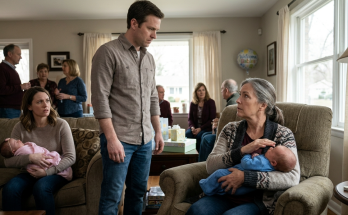
My mother, Evelyn, stood in the doorway. She wore a pristine silk robe, perfectly dry-eyed, her arms crossed in an irritated fold.
“It’s a minor scratch,” she said before I even reached the porch. “She’s always been clumsy.”
I pushed past her. The house smelled faintly of bleach and cheap bourbon. Behind my mother, Daniel leaned casually against the kitchen island, swirling amber liquid in a heavy crystal glass. I looked past him. There was a faint smear of pink on the stainless-steel refrigerator handle, hastily wiped but not gone, and a distinct, shallow dent in the metal. Exactly at the height of Maya’s head.
“She’s dramatic,” Daniel said, taking a slow sip. “Always has been. Panics over a little stumble.”
I looked at him. I looked at his knuckles, slightly red. I looked at the dent.
“Where is she?” I asked, my voice completely devoid of inflection.
“County hospital,” Mother sighed, rubbing her temples. “They’re keeping her for observation. Wasting the taxpayers’ time, honestly.”
Daniel smirked, his eyes trailing over my soaked coat. “You drove five hours in a flash flood for a bloody nose? That’s dedication, Claire.”
I wanted to bridge the gap between us and shatter that crystal glass against his teeth. I could feel the adrenaline begging me to act. But anger makes people cautious. Calm makes arrogant people careless.
Instead, I slowly removed my wet coat, folded it neatly over a dining chair, and gave him a polite, puzzled look. “I overreacted. The storm made me anxious. Tell me exactly how she fell.”
He laughed. A sharp, victorious sound.
That was his first mistake.
Daniel mistook my silence for surrender. He did not realize that I wasn’t just Maya’s older sister. For the past eight years, I had worked as a senior investigator for the state attorney general’s Medicaid Fraud and Vulnerable Adults Unit. My entire career was built on dismantling monsters who hid behind closed doors. And Maya’s primary care, handled by Daniel and my mother, was subsidized by the state.
I let him weave his lie. I nodded, memorizing every contradiction.
I am not just a sister anymore, I thought, watching him pour another drink. By dawn, I am going to be the executioner.The hospital room smelled of antiseptic and old linen. Maya’s face was swollen into a horrific landscape of purple and black beneath a rigid white splint. Her nose was fractured in two places. Deep, blooming bruises painted her ribs, and one of her custom forearm crutches lay propped against the wall—the metal cuff warped and snapped.
When she saw me step through the door, she immediately turned her face toward the window.
“I’m sorry,” she whispered, her voice nasal and thick with pain.
I pulled up a plastic chair and sat beside her, gently taking her unbruised hand. “For surviving?”
“For making trouble.”
That sentence felt like a physical blow. Before I could respond, heavy footsteps echoed in the corridor. A deputy entered, looking bored and holding a tiny notepad. Right behind him was my mother. Evelyn didn’t rush to the bed to comfort her broken daughter; she rushed to the bed to corner her.
“Tell the officer you fell, Maya,” Mother hissed, her fingers digging into the mattress. Her eyes were wide, silently threatening. “Daniel could lose his job over this misunderstanding. You know how your spasms get.”
Maya’s fingers tightened around mine. She looked at me, terrified.
The deputy sighed, clicking his pen. “Ma’am, your stepfather stated you lost your balance. Is that accurate?”
Daniel had already laid the groundwork. He had painted Maya as unstable, prone to violent muscle spasms, and easily confused by her pain medication. My own mother was validating every word. If Maya accused him now, it would be written off as “he said, she said”—the hysterical disabled girl against the tired, devoted caregivers.
I squeezed Maya’s hand once. A silent command. Wait.
“Let’s all just take a breath,” I said, standing up with a warm, conciliatory smile. “Maya is exhausted. My mother is right, she does have spasms. Let’s get her discharged and handle this privately. No need to burden the sheriff’s department.”
Evelyn’s shoulders instantly dropped. The deputy looked relieved to not have to do paperwork. Daniel, who had just strolled into the room, actually had the audacity to wink at me.
“Family takes care of family,” Daniel grinned.
“Exactly,” I replied.
They took Maya home a few hours later. Back at the house, I brewed a pot of coffee while Daniel loudly bragged about how local cops hated “domestic drama.” He leaned heavily on the counter, reminding me that Maya depended on him for her housing, her transportation, and her medical appointments.
“You can’t just pack her up and take her to the city, Claire,” he pointed out, chewing on a toothpick. “Her state benefits, her doctors, her accessibility ramps—they’re all registered to this house. She’s stuck with us.”
“Of course,” I said softly, pouring him a mug. “You’ve thought of absolutely everything.”
He heard admiration. I meant indictment.
Around 1:00 AM, the house finally fell silent. Daniel and Evelyn retreated to the master bedroom on the second floor. Maya was sedated in her ground-floor room.
I didn’t sleep. I began a methodical sweep of the house. I needed to document the environment before they scrubbed it clean. I photographed the dent in the fridge. I photographed the faint blood spatter on the baseboards that Evelyn had missed.
Then, I walked into the hallway and noticed something strange. The heavy oak door leading down to the unfinished basement was cracked open.
That door was always locked. Maya’s bedroom was only ten feet away.
Frowning, I pulled a penlight from my pocket and approached. The basement stairs were steep, concrete, and uncarpeted. A fall down those steps would be devastating for anyone, let alone someone with limited mobility.
I turned around and looked at Maya’s backup wheelchair, parked neatly by the hallway console table. She rarely used it inside, preferring her crutches, but it was there for bad pain days.
I knelt beside the chair, shining the thin beam of light onto the wheels.
Something was wrong. The locking mechanism on the right brake looked misaligned. I reached out and touched the main bolt securing the wheel to the chassis. It shifted under my finger. I twisted it.
It was entirely loose. Not worn down from use. Unscrewed.
I checked the left wheel. Loose. The anti-tip bars at the back? Removed completely.
My breath caught in my throat. The cold dread from the car ride returned, amplifying into sheer horror.
Daniel wasn’t just an abuser who lost his temper. The open door to the concrete stairs. The sabotaged wheelchair. The call Maya had made to me was an interruption. Tonight wasn’t a spontaneous assault.
Tonight was supposed to be a fatal accident.
He was going to kill her.
At 2:13 AM, the house was a tomb. I stood outside Maya’s bedroom door, my heart hammering against my ribs like a trapped bird.
Six months earlier, after noticing unexplained bruises during a FaceTime call and hearing Maya complain about missing pain pills, I had mailed her a small, voice-activated recorder. It was disguised as a standard USB charging adapter. I told her to plug it into the wall outlet right beside her bed, keep a cable attached to it so it looked authentic, and forget it existed.
I needed that recorder.
I silently turned the brass knob of her bedroom door and slipped inside. The room was pitch black, save for the pale moonlight filtering through the blinds. Maya was breathing heavily, deep in a medically induced sleep.
I dropped to my hands and knees, crawling over the plush carpet toward the wall outlet behind her nightstand. I found the plastic square, gripped it, and pulled it free.
Just as my fingers closed around the device, the floorboards out in the hallway groaned.
A heavy, deliberate step.
Then another.
Daniel.
Panic, sharp and blinding, spiked behind my eyes. The hallway light flicked on, illuminating the gap under Maya’s door. He was pacing. Checking the perimeter. Checking on his prey.
The doorknob rattled.
There was no closet within reach. No time to stand up. I threw myself flat onto my stomach and slithered under Maya’s heavy, oak-framed bed just as the door swung open.
Dust motes danced in the sudden wedge of light. I pressed my face into the carpet, holding my breath so tightly my lungs burned. I watched two bare, hairy feet step into the room.
Daniel stood there. Listening.
Breathe. Just breathe, I commanded my panicked mind. Do not move.
He walked slowly toward the bed. I could see the thick muscles in his calves twitching. He stopped just inches from my face. I could smell the stale whiskey sweating out of his pores. If he dropped a pen, if he bent down to check her restraints, he would be looking directly into my eyes.
Above me, Maya shifted, letting out a soft, pained moan in her sleep.
Daniel didn’t soothe her. Instead, I saw his foot shift. He raised his heel and brought it down violently on something hard.
CRACK.
It was Maya’s remaining, unbroken crutch lying on the rug. He had stepped on the carbon fiber shaft, snapping it cleanly in two. A silent, terrifying reminder of who held the power in this house.
He lingered for another excruciating minute, just standing in the dark, watching her sleep. Finally, he turned and padded out of the room, pulling the door shut until the latch clicked softly.
I stayed under the bed for twenty minutes, my body trembling so violently I thought the floor would shake. When I finally crawled out, my clothes were soaked in a cold sweat.
I retreated to the guest room, locked the door, and plugged the USB adapter into my laptop.
The device contained forty-seven hidden audio files.
I put my headphones on and began to listen. I heard Daniel threatening to leave Maya stranded at a gas station if she didn’t sign her disability check over to him. I heard him laughing about billing the state for “intensive overnight care” while he was actually at a casino three towns over.
But it was file number 46 that made the blood drain from my face.
It was from earlier that evening. The assault.
The audio was crisp. I heard the refrigerator impact thunder through my headphones. Maya cried out.
“You think your sister can save you?” Daniel sneered. Then came the brutal blow that shattered her nose.
But it was the voice that spoke next that made the floor drop out from beneath me. It wasn’t just Daniel in the kitchen.
“Jesus Christ, Daniel, look at the mess you made,” my mother’s voice snapped. It wasn’t panicked. It was deeply, chillingly annoyed. “Clean the blood before it stains the grout.”
Maya sobbed. “Mom, please…”
“Oh, shut up, Maya,” Evelyn snapped. “I told you to make it look like a fall down the stairs, Daniel! How the hell are we going to get the life insurance payout if she’s beaten to a pulp? The adjusters will ask questions. You’re so damn sloppy.”
I ripped the headphones off, clapping a hand over my mouth to stifle a physical gag.
My mother wasn’t a hostage to Daniel’s rage. She was the architect of it. They had taken out a life insurance policy on her own disabled daughter. And tonight, they had planned to cash it in.
I looked at the digital clock on my screen. 4:15 AM.
The sun was coming up. And I was going to burn this house to the ground.
By 6:00 AM, I had bypassed the state’s standard protocol. I called the emergency line for my unit director, disclosed my conflict of interest, and transferred the jurisdiction of the investigation to Special Agent Lena Ortiz, my former partner. I didn’t just send the audio files. I dumped the photographs of the wheelchair, the metadata from the casino proving the Medicaid fraud, and a request for a SWAT intervention based on an imminent threat to life.
The encrypted state server showed a green progress bar. Uploading… 98%… 99%…
Complete.
I closed the laptop just as I heard heavy boots on the stairs. Daniel was awake.
I walked down to the kitchen, poured myself a cup of black coffee, and sat at the island. The rain had stopped, leaving a gray, suffocating fog pressing against the windows.
Daniel walked in, scratching his stomach. He looked at me, surprised. Then he looked at my open laptop bag on the counter. He saw the glowing screen of my phone, which I had forgotten to lock, displaying a text from Lena: “Warrant secured. ETA 5 mins. Do not let him leave.”
Daniel stopped chewing his toothpick.
The silence in the kitchen suddenly turned dense, heavy as water. I watched his eyes track from the phone, to my calm face, to the front window where the fog obscured the long driveway.
He didn’t yell. He didn’t ask questions. The smug, arrogant abuser vanished, replaced instantly by an animal realizing the trap had snapped shut.
He walked slowly to the kitchen door, turned the deadbolt with a loud clack, and slipped the key into his pocket.
“You’ve been busy, Claire,” he whispered.
He took two steps toward the heavy wooden block on the counter. His hand closed around the black handle of a ten-inch carving knife. He pulled it free with a soft, metallic ring.
My heart slammed against my ribs. I had no weapon. I was locked in a room with a man who had nothing left to lose.
“Daniel,” I said, keeping my voice low, employing the exact tone I used during hostile interrogations. “There is a digital trail in three different federal databases right now. If you touch me, you go from white-collar fraud to capital murder. You don’t want to die in a concrete box.”
“You think I care about fraud right now?” he hissed, taking a step closer. The tip of the blade caught the dull morning light. “You arrogant bitch. You think you can just come into my house and ruin my life?”
Stall. That was the only objective. Three minutes.
“Your life was ruined the second Evelyn convinced you to take out that insurance policy,” I lied, shifting the blame. “She used you, Daniel. I have the tape. She calls you sloppy. She planned to let you take the fall if the stairs trick didn’t work.”
He paused. The knife lowered a fraction of an inch. “Evelyn loves me.”
“She loves the Medicaid checks,” I countered smoothly, sliding off the barstool, keeping the island between us. “Look at her. She’s upstairs sleeping while you’re down here holding a knife. Who do you think the jury is going to convict? The grieving mother, or the angry stepfather?”
His jaw clenched. I could see the gears turning, the paranoia I had just planted taking root.
“Give me the laptop,” he demanded, stepping around the counter.
“It’s already in the cloud. Lena Ortiz has it. The FBI has it. Destroying the hardware does nothing.”
“I’ll cut you to pieces,” he roared, lunging forward, sweeping the coffee mugs off the counter. Ceramic shattered across the tile.
I scrambled backward, pressing my spine against the refrigerator—right over the dent where Maya’s head had hit. He raised the knife, his eyes completely wild, the hesitation gone.
I braced myself, raising my arms.
CRASH.
The front window exploded in a shower of tempered glass. A flashbang grenade hit the living room floor, detonating with a concussive boom that rattled my teeth and blinded the room in brilliant white light.
Before Daniel could even turn his head, the kitchen door was kicked off its hinges. Three men in black tactical gear flooded the room.
“Drop the weapon! Drop it now!”
Daniel froze, bewildered, the knife still raised. A tactical shield slammed into his chest, throwing him backward over the kitchen island. The knife skittered across the floor, stopping at my feet.
As they pinned him to the linoleum, securing the zip-ties around his wrists, Special Agent Lena Ortiz stepped through the shattered doorway, her badge gleaming on her tactical vest. She looked at me, then down at the struggling man on the floor.
“Nice to see you, Claire,” Lena said dryly.
Upstairs, I heard Evelyn begin to scream.
The immediate aftermath of the raid was a blur of chaotic, beautiful justice. The acrid smell of the flashbang’s sulfur hung heavy in the kitchen, mixing with the metallic tang of blood and spilled coffee.
As the tactical team hauled Daniel up from the linoleum, his wrists bound in heavy plastic zip-ties, he didn’t look angry anymore. He looked hollowed out. The arrogant man who had stepped on my sister’s crutch mere hours ago was gone, replaced by a terrified animal staring at the steel trap that had finally snapped shut on his leg.
Upstairs, the screaming began.
Two deputies escorted my mother, Evelyn, down the wooden staircase. She wasn’t in her pristine silk robe anymore; they had given her a moment to throw on a gray tracksuit, and she looked utterly disheveled. Her eyes darted frantically around the ruined kitchen, landing on the shattered window, then on Daniel, and finally, on me.
She didn’t ask if Maya was okay. She didn’t ask what was happening. She lunged against the deputy’s grip, her face contorting into a mask of pure, unadulterated venom.
“You ungrateful little bitch!” she shrieked, the sound tearing through the damp morning air. “I gave you everything! This is my house! You have no right!”
“You lost the right to call this a home the moment you priced your daughter’s life,” I said, my voice eerily calm against her hysterics. I turned my back on her as they dragged her out into the blinding wash of the squad car lights.
Two hours later, I was back at the county hospital. The sun had finally broken through the storm clouds, casting long, pale rays across Maya’s bed. When I told her the truth—not just about the arrest, but about the life insurance policy, the sabotaged wheelchair, and the open basement door—she didn’t cry.
Instead, a profound, terrifying silence settled over her. I watched the realization fracture her worldview, piece by agonizing piece. The mother who was supposed to protect her had been meticulously calculating her expiration date. It was a betrayal so absolute it defied language. I simply held her hand as she stared at the ceiling, her grip tight enough to bruise my knuckles.
The legal fallout over the next six months was swift and merciless.
During the trial, Daniel attempted to mount a pathetic “family matters” defense. His lawyer tried to paint him as a stressed, overwhelmed caregiver who simply snapped under the pressure of Maya’s medical needs.
It worked, right up until the prosecutor introduced Exhibit 46.
Sitting in the stifling, heavy oak gallery of the courtroom, I watched the jury as the audio file echoed through the chamber. They heard the sickening thud of Maya hitting the refrigerator. They heard Daniel’s cruel taunt. But it was Evelyn’s voice that sealed their fate. When her cold, annoyed command to “clean the blood” and her complaints about the insurance adjusters filled the room, three jurors physically recoiled. One covered her mouth.
Evelyn attempted to play the victim on the stand, weeping dry tears, claiming Daniel had terrorized her into compliance.
“I’m a mother!” she wailed during her sentencing, reaching her trembling, handcuffed hands toward the gallery where I sat beside Maya’s wheelchair. “Maya, sweetie, please! You can’t let them do this to me! I gave you life!”
Maya didn’t flinch. She pressed the joystick on her chair, turning slightly away from the stand, and looked out the courtroom window.
Daniel accepted a plea deal to avoid attempted murder charges, taking twelve years in state prison for aggravated assault, followed immediately by federal time for the Medicaid fraud. Evelyn received six years for conspiracy, exploitation of a vulnerable adult, and insurance fraud.
Their assets were seized entirely. The state liquidated everything to repay the stolen government funds and establish a trust for Maya’s long-term, independent care. I personally supervised the clearing of the house. On the final day, before handing the keys to the realtor, I stood in the empty kitchen. I walked over to the stainless-steel refrigerator, running my fingers over the shallow, head-height dent in the metal.
We won, I thought, the house feeling more like a tomb than it ever had. We finally won.
Eight months later, the nightmare felt like a fading, jagged scar.
Maya had moved into a fully accessible, ground-floor apartment in Chicago, overlooking a quiet, winding stretch of the river. She had chosen bright blue curtains—a vibrant, defiant color that caught the wind whenever she opened the glass doors. She had secured a remote job as a software tester, and with the restitution money, she hired a specialized physical therapist whom she actually trusted. She rarely used her crutches anymore; she had a state-of-the-art motorized chair that she navigated with a terrifying, joyful speed.
On the first truly warm evening of spring, we sat together on her balcony. The sunset turned the river into a ribbon of liquid gold, reflecting off the high-rises. A cool breeze carried the distant, comforting hum of the city traffic.
Maya rested her arms on the railing, the faint, silvery line across the bridge of her nose barely visible in the fading light.
“Do you still hear it?” she asked softly, watching a small tourist boat drift by below us.
I traced the rim of my wine glass. “The recording?”
She shook her head, her dark hair catching the breeze. “No. The silence. That heavy, suffocating silence in the house when he would look at me, and I knew nobody was coming to help. When Mom would look right through me. Do you ever hear that silence?”
I looked at my brilliant, stubborn sister. “Sometimes,” I admitted, the memory of crawling under her bed sending a phantom chill down my spine. “But the shadows in the corners don’t scare me as much anymore.”
Maya smiled, a genuine, radiant thing. Behind us, the elevator down the hall chimed. The heavy, chaotic footsteps of our friends echoed down the corridor, accompanied by loud laughter, the smell of deep-dish pizza, and the clinking of bottles for our Tuesday night dinner.
“I don’t hear the silence at all anymore,” Maya said, turning her motorized chair around to face the front door, her eyes shining with tears she finally allowed to fall. “I only hear the sound of you coming to get me. And the sound of everyone else who stayed.”
For years, Daniel had conditioned her to believe that rescue was a myth. Evelyn had taught her that her very survival was a burden, an inconvenience to be monetized and erased. They had almost succeeded in burying her alive in that house of horrors.
They were wrong.
Maya did not just survive them. She did not magically become fearless overnight, and the trauma didn’t simply vanish because the monsters were locked in cages. Healing is messy, and some nights she still wakes up gasping.
But as her apartment door swung open, flooding the room with golden light, loud voices, and the chaotic embrace of a chosen family, I knew one thing for certain. The coup d’état was complete. She wasn’t just safe.
She was free.
And as for me? I still work for the state. Because there are thousands of closed doors out there, hiding thousands of monsters in plain sight. And I am going to kick down every single one.
If you want more stories like this, or if you’d like to share your thoughts about what you would have done in my situation, I’d love to hear from you. Your perspective helps these stories reach more people, so don’t be shy about commenting or sharing.