By early afternoon, the summer heat of Bakersfield had settled over Cypress Avenue like a wet wool blanket. The air shimmered above the baking asphalt, turning the distant horizon into a watery, distorted mirror. Sidewalks had bleached from gray to pale bone, and even the crows had abandoned the telephone wires for the meager shelter of dry oleander bushes.
I sat inside the cab of my battered pickup truck, letting the cracked air conditioner wheeze a pathetic stream of lukewarm air against my face. My fingers drummed a frantic, hollow rhythm against the cracked vinyl steering wheel. I was tired. Not the kind of tired that a good night’s sleep cures, but the bone-deep, hollow exhaustion that comes from carrying thirty years of memories that refused to stay buried.
My name is Hollis Crane. People around these parts knew me as a guy who ran a small engine repair shop, a man with a silver beard, quiet manners, and a limp in my left knee that acted as a personal barometer whenever a storm rolled in off the Sierra Nevada. But long before I turned wrenches or patched lawnmower carburetors, I answered to a different title. Sergeant. Infantry. A man who had led squads through places where the earth burned and the sun was an enemy as lethal as any sniper’s bullet.
That afternoon, I had business across town to pick up a reconditioned crankshaft, but traffic on Cypress Avenue had ground to a sickening, complete halt.
Cars idled in long, gleaming lines, their drivers trapped in metallic ovens, staring blankly ahead through tinted glass. Up ahead of me, near the curb of a quiet residential block, something looked terribly wrong. A large, olive-drab military-surplus backpack lay discarded on the pavement, its heavy nylon straps splayed out like the broken wings of a downed bird.
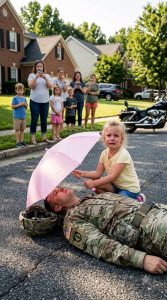
Several feet away from it, a man lay flat on his back on the radiating black asphalt.
He was broad-shouldered, perhaps in his early fifties, wearing a faded, collarless military-issue green shirt and heavy combat boots that looked completely out of place in a civilian California neighborhood. A silver-streaked beard rested against his heavily breathing chest. His sunglasses had shattered under his own weight when he dropped, and a thin, white-hot line of sunlight cut straight across his unmoving face.
People were stopping. Of course they were.
A teenager leaned against the fender of a Honda, holding up a smartphone, filming the scene with the detached curiosity of someone watching a glitching video game. Two women stood near a chain-link fence, whispering behind cupped hands, keeping a safe, calculated distance.
Nobody stepped closer. Nobody cast a shadow over him. Nobody offered a drop of water.
And then, cutting through the heavy, stagnant air, came a flash of bright, lemon yellow.
Her name was Willa Mercer. She was eight years old, wearing a faded denim skirt and scuffed sneakers, and in both hands, she carried a children’s umbrella that looked like it had survived a hurricane or two, its metal ribs slightly warped. She lived three blocks down with her grandmother, sent out on a simple afternoon errand to return a library book.
I watched through my dusty windshield as she paused at the edge of the asphalt. She didn’t look at the phone cameras. She didn’t look at the whispering adults. She looked only at the man on the ground, at his dry, cracked lips and the relentless hammer of the afternoon sun.
A woman near the sidewalk hissed, “Hey, little girl, get away from him! He could be dangerous!”
Willa didn’t flinch. She simply opened the yellow umbrella with a sharp, echoing snap, walked right up to the fallen man, and knelt down in the dirt, angling the bright canopy to block the searing light from his face.
As I shifted my truck into park and reached for the door handle, my chest tightened. I recognized that uniform shirt. I recognized the specific weave of that tactical pack, and the way his fingers were curled against the hot tar like he was trying to dig into a foxhole.
And as I pushed the door open and stepped out into the furnace-like air, I realized with a jolt of pure dread that I knew exactly who was lying under that sun—it was Marcus Vance, a sergeant from my old battalion—and I knew the explosive violence that would erupt if someone startled him the wrong way out of a heat-induced delirium.
My God, I thought, looking at the approaching shadow of a city police car down the street. He thinks he’s back in the sandbox.
Marcus’s hand twitched violently toward a concealed side zipper on his military pack, his knuckles turning chalk-white.
The heat hit me like the backdraft of a burning vehicle, but I forced my legs to move, my bad knee throbbing in sharp protest with every heavy step against the concrete.
Around us, the crowd was swelling, but it was a strange, hollow kind of crowd—frozen, hesitant, paralyzed by the modern disease of assuming someone else would handle the crisis, or worse, recording it for an audience that wasn’t there.
“Someone call an ambulance!” a man shouted from inside an air-conditioned SUV, though he made no move to roll his window down further than an inch.
“Already called!” another voice yelled back. “They’re ten minutes out!”
I kept my eyes fixed on that small, fragile circle of yellow light standing against the vast, blinding glare of the street. Willa was crouching now, her small arms trembling slightly as she fought against the hot thermal updrafts pushing at the umbrella’s fabric. She was talking to him, her voice a soft, steady murmur that I couldn’t quite make out over the dull hum of idling engines.
Marcus Vance stirred.
I knew Marcus from twenty years back. We had served together in the same bloody corridor of Al-Anbar province. We had carried each other through nightmares that the folks in this quiet Bakersfield suburb couldn’t even imagine in their worst fever dreams. But when Marcus came home, the war didn’t stay behind on a tarmac. It lived in his nervous system, in his hyper-vigilance, in the way a sudden shadow or a loud noise could instantly flip a switch in his brain from civilian back to soldier under direct fire.
“Step back, young lady,” I called out, my voice raspy from disuse, trying to cut through the murmurs of the crowd without raising my tone to an alarm.
Willa glanced back at me, her wide brown eyes unshakeable and clear. “He’s burning up, mister. He needs shade.”
“I know he does, sweetheart,” I said, coming up on her left flank, keeping my movements slow and deliberate, the way you approach a trapped animal or a spooked warhorse. “You did good. But let me take it from here.”
“I can hold it,” she whispered stubbornly, her knuckles white around the bent plastic handle.
Before I could answer, a high-pitched siren wailed in the distance, screaming down the avenue.
It was a local police cruiser, turning the corner onto Cypress Avenue a little too fast, its tires chirping against the asphalt and its strobe lights flashing an urgent, chaotic red and blue against the sun-bleached stucco walls of the houses. The moment the cruiser screeched to a halt, the atmosphere on the street shifted instantly from uneasy curiosity to razor-sharp tension.
A young officer—his name tag reading Officer Derek Rhodes—stepped out of the driver’s side door, his hand instinctively dropping to the retentive holster at his hip. His eyes swept over the chaotic scene—the military-surplus backpack, the heavy combat boots, the rigid posture of the fallen man, and the gathering crowd. To an untrained eye responding to a frantic 911 call about an “aggressive, potentially unstable military veteran down in traffic,” Marcus didn’t look like a victim dying of heatstroke.
He looked like an imminent tactical threat.
“Back up! Everybody back away from him right now!” Officer Rhodes commanded, unholstering his radio with one hand while taking a tactical step backward behind his vehicle door. “Step away from the subject, ma’am! Little girl, move back now!”
Willa didn’t move an inch. She planted her sneakers firmer into the hot asphalt and lowered the yellow umbrella another two inches to keep Marcus’s face completely shielded from the sun.
And then, right beneath us, Marcus Vance’s eyes snapped wide open.
They weren’t the eyes of a resting man awakening from a nap. They were bloodshot, dilated, and utterly wild, locked onto the flashing red and blue lights reflecting off the store windows across the street. The war had just caught up with him in a wave of blinding terror, and in his heat-addled mind, the quiet California street had vanished, replaced by the choking dust, screaming metal, and ambush of a desert highway.
“Get down! Incoming!” Marcus roared, a guttural sound torn straight from the bottom of his lungs.
Before any of us could react, his right arm lashed out with terrifying, mechanical speed. His hand caught the edge of the yellow umbrella, ripping it from Willa’s grip and sending it spinning across the hot pavement.
Willa gasped, stumbling backward onto the rough asphalt, scraping her palms bloody.
Officer Rhodes instantly drew his sidearm, stepping out from behind his door and raising the barrel directly at Marcus’s chest. “Sir! Stay where you are! Keep your hands where I can see them! Do not move or I will defend myself!”
“Marcus! Stand down! Look at me!” I yelled, throwing my arms out wide to block the officer’s line of sight while stepping directly into the line of fire. “Marcus, it’s me! It’s Hollis! You’re home, brother! You’re on Cypress Avenue!”
The name seemed to strike a faint chord behind the wall of sheer panic in his eyes, but his body was operating on pure, reflexive survival instinct. His right hand clawed frantically at the heavy canvas of his military backpack lying beside him, his fingers tearing at a heavy-duty metal zipper.
In the high-stakes theater of a modern street corner, a veteran with a tactical bag and a wild look in his eye reaching into a closed compartment is all it takes for an irreversible tragedy to ignite.
“Drop your hands! Drop them right now!” Rhodes screamed, his voice cracking with adrenaline, his finger tightening until the trigger guard took up the slack.
The crowd collectively sucked in a breath, several people ducking behind car doors. Marcus tore the zipper open and dragged a heavy, dark metallic object out of the bag.
Officer Rhodes began to squeeze.
“Don’t shoot!” I roared, throwing my body heavily over Marcus’s torso and forcing his arm down toward the pavement with all the weight I had left. “Look at the object! Look at his neck, dammit!”
The bullet didn’t fly. Officer Rhodes flinched, his knuckles white on his Glock, his breathing coming in frantic gasps as he held his fire by a fraction of a millimeter.
The heavy metallic object Marcus had pulled from the bag hit the asphalt with a dull, hollow clatter.
It wasn’t a firearm. It wasn’t an explosive.
It was a battered, grease-stained steel ammunition box from the Vietnam era, locked with a heavy brass padlock.
Marcus didn’t raise it. He clutched the steel box to his chest like a holy relic, curling into a tight fetal position on the burning road, his body shaking violently as severe heat stroke and post-traumatic panic pushed his vital organs to the brink of collapse.
“Read the tag!” I barked at Rhodes, ignoring the searing pain in my bad knee as I yanked open the collar of Marcus’s sweat-soaked green shirt.
Dangling against his chest was a stainless-steel medical identification dog tag. Rhodes stepped closer, his weapon lowered slightly, his eyes wide as he read the red-embossed lettering stamped into the steel: TRAUMATIC BRAIN INJURY / EXTREME THERMAL HYPERSENSITIVITY / PTSD / NON-COMBATANT MEDICAL CRISIS.
Rhodes lowered his firearm completely, holstering it with a shaking hand. “Dispatch… dispatch said an aggressive suspect refusing to clear the roadway…”
“Dispatch didn’t know a damn thing,” I gritted out, looking back at the crowd of onlookers who were still holding up their phones, capturing the spectacle. “And neither did any of you.”
Before another word could be spoken, a tiny figure walked back into the center of the danger zone.
Willa had picked herself up off the asphalt. Her palms were scraped red, but she didn’t cry. She picked up her battered yellow umbrella, walked right back up to Marcus’s curled form, and opened the canopy over his head once more, blocking out the sun.
“I told you,” Willa said simply, looking down at Marcus. “You needed shade.”
Marcus’s violent shivering began to slow under the shadow of the yellow cloth. The wild, frantic terror in his bloodshot eyes slowly dissolved into a profound, crushing exhaustion. His fingers loosened their death grip on the steel ammunition box. The heavy latch rattled, and the lid popped open slightly, spilling a cascade of worn paper photographs and handwritten letters onto the scorching asphalt.
I reached down, gently gathering the papers before the rising thermal wind could scatter them.
They weren’t maps or military orders. They were yellowed photographs of a young woman with a radiant smile holding a toddler in a quiet garden, and group photos of young men in desert fatigues—men whose faces were circled in black ink, with dates from twenty years ago written on the back. Memory ribbons. Letters from families of fallen soldiers.
Marcus looked up weakly from the pavement, his eyes finding Willa. “Was… was that you?” he rasped, his throat bone-dry.
Willa nodded, her small face serious. “I kept the sun off you.”
Marcus managed a faint, heartbreakingly gentle smile. “You didn’t just keep the sun off me, kid. You pulled me out of the fire.”
The siren of an approaching ambulance finally cut through the air. Paramedics tumbled out of the rig with ice packs, IV bags, and cooling blankets. They worked with rapid efficiency, loading Marcus onto a gurney.
As they rolled him toward the doors, Marcus reached out a weak, shaking hand. “Hollis… the box…”
“I’ve got it, brother,” I said, holding the heavy steel box under my arm. “I’ll keep it safe.”
The ambulance doors slammed shut, and the rig pulled away smoothly, heading toward the local Veterans Affairs hospital.
The crowd on Cypress Avenue began to disperse, people avoiding eye contact as they slipped back into their air-conditioned cars. But just as the street began to clear, a deep, thunderous roar echoed from the north end of the avenue—a low, rhythmic rumble that shook the glass in the storefronts.
Turning the corner in a tight, synchronized V-formation came a dozen heavy-duty Harley-Davidson motorcycles, their chrome pipes gleaming violently in the sun.
It was the local chapter of the Iron Sentinel Veterans Club—men and women who rode not as an outlaw gang, but as a brotherhood dedicated to protecting veterans who had been forgotten by the world. And leading the formation was Jax Miller, a towering ex-Marine with a silver-plated service cross tattooed along his left forearm.
Jax pulled his bike to a sharp halt right where Marcus had fallen, his dark eyes sweeping over the police cruiser, the blood on Willa’s knees, and the yellow umbrella in her hand. He killed his engine, and the heavy silence that followed was thick with tension.
Jax dismounted, his boots heavy against the pavement. “We got an emergency ping from Marcus’s beacon,” Jax said, his voice like grinding stones. “Who tried to take him down?”
Jax Miller stared down Officer Rhodes with a look that could have stripped paint off a hull. Rhodes took a step back, his hand nervously hovering near his belt, intimidated by the sudden presence of a dozen muscular, leather-clad veterans standing in the middle of Cypress Avenue.
“Stand down, Jax,” I said, stepping between them with the steel lockbox tucked under my arm. “The cop made a mistake, but he didn’t shoot. The heat almost took Marcus. His brain cooked out here while fifty people filmed it on their phones.”
Jax’s jaw tightened, the thick muscle in his cheek twitching violently. He turned his head and looked at the lingering bystanders, his gaze so cold and piercing that two men near a sedan immediately got into their car and drove away without saying a word.
Then, Jax’s eyes drifted lower, landing on Willa Mercer.
She was still standing there, holding her yellow umbrella, her small knees dusted with black soot from the street and her palms raw from where she had fallen.
Jax slowly dropped heavily down onto one knee in front of her. The giant ex-Marine reached up, removed his dark sunglasses, and looked at the eight-year-old girl with eyes that were suddenly wet with unshed tears.
“What’s your name, little sister?” Jax asked softly, his gravelly voice dropping an octave into pure gentleness.
“Willa,” she said clearly.
Jax nodded slowly. He reached inside his heavy leather vest and unpinned a heavy, gleaming brass-and-enamel coin from his inner lapel—the custom-minted Challenge Coin of the 1st Battalion, bearing their combat crest and the deeply carved motto: NEVER LEAVE A MAN BEHIND.
“My name is Jax,” he said, holding the heavy metal disk out on his flat palm. “Marcus is my brother. We fought in the same trenches. And today, when every grown adult on this street backed away and hid behind their screens, you stood your ground and saved his life.”
Willa’s grandmother, June Mercer, came hurrying down the sidewalk, her face pale with terror after seeing the pack of motorcycles. “Willa! Oh, sweetie, come here!” June cried out, reaching to pull her granddaughter back.
Jax immediately raised a hand, palms open, bowing his head respectfully toward June. “Ma’am, please. I mean no disrespect. Your granddaughter is a hero. I’d like to give her something.”
June paused, looking at the towering veteran kneeling on the pavement, then at the shiny medal in his hand, and finally at her granddaughter’s firm, proud posture. June’s eyes softened, and she nodded slowly, pressing a hand over her heart.
Jax gently placed the heavy coin into Willa’s small hand, folding her fingers over the smooth brass. “That coin was forged from the melted steel of an armored vehicle we lost in Iraq. It means you’re part of our unit now, Willa. If anyone in this town ever bothers you, or if you ever need help, you show them this coin and call the number on the back. Every veteran in this county will be on your front lawn in five minutes flat.”
Willa looked at the coin, running her thumb over the raised letters. “My grandpa was a soldier,” she whispered quietly. “He told me that hope is something small you carry in your pocket so you don’t lose your way in the dark.”
Jax let out a quiet, choked laugh, brushing a hand across his mustache. “Your grandpa was a wise man, kid.”
Over the next week, the story of what happened on Cypress Avenue didn’t make the national news networks—because June flatly refused to let television reporters exploit her granddaughter for cheap ratings.
“Willa doesn’t need a viral video,” June told a news crew that turned up on her lawn. “She just wants people to put their damn phones down and act like human beings.”
That statement echoed through the neighborhood like a thunderclap.
Within days, subtle changes began to transform the street. The local grocery shop installed a permanent shaded awning and an ice-water fountain outside its doors. A teenager named Toby—the same kid who had been filming Marcus on his phone when he fell—walked up June’s driveway four days later, his face red with shame. He handed Willa a handwritten letter of apology and offered to pull weeds in June’s garden every Saturday for free.
The neighborhood was waking up. But our battle for Marcus was far from over.
Ten days after the incident, I drove to the VA hospital to check on Marcus and bring him his clothes. But when I stepped into Room 214, the bed was stripped completely bare. The window was open, letting in the hot valley breeze, and resting on the bedside table was a folded piece of paper addressed to me.
I picked it up, my hands trembling as I read Marcus’s jagged handwriting:
Hollis—I can’t stay here. I saw the look in that young cop’s eyes. I saw the terror I caused that little girl when I snapped her umbrella. I’m broken, brother. I’m a weapon that goes off without warning, and I won’t risk hurting that child or anyone else. I’m heading up into the Kern River Canyon. Don’t come looking for me.
My heart sank like a stone into my stomach. I turned and sprinted down the hospital corridor as fast as my bad knee would carry me.
“He went into the high country,” I told Jax an hour later inside my repair shop, slamming the note down onto the workbench. “He’s running from himself. He thinks he’s a monster.”
Jax looked at the note, his jaw set like granite. “He’s not running alone. Saddle up.”
We took my pickup truck, towing Jax’s Harley behind us, and drove straight into the rugged, dry wilderness of the Kern River Canyon. The road wound dangerously along steep granite cliffs and scorching pine thickets. I knew Marcus’s old habits—when his PTSD flared up to an unbearable pitch, he retreated to an abandoned hunter’s cabin near the ridge where his father used to take him as a boy.
It took us three hours of searching through the dense brush, the late afternoon sun beating down mercilessly on the rocky terrain.
We found him sitting on the decaying wooden porch of the dilapidated cabin, staring blankly out over the canyon depth. He looked gaunt, his eyes hollow, a pocketknife resting open in his hand. He didn’t look up when our boots crunched against the dry pine needles.
“I told you not to come, Hollis,” Marcus said, his voice flat and dead.
“And since when have I ever listened to a stupid order from you?” I snapped, stepping onto the porch while Jax stayed at the perimeter, keeping watch. “What the hell are you doing out here, Marcus?”
“Protecting people,” Marcus rasped, his knuckles white around the handle of his pocketknife. “You saw me out there on Cypress Avenue. I lost control. I ripped that umbrella out of that little girl’s hands. I could have killed her, Hollis! A man like me doesn’t belong near normal people. I belong out here with the rocks and the dirt.”
“You listen to me, you stubborn bastard,” I said, dropping heavily onto the wooden bench beside him, leaning in until my face was inches from his. “Willa didn’t run away from you. She didn’t look at you like you were a monster. When you knocked her down, she got right back up, picked up her broken umbrella, and stood over you again. She didn’t give up on you! So what right do you have to give up on yourself?”
Marcus slammed his pocketknife shut, his shoulders heaving as a quiet, terrible sob tore out of his chest. He covered his face with his calloused hands, the weight of twenty years of guilt and trauma spilling out of him in the quiet canyon air.
“I tried to be strong, Hollis,” he wept. “I tried to carry it all.”
“You don’t have to carry it alone anymore,” Jax said, stepping onto the porch and placing a massive, heavy hand on Marcus’s shoulder. “That little girl gave you shade when you were burning up. Now it’s your turn to stand up and build something that lasts.”
It took two days to bring Marcus back down the mountain, but he didn’t go back to a hospital ward. He stayed at my house.
For three days and three nights, the three of us locked ourselves inside my workshop. We pulled out polished mahogany wood, brass hinges, velvet lining, and glass panes. Working by the light of hanging shop lamps, Marcus used his hands not to fight or destroy, but to create.
We were building a custom, handcrafted wooden shadow box.
Inside the glass case, we carefully mounted Willa’s small, yellow children’s umbrella—its metal frame meticulously straightened, its fabric cleaned, and its bent plastic handle reinforced with polished copper wire. Below the umbrella, we set a solid brass plaque engraved with words that Marcus chose himself:
TO WILLA MERCER: KINDNESS STANDS ITS GROUND.
On the fourth morning, we loaded the completed shadow box into the back of my truck and drove back toward Cypress Avenue.
But as we pulled onto the street, the peaceful atmosphere of the neighborhood was shattered once again.
Parked directly on the grass in front of June Mercer’s small white house were two black commercial SUVs and a city code enforcement vehicle. Standing on the front porch, waving a thick stack of legal papers and shouting at June, was a man in a tailored grey suit—Victor Sterling, a notoriously ruthless real estate developer who had been trying to buy up the block for commercial redevelopment.
“You have twenty-four hours to vacate the premise, ma’am!” Sterling shouted, his voice echoing down the quiet street. “The city has declared this structure an emergency structural hazard under Code 408! If you aren’t out by tomorrow morning, the bulldozers will clear it for you!”
June was standing on her porch, trembling, clutching Willa tightly against her apron as the developer sneered at her.
Marcus’s eyes hardened into tempered steel. He grabbed the heavy wooden shadow box from the back seat, opened the truck door, and stepped out onto the pavement.
“Get behind me,” Marcus said quietly as we reached the foot of June’s porch steps.
Victor Sterling turned around, his smug expression slipping for a second as he saw three heavy-set men—two rugged veterans and an ex-Marine—walking up the driveway with cold determination in their eyes.
“Who the hell are you?” Sterling demanded, adjusting his expensive tie and putting on a posture of corporate authority. “This is official city business. This property has been condemned for safety violations. Move along.”
“This house isn’t condemned,” I said, stepping up beside Marcus. “June’s lived here for forty years. Her roof was inspected last spring.”
“The city council updated the zoning ordinance three days ago,” Sterling sneered, holding up a stapled document. “The property fails modern commercial setback requirements. I own the development rights to this entire corridor now. So unless you want to be arrested for trespassing, clear out.”
Willa peeked out from behind her grandmother’s skirt, her small hands holding tight to June’s apron. She looked at Marcus, her eyes widening as she recognized him.
“You came back,” she whispered.
Marcus looked at her, his face softening into a warm, resolute smile. “I told you I would, kiddo.”
Then Marcus turned back to Sterling, his voice dropping into a low, terrifying calm that had commanded platoons under artillery fire. “You’re going to put those papers back in your briefcase, get into your fancy car, and leave this porch.”
“Or what?” Sterling laughed mockingly, taking out his phone. “You going to threaten me, old man? I have the police on speed dial.”
“Go ahead and call them,” a voice called out from the sidewalk.
We all turned. Walking up the driveway was Officer Derek Rhodes. He was in full uniform, but he wasn’t holding his gun or his radio. In his hand, he carried an official legal folder from the County District Attorney’s office. Behind him walked young Toby, holding a digital camcorder.
“Officer Rhodes,” Sterling stammered, his arrogance wavering. “Tell these men to stand down. I am executing an emergency code order.”
“I just spoke with the City Attorney, Mr. Sterling,” Rhodes said clearly, stepping onto the grass and looking Sterling straight in the eye. “It turns out the code violation notice you filed was fraudulently backdated. And young Toby here gave us full video footage of your assistant offering a cash bribe to the junior building inspector outside city hall two days ago.”
Sterling’s face went completely drain-white. “That’s… that video is unauthenticated nonsense!”
“The DA didn’t think so,” Rhodes replied smoothly, pulling out a set of steel handcuffs from his belt. “Mr. Sterling, you’re under arrest for attempted fraudulent seizure, falsification of public documents, and municipal bribery. Step down off the porch and put your hands behind your back.”
The crowd of neighbors who had gathered along the sidewalk burst into sudden, roaring cheers. Toby smiled proudly, holding his camera high, while two county sheriff deputies pulled up to take Sterling into custody.
As the police cars drove away with the disgraced developer in the back seat, a peaceful silence descended over June’s porch once more.
June collapsed weakly onto a porch chair, weeping tears of pure relief. “Oh, Lord… I thought we were going to lose everything.”
Marcus walked slowly up the wooden steps, holding the large, velvet-wrapped package in his arms. He stopped right in front of Willa, who was staring up at him with bright, curious eyes.
“Willa,” Marcus said, kneeling down so he was at eye level with the eight-year-old girl. “I brought you something.”
Willa stepped forward, reaching out her hand to touch the dark velvet cloth.
Marcus carefully pulled away the heavy velvet wrapping, revealing the handcrafted mahogany shadow box.
The afternoon sun struck the glass pane, making the polished wood glow like warm amber. Mounted inside against a dark navy velvet backdrop was Willa’s yellow umbrella—its canopy pristine, its frame straight, its handle reinforced with shining copper wire. Below it, the brass plaque caught the light, its engraved letters standing out sharp and bold:
TO WILLA MERCER: KINDNESS STANDS ITS GROUND.
Willa gasped, her breath catching in her throat. She reached out a finger, touching the cool glass right over the yellow fabric of her umbrella.
“It’s… it’s my umbrella,” she whispered, her eyes shining with wonder.
“It belongs in our veterans’ club house,” Marcus said, his voice rich with deep emotion. “Right above the main mantle, so every soldier who comes home broken can look at it and remember that there is still good in this world. But every single man and woman in our unit agreed—it had to come here first. To remind you, and everyone who walks past this house, that true courage isn’t about being big, or loud, or carrying a weapon. True courage is simply staying put and offering shade when everyone else runs away.”
June pressed both hands over her mouth, tears flowing freely down her cheeks as she looked at Marcus. “Thank you, son… thank you for bringing my granddaughter’s light back home.”
Marcus stood up, offering a crisp, sharp military salute to June before looking back down at Willa. “If you ever need someone to walk you to the library, or carry your books, or just make sure the sun isn’t beating down too hard on your path… you let me know. That’s an order, soldier.”
Willa beamed—a bright, radiant smile that completely outshone the hot California sun hanging above the rooftops. She pulled her heavy brass challenge coin out of her skirt pocket, holding it proudly against her chest. “I will, Sergeant Marcus.”
From that day on, Cypress Avenue was never the same again.
The story of the yellow umbrella didn’t stay buried in Bakersfield. It spread quietly from neighbor to neighbor, town to town. The local veterans’ club adopted the street, helping elderly residents paint their porches and fix their roofs. Marcus moved into a small house two blocks down, taking a job alongside me at my small engine repair shop. His hands, once tormented by tremors of past violence, became steady and masterfully skilled at bringing broken things back to life.
And every afternoon at three o’clock, like clockwork, Marcus would walk down to the corner of Cypress Avenue, wearing his clean blue shirt, to walk Willa Mercer home from the library under the clear, open blue skies.
We spend so much of our lives running from our shadows, terrified of the things we don’t understand, hiding behind tinted glass, screens, and safe, comfortable distances. But sometimes, when the heat of the world threatens to burn everything to ash, all it takes to heal a broken community is an eight-year-old girl with a bent handle, a bright yellow canopy, and the simple, radical courage to stand her ground.
If you want more stories like this, or if you’d like to share your thoughts about what you would have done in my situation, I’d love to hear from you. Your perspective helps these stories reach more people, so don’t be shy about commenting or sharing.