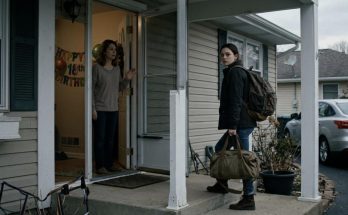
The first thing I repaired on our next visit to the cabin was the fence.
I brought a hammer, a small collection of nails, and the tools I thought I might need.
Camille carried the tackle box inside while I examined the loose board.
The repair didn't take long.
I removed the damaged nails and secured the wood.
Then I checked the neighboring boards.
Everything was fine.
I stood back.
For a moment, I considered finding something else to repair.
Old habits.
Then I smiled.
The job was finished.
I gathered my tools and went inside.
Camille was making coffee.
“Already done?”
“Yes.”
She handed me a cup.
I looked around the cabin.
There were no documents waiting on the table.
No attorneys.
No financial proposals.
Just the things we had brought for an ordinary visit.
A few months had passed since I sat across from Dad in Sterling's office.
The attempted sale had been terminated.
The buyer's deposit had been addressed through the arrangements made by the responsible parties.
I hadn't been required to fund the repayment or surrender any interest in the property.
Daniel confirmed that the matter concerning my rights in the cabin had been resolved.
Dad no longer performed the caretaker responsibilities Grandpa had originally assigned him.
The trust remained in effect.
The cabin and its forty-seven acres remained protected.
When I received the final confirmation, I placed the paperwork in the folder beside Grandpa's letters.
I didn't frame it.
I didn't send copies to relatives.
I didn't contact Dad to remind him of the outcome.
I simply kept the records somewhere safe.
That was enough.
Dexter's brewery had closed.
The financial consequences were now his responsibility to address with the appropriate professional assistance.
My parents had also begun making changes to their own financial arrangements.
They couldn't continue maintaining everything exactly as they had before.
Dad disliked that reality.
I knew he blamed me for at least part of it.
But the decisions that created those circumstances hadn't been mine.
And I wasn't going to pretend otherwise simply to make him feel better.
Dexter never gave me a complete explanation of the altered letter.
That remained disappointing.
The examiner's findings and the relevant documents were preserved.
His challenge had been withdrawn.
No one could reasonably use that document to establish that Grandpa had promised him the cabin.
I accepted that the legal question had been addressed even though some personal questions remained unanswered.
Life didn't always provide a complete explanation for every hurtful decision.
Sometimes you received enough information to protect yourself.
The rest belonged to the person who made the decision.
As for Mom, she had eventually spoken with Camille.
The conversation took place over the telephone.
I wasn't present for all of it.
Camille hadn't needed me to supervise her response.
My mother apologized for remaining silent on Christmas Eve.
She acknowledged that Camille hadn't deserved the insult or the humiliation.
When my wife told me afterward, I asked how she felt.
“I'm glad she said it.”
I nodded.
“Does that change anything for you?”
“A little.”
I understood.
An apology didn't erase the memory.
But it could establish that somebody finally understood why the memory mattered.
Camille wasn't interested in punishing my mother.
She was interested in being treated respectfully.
If Mom could manage that consistently, there was room for a different kind of relationship.
A cautious one.
An honest one.
Without money becoming the subject of every conversation.
Dad was different.
He hadn't offered the same acknowledgment.
For a while, I kept expecting him to call.
I imagined him explaining that Christmas Eve had been wrong.
I imagined hearing him apologize without mentioning Dexter's creditors or Grandpa's estate.
I imagined a conversation between a father and son that didn't involve an obligation.
Then I stopped imagining it.
Dad knew how to contact me.
He knew what needed to be acknowledged.
I had made that clear.
The decision to take responsibility belonged to him.
I wasn't going to spend the next twenty years waiting for him to make it.
Inside the cabin, Camille placed our coffee cups on the table.
I brought out Grandpa's photograph.
The boy holding the oversized fishing rod looked familiar in a way he hadn't when Eleanor first showed me the picture.
At first, I had looked at him and felt sorry for him.
I remembered how desperately he wanted his father's approval.
How much effort he put into being dependable.
How quickly he apologized whenever somebody became unhappy.
But now I noticed something else.
He was smiling.
Grandpa was standing beside him.
He had found somewhere he could feel comfortable long before he understood why that comfort mattered.
I looked at Camille.
“I think he was trying to give me this.”
She glanced around.
“The cabin?”
“The feeling.”
She smiled.
I placed the photograph carefully on the table.
We had spent the previous months working with qualified advisers concerning the estate.
There were practical decisions about investments, property, expenses, and responsibilities.
Receiving a substantial inheritance hadn't suddenly made me an expert in every financial matter.
I understood that.
I intended to ask questions, obtain independent advice, and make careful decisions rather than behave as though possessing money meant I couldn't make mistakes.
Grandpa's approximately $4.8 million in assets represented decades of work and patience.
It deserved the same care he had given it.
I didn't want to spend it merely to demonstrate that my life had become more successful than Dexter's.
I didn't want to buy things because Dad might hear about them.
And I certainly didn't want to use it to make people feel indebted to me.
Those were exactly the attitudes Grandpa had warned me against.
Instead, Camille and I discussed what would make our lives more secure.
What responsibilities we could reasonably undertake.
How we could preserve what had been entrusted to us.
We talked about the future without needing to prove anything to anybody.
I enjoyed those conversations.
They weren't about presenting an impressive life to other people.
They were about building a life we actually wanted to live.
Grandpa had understood that distinction.
His dented pickup truck was proof enough.
A few weeks before Christmas, Mom called.
She wanted to know what Camille and I were planning for the holiday.
I told her we intended to spend part of it at the cabin.
She became quiet.
“That sounds nice.”
“It should be.”
She asked whether we would be comfortable seeing her sometime during the holidays.
I told her we could arrange a visit separately.
I didn't want to recreate the circumstances that had led to our original separation.
Mom accepted that.
She didn't insist that I come to Dad's house.
She didn't tell me that Camille needed to make an effort for the sake of the family.
She didn't ask whether the inheritance had been distributed.
It was an ordinary conversation.
I appreciated it more than she probably realized.
Before we ended the call, she wished Camille and me a happy Christmas.
I thanked her.
Afterward, I sat quietly at our kitchen island.
Camille was beside me.
“Everything okay?”
“Yes.”
I told her about Mom's call.
She smiled.
“That's progress.”
I nodded.
It was.
Not everything that had been damaged needed to remain damaged forever.
But repairing a relationship required more than the person who had been hurt becoming willing to forget.
It required the people involved to behave differently.
I was beginning to see a little of that from Mom.
I hoped it continued.
Christmas Eve arrived.
Camille and I drove to the cabin.
Snow covered the surrounding ground.
The trees were quiet.
As we approached the property, I noticed the fence board I had repaired.
It was holding exactly as it should.
I smiled.
Camille followed my gaze.
“Still checking your work?”
“Grandpa would have.”
She laughed.
We carried our belongings inside.
The cedar tackle box came with us, even though we weren't planning to spend the evening fishing.
I placed it on the table.
Then I took out the photograph.
Camille helped arrange our things while I stood looking at the familiar room.
Two Christmases earlier, the snow had represented something painful.
I remembered leaving Dad's house.
I remembered the insult directed at my wife.
I remembered the shame I felt, even though I hadn't been responsible for what he said.
For a long time afterward, Christmas had carried the memory of being unwanted.
That evening, standing inside Grandpa's cabin, I felt something different.
I was warm.
Camille was with me.
Nobody was going to tell either of us that we didn't belong.
I took off my coat.
Then I helped my wife prepare dinner.
Nothing elaborate.
We had brought food we enjoyed, and there was no reason to make the evening more complicated than it needed to be.
We laughed when we discovered how much we had packed.
Grandpa would probably have told us we'd brought enough for several days.
I could almost hear him.
That thought made me smile.
Later, my phone rang.
It was Dad.
I looked at the screen.
Camille noticed.
She didn't tell me whether to answer.
I decided to.
“Hello?”
“Warren.”
His voice was quieter than usual.
“Merry Christmas, Dad.”
There was a pause.
“Merry Christmas.”
I waited.
He asked whether we were at the cabin.
I told him we were.
Another pause followed.
Then he said something about the weather.
We discussed the snow briefly.
It was strange having such an ordinary conversation with him.
There were no immediate demands.
No accusations concerning Grandpa's decisions.
No request that I finance something.
Part of me wondered whether he was finally going to apologize.
I waited.
He didn't.
Instead, he said he hoped we would speak again.
I told him we could, provided our conversations remained respectful.
He didn't argue.
He wished me a good evening.
Then he ended the call.
I looked down at the phone.
Camille came over.
“What did he say?”
“He wished me a merry Christmas.”
She nodded.
“Anything else?”
“Nothing important.”
I put the phone away.
I wasn't disappointed in quite the same way I would have been a year earlier.
Dad hadn't offered the acknowledgment I wanted.
But I hadn't needed him to offer it for the evening to be meaningful.
I hadn't answered the call expecting him to determine whether I could enjoy Christmas.
He was responsible for his own words.
I was responsible for deciding what place those words occupied in my life.
Camille took my hand.
“Dinner's ready.”
I followed her to the table.
We ate slowly.
We talked about ordinary things.
Our plans.
The cabin.
Things we wanted to do during the coming year.
At one point, Camille asked what I thought Grandpa would say if he could see us.
I looked toward the tackle box.
“He'd probably ask why I hadn't checked the fence again.”
She laughed.
I laughed too.
Then I became quiet.
“He'd be happy you were here.”
Camille smiled.
“I hope so.”
“I know so.”
Eleanor had told us how highly Grandpa regarded her.
He had understood something Dad refused to acknowledge.
Camille hadn't taken me away from my family.
She had helped me understand that loving somebody didn't require constantly surrendering my independence.
She had encouraged me to become more comfortable with the person I already was.
Grandpa had recognized that.
I wished Dad could recognize it too.
But whether he did or not, I knew what I had.
After dinner, I retrieved Grandpa's original letter from its folder.
The folds had become increasingly familiar.
I opened it carefully.
Camille sat beside me while I read.
I didn't need to read every sentence aloud.
I knew most of the message by now.
Grandpa had seen the effort I put into being accepted.
He had recognized how often I confused responsibility with affection.
He had understood what the cabin meant to me.
He had made arrangements to protect it because he knew somebody might eventually try to use it for something else.
And he had wanted me to understand that refusing unreasonable demands didn't make me a bad son.
I reached the final lines.
Then I folded the letter.
For months, those words had helped me navigate arguments, legal questions, financial proposals, and painful conversations.
Now they felt less like instructions.
They felt like something I had finally learned.
I placed the letter beside the photograph.
Camille rested her head against my shoulder.
We sat quietly.
Outside, the snow continued falling.
I remembered the sealed envelope beneath the bottom panel of the cedar tackle box.
The tiny screws.
The patience it had taken to remove them without damaging the wood.
At the time, I believed I was opening something Grandpa had hidden.
Looking back, I realized I had also been closing something.
A long period of my life during which I believed I needed to earn permission to be myself.
Dad had demanded my signature because he thought my decisions still belonged to him.
Dexter had challenged the trust because he believed Grandpa's property might solve his financial problems.
My mother had initially expected me to return because everybody else's circumstances had become difficult.
They had all expected the old Warren.
The one who apologized.
The one who volunteered.
The one who accepted responsibility before asking whether it was his.
I didn't hate that version of myself.
He had been trying to maintain relationships with the people he loved.
He simply hadn't understood that some relationships could never become healthy while only one person was expected to make sacrifices.
Grandpa had understood.
He had left me the cabin.
He had left me the greater portion of his remaining estate.
But he had also left me permission to stop participating in something that had been hurting me for years.
I no longer needed to prove that I deserved those things by giving them away.
I no longer needed to become angry whenever Dad misunderstood me.
I could make careful decisions.
I could protect Camille.
I could care about my family without accepting responsibility for every consequence of their choices.
And I could continue living even if some of them never understood why.
I stood and carried the tackle box toward the shelf.
Camille watched me.
“Leaving it there?”
“Yes.”
I positioned it carefully.
Grandpa had built that box with his own hands.
For years, it had held ordinary fishing equipment and a secret beneath a wooden panel.
Now its secret had served its purpose.
There was nothing left inside that needed discovering.
I turned toward the table.
The photograph remained beside the folded letter.
I looked at the boy holding the fishing rod.
For once, I didn't feel sorry for him.
He had been loved.
Perhaps not by everyone whose approval he wanted.
But genuinely loved by someone who understood him.
Grandpa had made sure that love would remain part of his life long after the man himself was gone.
I returned to Camille.
She held out her hand.
I took it.
Outside the cabin, the snow covered the fence and the surrounding land.
Forty-seven acres.
A place my grandfather had protected.
A place my father had tried to sell.
A place where my wife and I could spend Christmas without wondering whether somebody would tell us to leave.
I looked at Camille.
“Merry Christmas.”
She smiled.
“Merry Christmas, Warren.”
I kissed her forehead.
Then I turned down the lights and sat beside her.
The cabin was quiet.
The tackle box rested on its shelf.
Grandpa's photograph stood on the table.
And for the first time in my life, I understood that belonging somewhere wasn't something I needed to earn.
I was home.
The End
Read more original stories on readstoryus.
My Father Expected Me to Sign Away the Only Place Where I Had Ever Felt Like I Truly Belonged
Part 15 of 15