
The photograph had faded around the edges, but there was nothing vague about the little girl standing in the center.
It was me.
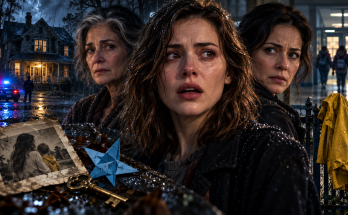
I recognized the blue sweater with the white rabbit stitched near the hem. I recognized the uneven haircut I had given myself with kitchen scissors and the gap where my front tooth had been missing. I was standing in front of the house where I had lived until I was six, one hand lifted as if I had been caught mid-wave.
Behind me stood two women.
One was Eleanor Bell, the woman I had called Mom for the first six years of my life.
The second woman was a stranger.
Or at least she should have been.
She was young, probably no more than twenty, with long dark hair and a thin silver chain at her throat. Her face was turned partly toward me rather than toward the camera. There was tenderness in that expression that felt too private for a stranger.
My gaze stayed on her longer than I intended.
“Who is that?” I asked.
Wren pointed.
“My mommy.”
Celia Ellis.
I studied the woman’s features again. There was something disturbing about the shape of her eyes. They were like Wren’s, certainly, but that wasn’t what caught me. The line of the nose, the dark eyebrows, the slight asymmetry of the mouth—
I stood abruptly and crossed to the mirror hanging beside Ms. Dorsey’s filing cabinet.
My reflection stared back.
Same mouth.
Not identical.
Close enough that I felt cold.
Ms. Dorsey saw it too. “Mara.”
“I know.”
Wren remained in the chair. “Mommy says you make that face when you’re confused.”
I turned.
“What face?”
“The one where you press your teeth together.”
I immediately realized I was doing exactly that.
“How would she know?”
Wren shrugged, as though the answer was obvious. “She watches you.”
A harder chill ran along my spine.
“Watches me where?”
“Sometimes outside.”
“Outside where?”
“Your work.”
Ms. Dorsey stepped closer. “Wren, does your mother follow Mara?”
The word follow made the situation sound sinister. The child frowned.
“No. She checks.”
“Checks what?”
“That she’s okay.”
I rubbed my forehead. Until twenty minutes earlier, Celia Ellis had been a name I had never heard. Now I was looking at proof that she had known me when I was a child and learning that she had apparently kept track of my life for years.
“Have I ever met your mother?”
Wren nodded.
“When?”
“You were little.”
“I mean recently.”
“No.”
“Has she ever spoken to me?”
Wren’s eyes moved toward her backpack.
I noticed.
“What?”
“Nothing.”
“You looked at the bag.”
She squeezed the straps between her fingers.
“Wren, if your mother is missing, anything she gave you could matter.”
“She isn’t missing.”
Ms. Dorsey and I both looked at her.
“What do you mean?” I asked.
“Missing means you don’t know where somebody went.”
“That is exactly what’s happening.”
Wren shook her head.
“Mommy went because she had to.”
“Where?”
“I don’t know.”
“Then she’s missing.”
“No.” Her voice grew sharper. “She said not to call it that.”
The distinction obviously mattered to her mother, which made it matter to me.
“What did she tell you to call it?”
Wren thought carefully.
“Finishing something.”
I sat again.
“Finishing what?”
“I don’t know.”
“Did she say when she would come back?”
“When it stopped raining.”
All three of us glanced toward the window.
Rain still ran in silver sheets down the glass.
“And if she didn’t come back?”
Wren studied my face.
“She told me what to do.”
“That’s why you asked for me?”
“Yes.”
“How did you know my phone number?”
“Mommy made me learn it.”
“Why?”
“In case my backpack got taken.”
“What else did she make you memorize?”
Wren began counting on her fingers. “Your name. Your phone. Your birthday. Where you work. Grandpa Daniel’s name.”
My chair moved beneath me.
“What did you say?”
“Grandpa Daniel.”
“My father?”
She nodded.
Daniel Bell had no biological grandchildren that I knew of. I had no siblings. I was his only child.
“Why do you call him Grandpa?”
“I don’t.”
“But you just did.”
“Mommy does when she talks about him to me.”
My skin prickled.
“Has Wren ever met your father?” Ms. Dorsey asked.
“I have no idea.”
Wren answered for me. “Once.”
I turned back to her. “When?”
“Mommy told me not to say.”
The pattern was beginning to make me angry, although not at Wren. Every answer revealed another locked door.
I forced my voice down. “Did you meet him recently?”
She stared at the floor.
“That means yes.”
Her eyes filled with tears.
I stopped.
“Okay. I won’t push.”
“I’m not supposed to make him know we know.”
The sentence was awkward, childish, but its meaning landed cleanly.
“Know what?”
Wren shook her head.
Ms. Dorsey walked into the hallway to call the principal and update him. She left the office door partly open. For the first time since I arrived, Wren and I were nearly alone.
I placed the old photograph on the desk between us.
“Your mother and my mother knew each other.”
“Yes.”
“How?”
“Best friends.”
“Did your mother tell you that?”
“Yes.”
“What else did she tell you about Eleanor?”
Wren smiled faintly for the first time.
“She liked yellow flowers. She sang wrong words to songs. She burned pancakes.”
My chest tightened.
All three were true.
I remembered my mother putting daisies in old glass jars. I remembered her confidently replacing forgotten lyrics with nonsense. I remembered Sunday mornings when my father would open windows because Eleanor had filled the kitchen with smoke again.
Details like that could not have come from a photograph.
“Did Celia know what happened to her?”
Wren’s smile vanished.
“Yes.”
I barely breathed. “What happened?”
“She said it was complicated.”
“That’s an adult answer.”
“Mommy gives lots of those.”
Despite myself, I almost smiled.
Then Wren added, “She said you were told something different.”
My fingers curled around the edge of the desk.
“Different from what?”
Before she could respond, someone knocked sharply on the open door.
A custodian stood outside holding an umbrella.
“Ms. Dorsey around?”
“She’s in the hallway.”
He looked at Wren, then at me. “There’s a dark sedan circling the parking lot. Third time in ten minutes.”
Wren’s entire face changed.
She slid from the chair and rushed to the window.
“Don’t.”
I caught her before she reached it.
She twisted toward me. “We have to go.”
“Why?”
“He found us.”
“Who?”
Wren grabbed the front of my coat.
“The man.”
I moved away from the window.
“Did you see the car?”
She shook her head.
“Then how do you know?”
“Mommy said if the same car comes three times, don’t wait for the fourth.”
That was not advice someone gave a child casually.
I stepped into the hallway and saw Ms. Dorsey ending her call.
“Call the police now.”
She nodded immediately.
Wren began crying.
“No, no, no.”
I crouched in front of her. “Listen to me. We don’t know who is outside. Police can check.”
“You promised.”
“I promised I would listen. I didn’t promise I would let someone hurt you.”
That stopped her.
Her lower lip trembled.
“You sound like Mommy.”
The compliment hurt in a way I did not understand.
Within minutes the front doors were locked and the school’s remaining staff had moved away from the lobby. The sedan was gone before officers arrived.
Two patrol cars swept the surrounding streets and found nothing.
While we waited, Ms. Dorsey tried Naomi Park again. Straight to voicemail.
Wren refused snacks, refused water and refused to leave my side.
Eventually I asked the question I had been avoiding.
“Where do you live?”
She looked at me cautiously.
“With Mommy.”
“I know. What street?”
“I can’t tell.”
“The police need somewhere to look for her.”
“No.”
“Why not?”
“She said our house isn’t safe if she doesn’t come back.”
I was beginning to understand that Celia had prepared her daughter for this exact scenario.
“What was supposed to happen after you found me?”
Wren reached into her backpack again.
This time she removed a small paper envelope.
There was no address on the front. Only my first name.
She started to hand it over, then pulled it back.
“What?”
“Mommy said I could only give you this after you believed the picture.”
I looked toward the photograph.
“I believe your mother knew me.”
“That’s not what she said.”
“What am I supposed to believe?”
Wren glanced at my face, then at the photograph of Celia.
“That she’s your mother too.”
I stared at her.
The statement was ridiculous.
Impossible.
Eleanor Bell had been my mother. I remembered her bathing me, brushing my hair, carrying me when I had a fever. I remembered the smell of her hand lotion and the smooth silver necklace she wore every day.
“My mother was Eleanor.”
“I know.”
“A person can only have one mother who gave birth to them.”
Wren frowned with the impatience children reserve for adults who are missing something simple.
“Mommy said that’s not true.”
I looked again at Celia.
Same dark eyes.
Same mouth.
A strange pressure formed behind my ribs.
“How old is your mother?”
“Forty-seven.”
I calculated without wanting to.
Forty-seven minus twenty-eight.
Nineteen.
Exactly the age the young woman appeared to be in the photograph.
I stood.
“No.”
Wren’s eyes followed me.
“No, that doesn’t prove anything.”
“I know.”
“People resemble one another.”
“I know.”
“Your mother being nineteen when I was born means nothing.”
“I know.”
I turned toward her. “Then why are you agreeing with me?”
“Because Mommy said you would say all those things.”
The room went very still.
I stared at the envelope in her hand.
“Give it to me.”
Wren hesitated.
Then she placed it in my palm.
Inside was another photograph.
Unlike the first, this one looked recent.
Three people stood on a beach under a pale summer sky: Wren, Celia and an older woman whose face was turned toward the camera.
At first I could not understand what I was seeing.
Then my breath disappeared.
The older woman had dark hair streaked with gray, a narrow face and a tiny scar above her left eyebrow.
Around her neck hung a thin silver chain.
My knees weakened.
Because I had seen that scar every morning of my childhood.
I had touched that necklace while falling asleep against her shoulder.
The woman in the photograph looked older than the mother preserved in my memories, but she looked unmistakably like Eleanor Bell.
The mother I had buried twenty-two years ago.
On the back of the photograph someone had written a date.
Six weeks earlier.
Click here to continue reading: PART 3: My Mother Had Been Dead Since I Was Six, Yet Wren Carried a Recent Photograph and a Warning Written in Her Handwriting
A School Secretary Called About the Daughter I Had Never Met, and Somehow the Little Girl Already Knew My Name
Part 2 of 15

One Comment on “PART 2 – The Photograph in Wren’s Backpack Came From a Life I Was Told Had Ended Twenty-Two Years Before That Rainy Evening”