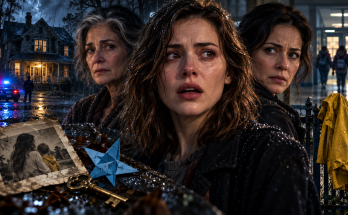
Three months later, I returned to Hawthorne Street in daylight.
The house looked smaller.
That was the first thing I noticed.
For twenty-two years it had existed in my memory as something enormous and lost, a whole childhood compressed behind one front door. But under a clear autumn sky, number forty-two was simply an aging two-story house with peeling shutters, damp gutters and a maple tree leaning too close to the roof.
Wren stood beside me on the sidewalk.
“Are we going in?”
“Yes.”
“Is anybody going to shoot at us?”
Celia closed her eyes.
“Wren.”
“What?”
“It’s a reasonable question,” I said.
Celia looked at me.
Then, reluctantly, laughed.
“No,” she told Wren. “Nobody is going to shoot at us.”
“Good.”
Wren walked up the steps.
She had a new backpack.
Purple again.
This time there was nothing sewn into the lining.
I had checked.
Twice.
Some habits would take time.
The criminal cases had expanded faster than anyone expected.
Malcolm Price survived surgery and was indicted on charges connected to conspiracy, kidnapping, obstruction, fraud and multiple homicides. Adrian Vale faced his own list of charges. Victor Hale entered a cooperation agreement and began identifying people whose names appeared in the archive.
Thomas Vance’s role was documented after his death.
The murder of Julian Cross was officially reopened.
So was Aaron Price’s.
Thirty-two custody cases became forty-seven.
Some of the children were adults now.
Some had never known their original identities.
Federal and state courts began the slow process of untangling records that had been designed to look legitimate.
Nothing about that process was clean.
Truth rarely restored the life that would have existed without the lie.
It only gave people the right to decide what to do once they knew.
Daniel was charged too.
Not with the crimes Price committed.
With his own.
Document fraud.
Obstruction.
Interference with parental rights.
His attorney believed prison was possible.
Daniel refused to contest the core facts.
When investigators asked why, he said the sentence I had heard first in the hospital cafeteria.
“I’m done asking other people to carry the cost of what I chose.”
I visited him once before his hearing.
We sat across from each other in a quiet room at the courthouse.
He looked older.
Not because three months had changed his face dramatically.
Because I was finally seeing him without childhood overlaid on top.
“Are you angry?” he asked.
“Yes.”
He nodded.
“Do you hate me?”
“No.”
That surprised him.
“It would be easier if I did.”
“I’m sorry.”
“I know.”
Silence.
Then he asked, “Do you still think of me as your father?”
I looked at him.
That was not a question anyone else could answer.
“Yes.”
His eyes filled.
“But not the way I did before.”
“I understand.”
“No, I don’t think either of us understands yet.”
He almost smiled.
“Fair.”
I reached across the table.
He took my hand.
“You’re my father because you raised me.”
A breath.
“And because I choose to call you that.”
Daniel nodded.
“That second part matters now.”
“It always should have.”
“Yes.”
I did not tell him everything would be fine.
It wouldn’t.
Consequences were not cruelty.
Forgiveness was not erasure.
Love did not cancel accountability.
Those distinctions had become necessary if we were going to build anything honest from what remained.
Eleanor chose not to move back into Hawthorne Street.
She could have.
The title had remained under a shell trust Daniel created years earlier, and after the investigations began, ownership was transferred legally into her name.
Instead, she gave me the house.
I refused at first.
Then accepted on one condition.
“No secrets.”
She smiled sadly.
“That excludes the basement.”
“Especially the basement.”
We hired contractors to remove the hidden shelves, repair the tunnel door and open every sealed wall cavity under police supervision.
Nothing important remained concealed.
For the first time, the house became only a house.
That mattered more than I expected.
Celia came almost every weekend.
At first our conversations were exhausting.
We had twenty-eight years of questions and almost no shared rhythm.
She talked too quickly when nervous.
I became sarcastic when overwhelmed.
We both hated olives.
We both reorganized kitchen drawers when angry.
Wren found this hysterical.
“You do the same mad cleaning.”
“We do not,” Celia and I said simultaneously.
Wren laughed so hard she nearly fell off her chair.
There were harder moments too.
One afternoon I asked Celia why she had never simply walked into my office after I became an adult.
She cried.
Then she answered.
“I was afraid you would reject me.”
It was the least heroic explanation she had ever given.
Also the most honest.
“That’s different from protecting me.”
“Yes.”
“So sometimes you stayed away for yourself.”
“Yes.”
I appreciated the truth.
It gave me room to be angry at the correct thing instead of an invented noble reason.
Another evening, Celia showed me a box of photographs.
Years of my life from a distance.
Graduation.
First office job.
Apartment move.
A charity 5K I barely remembered.
At first I felt violated.
Then sad.
“You stood this close?”
“Sometimes.”
“And never said anything.”
“No.”
“What did you think would happen?”
“I imagined every version.”
“Which one scared you most?”
She looked at me.
“That you would believe Daniel and call the police.”
I almost laughed.
“That probably would have happened.”
“I know.”
We both smiled.
The possibility no longer needed to be denied.
Eleanor joined us more slowly.
Her guilt was quieter than Celia’s.
She had not stolen me.
But she had participated in the silence.
We argued once in the kitchen.
She said she had believed disappearing would keep me alive.
I answered that staying dead in my mind had also taken something from me.
She listened.
Did not defend herself.
At the end, she said, “I wish I had trusted the woman you would become.”
That sentence stayed with me.
Not trusted the child.
The woman.
She and Celia had spent years imagining what I could handle without ever meeting the adult version of me.
Now they had to.
And I had to meet the real versions of them too.
Not martyrs.
Not villains.
Women who had been brave in some moments and afraid in others.
Michael moved near us after his release from protective custody.
He refused every suggestion that we call him Uncle Mike immediately.
“You don’t know me.”
Wren solved the problem.
She called him Michael until Christmas.
Then one morning she said, “Uncle Michael, can you open this?”
He stared at the jar in her hands as though she had handed him a medal.
Nobody mentioned it.
That was probably why he cried.
The recording Julian made became central evidence.
I listened to the full version once.
Only once.
Hearing my father’s voice—my biological father—was different from reading his letter.
Julian sounded younger than I expected.
More impatient.
More alive.
On the recording, Price told him to think about Celia.
Julian answered, “I am.”
Price told him to think about the child.
Julian answered, “That’s why I’m here.”
Then came the line Michael had warned me about.
Price said children grew into witnesses.
Julian replied:
“Then maybe you should be more afraid of what they grow into than what they remember.”
That sentence followed me for weeks.
Eventually I understood why.
Price’s whole system depended on controlling stories before children became adults capable of asking questions.
Who your parents were.
Why someone disappeared.
Why a court made a decision.
Why a house was sold.
Why a woman never came back.
He had counted on paperwork becoming memory.
He had almost succeeded.
Then Wren waited at school.
Seven years old.
Yellow raincoat.
Purple backpack.
Paper star.
The smallest person in the story broke the entire structure open simply because Celia taught her one thing Price never understood.
If something goes wrong, find Mara.
Our relationship confused people.
Even us.
Technically Wren was my half-sister through Celia.
For a while she called me Mara.
Then sometimes Sis.
Once, while tired, she called me Mom.
She froze afterward.
So did I.
Celia heard.
Nobody laughed.
Wren whispered, “Sorry.”
I crouched.
“You don’t have to be sorry.”
“Was that bad?”
“No.”
“Should I call you that?”
The question caught me completely unprepared.
I looked at Celia.
She did not interfere.
That mattered.
I turned back to Wren.
“You can call me Mara.”
She frowned.
“Only Mara?”
“For now.”
“Can I call you Sis when I want?”
“Yes.”
“And Mara when I’m mad?”
“Apparently.”
She smiled.
The answer was imperfect.
Which made it ours.
I did not become Wren’s mother.
Celia remained her mother.
I became something else.
Her sister.
Her emergency contact.
The person she called when Celia said no to dessert.
The person who checked under her bed when storms were loud.
The person she knew would come if school called.
That last part mattered most.
The first time Alder Creek Elementary called me again, six months had passed.
My phone rang while I was standing in the renovated kitchen at Hawthorne Street.
I almost stopped breathing when I saw the school number.
Then I answered.
“This is Mara Bell.”
“Hi, Ms. Bell. This is Alder Creek Elementary.”
My heart accelerated.
“Is Wren okay?”
“She’s fine.”
I closed my eyes.
The secretary laughed gently.
“She forgot her science project.”
I leaned against the counter.
Of course she had.
“What science project?”
“A model volcano.”
I looked toward the dining room.
A papier-mâché mountain sat on the table beside two bottles of food coloring.
“Found it.”
“Could someone bring it before eleven?”
“Yes.”
“Thank you.”
The call ended.
I stood there holding the phone.
Ordinary.
It was so ordinary I nearly cried.
Celia entered carrying groceries.
“What happened?”
“School called.”
Her face went white.
“Wren?”
“She forgot her volcano.”
Celia stared.
Then laughed.
I started laughing too.
Eleanor came in from the porch.
“What?”
“Emergency.”
“What kind?”
“Baking soda.”
She shook her head.
“You two are impossible.”
Maybe.
But we were there.
That was the difference.
Not hidden.
Not presumed dead.
Not watching from across parking lots.
There.
On the anniversary of Julian’s death, we went to his grave.
Celia had avoided it for decades.
This time she brought Wren.
Michael came too.
I stood before the stone with Julian’s letter in my coat pocket.
For years the grave had been only a name connected to a story I had not known belonged to me.
Now I knew enough.
Not everything.
Probably never everything.
That no longer felt unbearable.
Celia touched the stone.
“You would hate what all of us did.”
Michael laughed softly.
“He would have opinions.”
“I remember.”
Then she looked at me.
“He would love you.”
I did not answer immediately.
People had told me what dead people would think before.
I had learned to resist easy certainty.
So I said, “I think I would have liked him.”
Celia smiled.
“That’s enough.”
We left flowers.
Yellow ones.
Eleanor’s favorite.
Another contradiction.
Another connection.
Our family had become full of them.
A year after the night at Alder Creek, Daniel received a reduced sentence after cooperating extensively with investigators and helping authenticate old Hale security records.
I visited him regularly.
Not every week.
Not because I owed him.
Because I wanted some relationship with the person who raised me.
It became quieter.
More honest.
He stopped saying, “I was trying to protect you.”
Instead he said, “I was afraid.”
The first time he used that sentence, I believed we might actually know each other someday.
Price’s convictions came later.
Vale’s too.
Hale testified.
Cases involving the custody network continued for years.
Some families reunited.
Some chose not to.
Some discovered biological relationships they did not want.
Others found answers too late to change anything.
I followed those cases carefully without pretending every truth created a happy ending.
Truth simply returned choice.
Sometimes that was enough.
On the second autumn after everything changed, Wren asked if we could repaint the basement wall.
The blue one.
The height marks were still there.
Mara — 6 years.
Wren — 7 years.
I hesitated.
“Do you want them gone?”
“No.”
“What do you want?”
“More.”
Celia brought a pencil.
Eleanor brought a ruler.
Wren stood against the wall.
Nine years.
We marked the line.
Then Wren pointed at me.
“You.”
“I’m twenty-nine.”
“So?”
“That’s not how height walls work.”
“It is now.”
She insisted.
I stood against the wall.
Celia marked my height.
Then hers.
Eleanor’s.
Michael’s.
Eventually even Daniel’s measurement was added when he came home.
The wall stopped being evidence.
It became history.
Not the kind hidden behind a furnace.
The kind people wrote in the open.
One evening, after everyone left, I stayed alone in the basement.
The house above me creaked gently.
Rain tapped the small window near the ceiling.
For years, rain had belonged to one terrible evening.
A school office.
A frightened child.
A photograph of a woman I thought was dead.
Now it sounded different.
Just weather.
I ran my fingers over the pencil mark beside my six-year-old name.
I could not recover every memory.
I no longer wanted to force them all.
Some belonged to the child I had been.
Some had been reshaped by fear.
Some would always remain missing.
But missing was different from stolen now.
Nobody was actively keeping the truth from me.
That distinction gave the gaps room to exist.
Upstairs, the front door opened.
Wren shouted, “Mara!”
I smiled.
“What?”
“You promised movie night!”
“I’m coming.”
“You said that five minutes ago!”
“I said one minute.”
“That’s worse!”
I climbed the stairs.
At the top, I looked back once.
The basement light illuminated the height marks.
My name.
Wren’s.
Celia’s.
Eleanor’s.
Michael’s.
Daniel’s.
No secret compartment.
No hidden box.
No false wall.
Just names.
I turned off the light.
Then I went upstairs to the family I had not known I had, the father who had loved me badly but was learning to love without controlling, the women who had finally stopped disappearing, and the little girl who had waited at school because she believed I would come.
She had been right.
The End
Read more original stories on Feel Every Story.
A School Secretary Called About the Daughter I Had Never Met, and Somehow the Little Girl Already Knew My Name
Part 15 of 15