
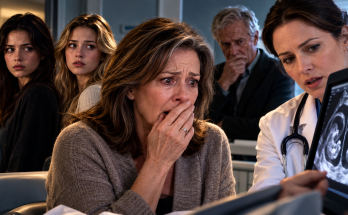
I stared at the ultrasound screen until the shapes blurred.
Dr. Evans moved the cursor and enlarged another section. “There may also be evidence of instrumentation here. Imaging isn’t enough to tell us exactly what happened, but this is not what I would expect from someone with the history you’ve given me.”
“I gave birth to Jake.”
“Years before 2008.”
“Yes.”
“No other pregnancies?”
The question landed strangely.
“Not that I knew of.”
Dr. Evans looked at me over the rim of her glasses. “No miscarriages?”
“No.”
“Termination?”
“No.”
“Dilation and curettage? Laparoscopy? Treatment for an ectopic pregnancy?”
“No. Nothing.”
She checked the chart again.
I could hear the ventilation system overhead and a cart squeaking somewhere beyond the examination-room door. My heartbeat seemed louder than both.
“You were hospitalized in March 2008,” she said.
“Yes.”
“For an overdose?”
I flinched at the clinical bluntness of the word.
“Yes.”
“Do you remember what treatment you received?”
“They pumped my stomach. I was sedated. I stayed a couple of nights.”
Dr. Evans’s fingers stopped above her keyboard.
“A couple?”
“I think two.”
She studied the electronic summary.
“The old record imported into our system is unusually sparse. It says medication ingestion, stabilization, psychiatric evaluation. There’s no operative detail here.”
“Because there wasn’t an operation.”
She did not answer.
My hands became cold.
“Dr. Evans?”
“I want the original records.”
The room seemed to shrink around me.
“What are you saying?”
“I’m saying your imaging suggests something happened that isn’t reflected in the history available to me.”
I shook my head automatically. “Michael would have told me.”
Even as I said it, I remembered the nurse.
The look she had given him.
Michael’s calm interruption.
Dr. Evans watched my face change.
“You remembered something.”
“I don’t know.”
“Tell me anyway.”
I described the hospital in fragments. The white ceiling. The abdominal pain. Michael beside me. A nurse whose expression had seemed almost angry. Michael telling her I was confused.
“Do you remember signing consent forms?”
“No.”
“Were you conscious the entire admission?”
“Absolutely not.”
Dr. Evans leaned back.
“Then we need documentation before drawing conclusions.”
I gripped the edge of the paper sheet beneath me.
“Could someone operate on me while I was unconscious?”
“In an emergency, treatment can sometimes proceed under specific legal and medical circumstances. But that does not mean you should have been left unaware afterward.”
“So you think I had surgery.”
“I think your body gives us reason to ask.”
The distinction did not comfort me.
I dressed with clumsy hands. Before I left, Dr. Evans printed instructions for obtaining archived hospital records and scheduled further evaluation. At the door, she stopped me.
“Susan.”
I turned.
“Try not to confront anyone until we understand what the evidence actually says.”
Anyone.
She did not say Michael.
She did not need to.
I drove home with the radio off. The route took forty minutes, past the elementary school where Jake had once played baseball, the grocery store Michael and I had used since our twenties, and the church where we had renewed nothing but appearances every Sunday.
At a traffic light, I pressed my palm against my lower abdomen.
There was no pain now.
Only memory.
I tried to reconstruct the days after the overdose.
Michael had brought me home himself. He had made soup I barely ate. He had placed my medication beside a glass of water each morning. When I asked why my abdomen hurt, he said the hospital treatment had been rough on me.
I had believed him because I had already lost the right, in my own mind, to question his kindness.
That thought unsettled me more than the scar tissue.
Michael’s truck was in the driveway when I arrived.
He had retired two years before me and had settled into a routine of repairing things that were not broken. Hinges. Fence panels. Drawer tracks. The old mower. He seemed happiest when dealing with objects that obeyed predictable rules.
I found him on the back porch sanding the arm of a wooden chair.
His hair had become nearly white. At seventy-one, he was leaner than he had been in 2008, but his hands remained steady.
“You’re late,” he said.
“I had the doctor.”
“Evans?”
I stopped inside the doorway.
“How did you know?”
“You mentioned it at breakfast.”
I had.
The fact that I had forgotten showed how scattered I already was.
Michael set down the sandpaper.
“Everything all right?”
“No.”
His eyes sharpened.
“What happened?”
I put my purse on the counter because my fingers had begun trembling.
“She found something during the ultrasound.”
He stood.
“What?”
“Scarring.”
There was a pause.
Tiny.
Almost nothing.
But after eighteen years of watching a man who hid emotion behind stillness, I saw it.
His face emptied.
“She thinks I had a procedure.”
Michael looked toward the yard.
“What kind?”
“I don’t know.”
“Then don’t frighten yourself until you do.”
The familiar calmness suddenly enraged me.
“She asked about 2008.”
His thumb moved across his wedding ring.
Once.
Twice.
A nervous habit I had seen throughout our marriage.
“Why would she ask about that?”
“Because that’s apparently when something happened.”
He picked up the sandpaper again.
“You were hospitalized. Bodies go through trauma.”
“Michael.”
He kept his eyes on the chair.
“She specifically asked whether I’d ever had surgery.”
“You told her no?”
“Yes.”
He rubbed the same patch of wood despite its already smooth surface.
“Then perhaps the imaging is unclear.”
“Was I operated on?”
His hand stopped.
The porch seemed very quiet.
“Why would you think that?”
“Because my doctor thinks it.”
“She doesn’t know.”
“She knows there are scars.”
Michael placed the sandpaper down with deliberate care.
“Susan, medical technology sees things now that no one understood years ago.”
I almost accepted that answer.
For eighteen years, accepting Michael’s answers had become instinct.
Then I saw the hospital nurse again in my mind.
“She tried to tell me something.”
His eyes snapped toward mine.
“Who?”
“A nurse.”
“When?”
“In 2008.”
His face changed.
There it was again.
Fear.
Not anger.
Not the old contempt I had imagined behind his distance.
Fear.
I stepped closer.
“What happened to me?”
“Nothing you need to worry about.”
My stomach twisted.
“That isn’t an answer.”
“I’m saying there is no benefit in dragging everything from that year back into this house.”
“That year never left this house.”
He flinched.
I continued before courage failed me.
“It has slept in our guest room for eighteen years. It has eaten dinner across from me. It has come to every birthday and funeral and Christmas. So don’t tell me 2008 is buried.”
Michael’s jaw tightened.
“I don’t want to fight.”
“Neither do I. I want the truth.”
He turned away.
I followed him into the kitchen.
“You told me the hospital pumped my stomach.”
“They did.”
“And nothing else?”
He opened the refrigerator.
“There’s leftover chicken.”
I stared at him.
“Michael.”
He reached for a container.
“Are you hungry?”
“No.”
He closed the refrigerator harder than necessary.
“What exactly do you want me to say?”
“I want you to look at me and tell me I never had surgery.”
He did not.
The silence between us changed shape.
For almost two decades, silence had meant accusation.
Now it sounded like concealment.
“Michael.”
His shoulders sagged.
“She doesn’t know what she saw.”
“That isn’t what I asked.”
He finally looked at me.
I had seen grief in his face when his mother died. Pride when Jake graduated. Exhaustion during long work projects. Cold fury after discovering my affair.
I had never seen this.
He was afraid of me asking the correct question.
“What happened in the hospital?” I whispered.
Michael rubbed his ring again.
Then, almost to himself, he said, “Why now?”
Every hair on my arms lifted.
“What?”
He closed his eyes.
I stepped backward.
“You know.”
“No.”
“You do.”
“Susan—”
“You know exactly what she found.”
“I didn’t say that.”
“You didn’t need to.”
He walked past me toward the hallway.
I caught his sleeve.
He stopped but did not face me.
“Did you authorize something while I was unconscious?”
His entire body went rigid.
That was answer enough.
I let go.
Michael continued upstairs without another word.
I remained in the kitchen until darkness filled the windows.
At dinner, he did not come down.
At ten, I heard his bedroom door close.
At midnight, I was still sitting on the couch with the archived-record instructions Dr. Evans had given me.
At 2:13 a.m., one thought finally became impossible to ignore.
Before 2008, Michael and I had kept every important document together.
Taxes.
Insurance.
Jake’s school records.
Medical bills.
After 2009, Michael began keeping his study locked.
I had never questioned why.
Perhaps because guilt teaches you not to ask where another person keeps the evidence against you.
I went downstairs barefoot.
The study door waited at the end of the hall.
Moonlight lay across the floorboards.
I wrapped my hand around the brass knob.
To my surprise, it turned.
Michael had left the door unlocked.
Inside, dust and paper gave the room the dry smell of forgotten years. I switched on the desk lamp and opened the metal filing cabinet.
Tax returns.
Property records.
Insurance policies.
Then, at the bottom, a thick folder.
2008 — MEDICAL.
I pulled it free.
The first sheet was my hospital discharge summary.
Admission: March 14, 2008.
Discharge: March 19, 2008.
Five days.
I sat down hard in Michael’s chair.
He had told me two nights.
I turned the page.
Medication records.
Laboratory results.
Anesthesia.
My breath stopped.
Anesthesia?
Then I found the line Dr. Evans had suspected existed.
Exploratory laparoscopic surgery.
For several seconds, I simply stared.
My husband had not merely withheld an explanation.
He had erased three days and an operation from my memory of my own life.
And somewhere upstairs, he was sleeping less than fifty feet away.
Click here to continue reading: PART 3: In Michael’s Locked Files I Found a Consent Form Bearing My Name, but the Signature Beneath It Was Not Mine
For Eighteen Years My Husband Slept Across the Hall, Until One Routine Question Made Our Silence Feel Suddenly Dangerous
Part 2 of 15


One Comment on “PART 2 – The Ultrasound Showed Scars I Could Not Explain, and Michael’s Old Hospital Story Began Falling Apart Piece by Piece”