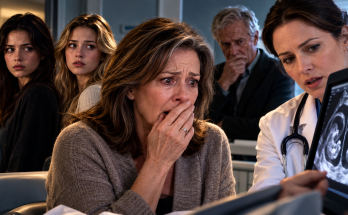
The courtroom was smaller than I expected.
After decades of hidden accounts, falsified medical records, stolen identities, surveillance, threats, and children moved between families, I imagined the truth deserved marble columns and rows of witnesses.
Instead, we sat beneath fluorescent lights while a judge adjusted reading glasses and reviewed documents in silence.
Jake sat to my left.
Lily and Emma beside him.
Michael sat to my right.
Not touching me.
Close.
The blue ledger rested in an evidence box on the clerk’s table.
My father’s final codicil lay beside it.
Martin Cole appeared by video from custody.
Price had waived appearance after his attorney requested additional medical evaluation.
Margaret sat behind her lawyer with her injured arm still supported.
Daniel was not present.
The judge spoke for almost forty minutes.
Most of it was technical.
Jurisdiction.
Asset control.
Beneficiary verification.
Forensic release requirements.
Challenges filed by shell corporations connected to Cole.
Objections from parties whose names appeared in the blue ledger.
Then came the sentence we had been waiting for.
“The conditions established in the authenticated codicil have been satisfied.”
I heard Lily inhale beside Jake.
The judge continued.
“The forensic accounting records shall be released to the relevant investigative authorities and made available to affected beneficiaries subject to existing privacy restrictions.”
Cole closed his eyes on the screen.
The truth was no longer dependent on a hidden folder in a study.
No longer dependent on Michael deciding whether I could survive knowing.
No longer dependent on Margaret’s fear.
No longer dependent on Claire running.
The records were now evidence.
Public process.
Something no single frightened person could bury.
Provisional control of the family trust passed into court-supervised administration with me as lead family representative and all three children listed as verified beneficiaries.
Jake whispered, “Lead family representative sounds dangerous.”
Emma elbowed him.
Lily laughed under her breath.
The judge looked over her glasses.
The three of them immediately became serious.
I nearly smiled.
Outside the courthouse, reporters waited.
Someone had already leaked enough of the case to attract national attention.
Medical consent violations.
Secret fertility procedures.
A financial trust.
Kidnapped twins.
A doctor living under false identities.
It contained every ingredient journalists loved.
Ruiz had warned us.
“You do not owe anyone your trauma.”
So we walked past.
One reporter shouted my name.
Another asked whether I planned to sue the hospital network.
Another asked whether I blamed my husband.
That question stopped me for half a second.
Michael noticed.
He did not touch my arm.
Did not guide me away.
Did not answer for me.
He waited.
I kept walking.
That was the first answer I gave.
Later, there would be civil lawsuits.
The original hospital had changed ownership twice, but successor entities faced claims tied to record destruction and supervisory failures.
The clinic’s insurers fought responsibility.
Price’s attorneys disputed nearly everything.
Cole offered cooperation in exchange for reduced charges.
Margaret pleaded guilty to offenses connected to falsified guardianship records and concealment.
Her sentence took into account her cooperation and the evidence that she had protected Lily from Robert Harris after the original conspiracy began to fracture.
None of the outcomes felt completely satisfying.
Real life rarely produces one punishment proportionate to twenty different harms.
Claire’s case produced the result Emma needed most.
Investigators proved her vehicle had been deliberately tampered with.
A mechanic connected to Cole admitted receiving payment.
Cole denied ordering her death.
The evidence said otherwise strongly enough for prosecutors to add charges.
Emma sat beside me when Ruiz told us.
“She wasn’t careless,” Emma whispered.
“No.”
“I spent six years thinking maybe she was tired.”
“She was protecting you.”
Emma cried then.
Not quietly.
Not neatly.
I held her.
At first her body remained rigid.
Then she leaned against me.
I did not tell myself this made me her mother.
I did not need the title in that moment.
She needed arms.
I had them.
Lily returned to university the following semester.
She changed majors from biology to social work.
When I asked why, she shrugged.
“I’ve had enough laboratories.”
Then she smiled.
“I want to help kids who grow up with adults making decisions around them instead of with them.”
I understood.
Jake continued working at his firm.
His relationship with Emma became a source of painful humor only after enough time had passed.
They had never lived together or planned marriage, and neither carried blame for a truth deliberately hidden from them.
One night, Jake groaned and said, “I’m going to need a therapist with a specialty nobody has invented.”
Emma replied, “Ask for the family-disaster package.”
Lily nearly fell off the sofa laughing.
That was how healing often arrived.
Not as wisdom.
As laughter in a room where something terrible had once been unspeakable.
Daniel received prison time.
Less than he might have faced without cooperation.
More than he hoped.
Before sentencing, he wrote me a letter.
I almost threw it away.
Instead, I read it once.
He did not ask for forgiveness.
That helped.
He wrote that he had spent his life believing being wronged gave him permission to wrong someone else.
It did not.
He wrote that the only useful thing he could do now was tell the complete truth wherever prosecutors asked.
At the end he wrote:
I am sorry that I entered your life as a lie and left you carrying one.
I placed the letter in a drawer.
Not beside family photographs.
Not in the trash.
Somewhere in between.
Margaret and Lily continued speaking.
At first, I did not understand how Lily could want that.
Then I remembered that Margaret had been her mother in every practical sense for eighteen years.
Fevers.
School mornings.
Birthdays.
Bad dreams.
Surgeries.
College applications.
A crime had begun the relationship.
Love had grown inside it anyway.
Both could be true.
One afternoon, Lily asked whether it bothered me.
“Yes.”
She looked worried.
I continued.
“But that doesn’t mean you should stop.”
Relief changed her face.
“Really?”
“She raised you.”
“She took me.”
“Yes.”
“She loved me.”
“I believe that too.”
Lily looked down.
“I don’t know what to call her now.”
“You don’t have to decide for anyone else.”
She smiled.
“No more invented choices?”
“Exactly.”
Emma kept Claire’s surname.
I never asked whether she would change it.
Lily kept Harris too.
At first, Michael seemed surprised.
Then he understood.
Names were not proof of loyalty.
They were evidence of lives already lived.
The trust eventually funded restitution payments where the courts allowed, legal costs, medical support, and education.
My children each retained their lawful portions.
None became a different person overnight.
Money was no longer permitted to become mythology.
We hired professionals.
We held meetings.
We documented everything.
Jake complained endlessly about spreadsheets.
Emma secretly enjoyed them.
Lily doodled in the margins.
I chaired the meetings because apparently surviving a thirty-year conspiracy qualified me for administration.
Michael attended only when invited.
That mattered.
He had finally learned the difference between helping and taking control.
Our marriage was harder.
There was no judge who could declare the conditions satisfied.
No DNA report could tell us what belonged together.
For months, Michael remained in the guest room.
We attended counseling.
Together this time.
The first session was almost unbearable.
The therapist asked, “Why did you stay married?”
Michael answered first.
“Jake.”
I said, “Fear.”
Then he added, “Love.”
I looked at him.
The therapist asked me the same.
I thought longer.
“Shame.”
Michael’s face tightened.
Then I added, “And love too.”
That was the problem.
Love had survived beneath too many ugly things.
Neither of us knew what form it deserved now.
In counseling, Michael admitted that after discovering the affair, he wanted me to hurt.
Not die.
Not disappear.
Hurt.
His refusal to touch me had begun as punishment before Price’s threats turned distance into strategy.
Hearing him say it wounded me.
It also freed me from rewriting him into a saint.
He was not.
Neither was I.
I told him that Ethan had made me feel visible at a time when I resented Michael for being absorbed in work and Jake’s departure.
I admitted that I had liked being wanted.
I had lied because I did not want to give up either life.
No conspiracy erased that.
No manipulated pregnancy absolved it.
Michael listened.
Then he said, “I wish you had told me you were lonely.”
“I wish you had noticed.”
“I did.”
That surprised me.
“Then why didn’t you say anything?”
“I thought marriage meant giving each other space.”
I laughed bitterly.
“We were excellent at space.”
He smiled sadly.
“Yes.”
Some sessions ended with us angry.
Some ended in silence.
Some ended with coffee afterward.
Nothing dramatic.
No sudden reunion.
Then, almost a year after Dr. Evans found the first scar, Michael knocked on my bedroom door.
He had knocked before.
That was another new habit.
“Come in.”
He opened the door.
He wore an old blue shirt I remembered from vacations when Jake was young.
“I made tea.”
“Is that a proposal?”
“No.”
“Good.”
He smiled.
Then he remained by the door.
“What?”
“I wanted to ask something.”
“Ask.”
“Can I sit here?”
He pointed to the edge of the bed.
For eighteen years, the bed had belonged to the version of us that no longer existed.
I looked at the space.
“Yes.”
He sat.
Not too close.
He handed me tea.
We talked about Lily’s classes.
Emma’s new job.
Jake’s complaint that his neighbor’s dog barked at six every morning.
Normal things.
Then silence came.
Michael looked at his hands.
“I don’t know how to do this.”
“Neither do I.”
“I’m afraid touching you will feel like pretending nothing happened.”
“It won’t.”
“How do you know?”
“Because I remember all of it.”
He looked at me.
“So do I.”
I set down my cup.
“We don’t have to restore what we had.”
“No.”
“We can decide whether there is something new.”
His eyes filled.
“That sounds terrifying.”
“It is.”
I held out my hand.
He stared at it.
Then placed his hand in mine.
His palm was warmer than I remembered.
Or perhaps I had forgotten.
We sat that way for several minutes.
Nothing more.
It was enough.
Weeks later, he moved one drawer of clothes into my room.
Not all of them.
One.
I laughed when I saw it.
“Ambitious.”
“I’m pacing myself.”
“Good.”
He still kept the guest room.
Sometimes he slept there.
Sometimes beside me.
The first night we shared the bed, we did not have sex.
We talked until after midnight.
Then Michael fell asleep facing me.
I remained awake for a while, listening to his breathing.
For years, I had imagined that intimacy would return as proof of forgiveness.
It did not.
It returned as permission.
Mine.
His.
Freely given.
When we eventually touched each other as husband and wife again, there was no dramatic music, no perfect reconciliation, no sense that eighteen years had vanished.
They had not.
The lost years stayed lost.
But they no longer controlled the years ahead.
On the anniversary of the day Dr. Evans asked that first uncomfortable question, all three children came to the house.
Jake brought too much bread.
Emma brought wine.
Lily brought a framed photograph.
It showed the five of us by the river after one of our lunches.
Michael stood beside me.
Jake between his sisters.
Everyone looked slightly uncomfortable.
Everyone looked real.
Lily handed me the frame.
“I thought you needed one family picture where everyone knows who everyone is.”
I laughed so hard I cried.
Michael hung it in the hallway.
Not beside our wedding portrait.
Beneath it.
Both stories belonged there.
That evening, after the children left, I walked onto the back porch.
The wooden chair Michael had sanded nearly to death finally looked finished.
He sat in the other one.
I lowered myself beside him.
The maple tree moved gently in the dark.
“Do you regret staying?” I asked.
Michael thought.
“Sometimes.”
I laughed.
“Terrible answer.”
“You asked for truth.”
“I did.”
He looked at me.
“Do you?”
“Sometimes.”
He nodded.
Fair.
Then I said, “I’m glad we’re here.”
“So am I.”
He reached for my hand.
This time, he did not hesitate.
Neither did I.
For eighteen years, I had believed our marriage ended the night Michael discovered my affair.
I was wrong.
It had changed.
Then hardened.
Then become trapped beneath fear, punishment, secrecy, and choices neither of us knew how to undo.
Dr. Evans had found scars in my body.
What followed uncovered scars everywhere else.
Some had been inflicted on me.
Some I had inflicted on others.
Some Michael had created trying to protect what he loved.
None disappeared because the truth came out.
Truth does not erase scars.
It tells you where they came from.
It lets you stop calling an old wound a mystery.
And sometimes, if the people involved are willing to live without invented choices, secret protections, and convenient lies, truth gives them something scars alone never can.
A future that belongs to them.
Michael squeezed my hand.
Inside the house, Lily’s family photograph caught the light from the hallway.
Three children.
Two parents.
Thirty years of marriage.
Eighteen years without touch.
And finally, no hidden room left unopened.
The End
Read more original stories on Feel Every Story.
For Eighteen Years My Husband Slept Across the Hall, Until One Routine Question Made Our Silence Feel Suddenly Dangerous
Part 15 of 15