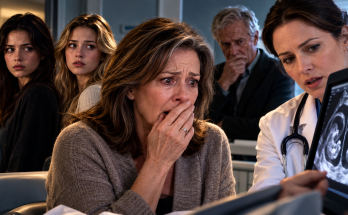
I did not remember sitting down.
One moment I was standing beside Michael’s desk with my father’s letter in my hand. The next I was in the chair, staring at a sentence that had split eighteen years of memory into two versions.
The child survived.
“Tell me that doesn’t mean what it says.”
Michael remained near the filing cabinet.
“I can’t.”
“You knew?”
“I knew there were questions.”
“Stop.”
He fell silent.
I stood again.
“No more careful words. No more ‘questions,’ ‘suspicions,’ or ‘I thought.’ You knew enough to hide this letter. You knew enough to lock these records away. So tell me what you know.”
Michael nodded slowly.
“All right.”
He pulled out the opposite chair.
“Sit.”
“I’m done sitting while you decide what I’m allowed to hear.”
His expression tightened, but he did not argue.
“After you were admitted, bloodwork showed the pregnancy.”
“I understand that.”
“They believed you were about eight weeks along.”
“My father’s letter says the child survived.”
“I know.”
“Eight-week pregnancies do not turn into living children after surgery.”
“No.”
“So something is wrong.”
“Yes.”
The word chilled me.
Michael opened another file.
“The original records contain contradictions. Dates that don’t align. Lab values that appear under different timestamps. Notes referring to examinations that aren’t included in the file.”
“You knew this in 2008?”
“Not all of it. I found pieces over the years.”
I looked at the papers.
“Start at the beginning.”
He rubbed both palms over his face.
“The night you overdosed, Dr. Harris told me there was abdominal bleeding. He said they needed to operate and that the pregnancy was unlikely to survive.”
“And I was unconscious.”
“Yes.”
“You signed.”
“Yes.”
“What happened during surgery?”
“I still don’t know exactly.”
My anger surged.
“You expect me to believe that?”
“I have tried for eighteen years to find the complete operative report.”
“Why isn’t it here?”
“Because pages disappeared.”
“From your copy?”
“From the hospital archive too.”
He showed me a request dated years earlier, followed by correspondence stating that some records from my admission could not be located.
I recognized Michael’s methodical handwriting in the margins.
Names.
Dates.
Telephone numbers.
He had been investigating privately for years.
“You never stopped looking.”
“No.”
“Yet you stopped speaking to me.”
His eyes met mine.
“I thought the less you knew, the safer you were.”
“That excuse is beginning to sound very convenient.”
“I know.”
He opened a second folder.
Inside was a birth record.
The name printed across it was Lily Harris.
Date of birth: October 29, 2008.
I stared at the month.
“October.”
Michael nodded.
“That’s seven months after the hospital.”
The dates would have been roughly consistent with a pregnancy beginning before March, but not with the eight-week timeline I had been given.
I read the certificate.
Birth mother: unknown.
Father: unknown.
“This proves nothing.”
“No.”
“Then why do you have it?”
“Because of who raised her.”
My stomach tightened before he spoke.
“Dr. Harris.”
The room became silent.
I looked at the name again.
Lily Harris.
The doctor who had operated on me had raised a girl born months after my hospitalization whose biological parents were not listed.
“Did he adopt her?”
“There’s no ordinary adoption record that I could find.”
“Then how did she become his child?”
“I don’t know.”
“You said you investigated.”
“I said I tried.”
I threw the certificate onto the desk.
“Eighteen years, Michael.”
His face hardened.
“You think I don’t know how long it’s been?”
“I think you became comfortable deciding what truths everyone else could survive.”
He absorbed that without answering.
I picked up the certificate again.
“Is Lily mine?”
“I don’t know.”
My eyes burned.
“That is not acceptable.”
“I can’t manufacture certainty.”
“Did you ever see her?”
“Yes.”
The answer came too quickly.
I stared at him.
“When?”
“From a distance.”
“How old?”
“Six, the first time.”
The room seemed to lose air.
“You saw a six-year-old girl you thought might be my daughter and came home to me without saying a word.”
Michael looked down.
“Yes.”
“Again?”
“Several times.”
I gripped the desk.
“How many?”
“I don’t know.”
“You know.”
“A dozen, maybe more.”
I covered my mouth.
For years Michael had returned from supposed errands, work trips, and long drives while carrying knowledge that somewhere nearby a child might be mine.
“Where is she now?”
“I don’t know exactly.”
“You’re lying.”
“I know the university she attends.”
I stared at him in disbelief.
“You know where she goes to school.”
“Yes.”
“And you still say you don’t know where she is?”
“I stopped following her directly after someone broke into the house.”
“When?”
“2011.”
I remembered that incident. Michael had told me a basement window probably had been forced by teenagers. Nothing was taken, and police found little evidence.
“There was another break-in,” he continued. “2016.”
That one I did not remember.
“When?”
“You were visiting Jake.”
“What was stolen?”
“Your father’s files.”
A slow chill spread through me.
“What files?”
“Financial papers, correspondence, trust documents.”
“Trust?”
Michael hesitated.
I pointed at him.
“Don’t.”
He nodded.
“Your father apparently created a financial trust before his death.”
“For me?”
“Partly.”
I laughed in disbelief.
“My father could barely explain his taxes without getting angry. You’re telling me he secretly created some elaborate trust?”
“He owned assets you never knew about.”
“How much?”
“I don’t know the current value.”
“How much originally?”
“Enough to attract people who were willing to manipulate medical records.”
That stopped me.
I thought of Daniel.
Ethan.
Whatever name he had used.
“He approached me for money?”
“Possibly.”
“Then why hide his identity?”
“Because the trust had conditions.”
Michael removed a photocopy of a handwritten note.
The paper contained three lines in my father’s unmistakable block script.
The account is not in Susan’s name.
The child is the key.
Never trust Harris.
I read the note several times.
“The child.”
Michael nodded.
“He wrote this before I was pregnant?”
“I don’t know exactly when he wrote it.”
“How could he know?”
“That’s one of the questions I could never answer.”
“Unless he meant Jake.”
“I thought that too.”
“Does Jake have access to the trust?”
“No.”
“Then why write child?”
Michael had no answer.
I returned to Lily’s birth certificate.
“Why Harris?”
“Dr. Harris and his wife raised her.”
“His wife?”
“Margaret.”
I repeated the name silently.
“Is she alive?”
“As far as I know.”
“And Dr. Harris?”
“Dead. About twelve years.”
I felt an irrational flash of rage toward a dead man.
He had taken whatever answers he possessed with him.
“Does Margaret know about me?”
Michael’s pause was enough.
“Yes.”
I stepped toward him.
“You spoke to her.”
“Once.”
“When?”
“Years ago.”
“What did she say?”
“She told me to stop looking.”
“Why?”
“She said there were people who still had an interest in your father’s estate.”
“Who?”
“She wouldn’t tell me.”
“And you obeyed her?”
“Not immediately.”
Michael walked to the window.
“My car was followed for weeks. Then someone sent photographs of Jake.”
My anger collided with fear.
“Again?”
“Yes.”
“Why didn’t you call the police?”
“I did after the first incident. There was nothing actionable. No names. No clear threats in writing. Whoever was doing it knew exactly how far to go.”
I thought about Jake as a college student, then a young professional, unaware that his father believed someone was tracking him because of a trust created by a grandfather he barely remembered.
“How many lies are inside this family?”
Michael looked at me.
“More than there should be.”
At sunrise I called Dr. Evans.
I told her I had found the hospital records, surgical documentation, and evidence that my admission lasted five days rather than two.
She asked me to bring everything.
Then I told her about the pregnancy.
Dr. Evans went quiet.
“Who told you?”
“My husband.”
“Does the hospital record confirm it?”
“Partially.”
“Bring every page.”
“There’s also a birth certificate.”
This time the silence lasted longer.
I explained Lily’s birth date without mentioning the trust or surveillance.
Dr. Evans carefully separated medicine from speculation.
“If you were truly eight weeks pregnant in March, a pregnancy could not have been removed and then somehow continue elsewhere. That would not be medically plausible.”
“So Lily can’t be mine.”
“I did not say that.”
I tightened my grip on the phone.
“What are you saying?”
“I’m saying one of your premises may be wrong.”
“The dates?”
“The gestational age. The procedure description. The identity associated with records. We need originals.”
Two days later she called after reviewing what I brought.
Several pages were missing from the operative report.
There was evidence of uterine intervention.
There was documentation strongly suggesting pregnancy.
But the timeline was inconsistent.
“The eight-week estimate may not be reliable,” she said.
“How wrong could it be?”
“That depends on whether the record itself was altered.”
The word altered left me cold.
Someone had changed my medical history.
Not misunderstood it.
Changed it.
When I returned to the living room after the call, Michael was gone.
His truck was missing.
His phone went directly to voicemail.
Then a message appeared on mine.
Do not come looking for me.
A second followed.
They know you found the records.
My heart began pounding.
Then:
Go to the old hospital.
Basement. Room 14.
I called him again.
Nothing.
Dr. Evans had specifically warned me not to confront anyone alone.
For eighteen years I had obeyed warnings.
This time, I took my keys.
The hospital had expanded since 2008, but an older basement corridor remained behind a service stairwell. Room 14 was at the far end.
Locked.
I tried the handle.
Then noticed an envelope taped beneath the door.
SUSAN.
Inside was a key and one sentence.
You deserve the truth, but after this you cannot return to not knowing.
I unlocked the door.
Rows of boxes filled the dark room.
Medical files.
Photographs.
Patient records.
On the far wall was a corkboard.
My name occupied the center.
Around it were dates spanning eighteen years.
2008.
2010.
2014.
2018.
2023.
Photographs showed me leaving school, carrying groceries, attending Jake’s graduation, sitting on my porch.
Someone had documented my life.
Then I saw another photograph.
A young woman stood outside a university building.
Dark hair.
Brown eyes.
A small birthmark near her left eyebrow.
My fingers rose involuntarily to the identical mark on my own face.
Beneath her photograph was a name.
LILY HARRIS.
I moved closer.
She had my father’s eyes.
My mother’s smile.
My knees weakened.
Then a woman’s voice came from behind me.
“You finally found her.”
I spun around.
A woman in her sixties stood in the doorway holding an old gold ring.
I knew the ring immediately.
My father’s wedding band.
“How did you get that?”
The woman closed the door.
“Your father gave it to me.”
My throat tightened.
“Who are you?”
“Margaret Harris.”
I stared at her.
“Dr. Harris’s wife.”
“Widow.”
She looked toward Lily’s photograph.
“My husband died twelve years ago.”
I pointed at the board.
“What is this?”
“Protection that became surveillance. Surveillance that became secrecy. Too many people convinced themselves they were doing the right thing.”
“Is Lily my daughter?”
Margaret looked directly at me.
“Yes.”
The word struck harder than anything Michael had told me.
“She knows who you are,” Margaret added.
I stopped breathing.
“How?”
“Michael told her.”
My anger flared instantly.
“He told her but not me?”
“He made promises to people who were terrified of what would happen when the trust became accessible.”
“What trust?”
Margaret’s expression sharpened.
“So he finally told you that much.”
“Not enough.”
“No. Michael has never been good at understanding when protection becomes another form of harm.”
I stepped closer.
“Where is my daughter?”
Margaret handed me a sealed envelope.
“Read that before you see her.”
“What’s inside?”
“What actually happened in 2008.”
I stared at the envelope.
“Where is Lily?”
“She’ll meet you where you last saw her.”
“I have never seen her.”
Margaret’s eyes softened.
“Yes, Susan. You have.”
A memory moved at the edge of my mind.
A Christmas gathering.
Jake bringing friends home.
A dark-haired girl standing in my kitchen.
A polite smile.
A name I had forgotten moments after hearing it.
Lily.
Margaret turned to leave.
“Wait.”
She stopped.
“How close has she been?”
Margaret nodded toward the envelope.
I turned it over.
An address had been written on the back.
My address.
Our house.
Below it were six words.
She has been closer than you think.
Click here to continue reading: PART 5: The Letter Explained Why Lily Had Entered My Home Years Ago, and Why Michael Had Let Her Leave Without Calling Me Mother
For Eighteen Years My Husband Slept Across the Hall, Until One Routine Question Made Our Silence Feel Suddenly Dangerous
Part 4 of 15