The ninth call went to voicemail just as the clock above my hospital bed changed to 6:41.
I watched the minute hand move with an attention I couldn’t explain. The room smelled faintly of disinfectant and warm plastic, and somewhere behind my head a monitor kept up its patient electronic rhythm. My right wrist was splinted. My ribs hurt every time I breathed too deeply. There was dried blood beneath one edge of the bandage near my temple.
I tried my mother again.
Straight to voicemail.
Then my father.
Nothing.
I opened our family group chat and stared at the last message I’d sent nearly an hour earlier.
Please call me. I need you.
No one had answered.
My mother had sent one message before that.
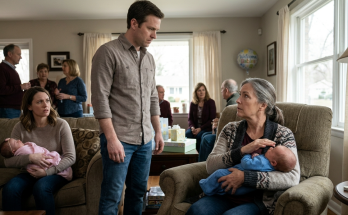
We’re at Lauren’s helping with the house. Is this urgent?
I had looked at those words so many times that they no longer seemed real.
Urgent.
I turned my head toward the window. The late afternoon light had faded into a gray-blue reflection, leaving the glass more mirror than view. I could see my own face floating there, pale and swollen, with a strip of gauze above my eyebrow.
Yes, Mom.
It was urgent.
Yesterday morning, a delivery truck had gone through a red light and hit my car at an intersection three miles from my office. I remembered the horn, the violent sideways impact, the taste of metal in my mouth, and a stranger telling me not to move. After that, the memories became disconnected pieces.
A paramedic’s glove.
A ceiling passing above me.
Someone asking my name.
The emergency department doors opening.
Then pain.
The doctors had repaired several injuries, but by the following morning they had found internal bleeding that required another procedure. Dr. Patel had explained the risks in a calm voice. He told me the next twenty-four hours mattered.
I understood every word.
What I hadn’t understood was how frightened I would become once the room went quiet.
I had always been good at handling emergencies. At thirty-four, I had built a medical software company from a cramped rented office into a successful business and sold it two years earlier. I had negotiated contracts, managed crises, fired people I liked, and made decisions while everyone else was still debating possibilities.
But lying alone beneath hospital lights was different.
There was no spreadsheet for fear.
No strategy.
No reason to pretend I didn’t want somebody familiar beside me.
So I called my parents.
Then again.
And again.
The ninth attempt was the one that finally changed something inside me.
Not because they answered.
Because they didn’t.
My phone slipped slightly in my hand. I stared at the screen until the numbers blurred.
A nurse named Marisol entered carrying a small plastic cup of water.
“You’ve been watching that phone for ten minutes,” she said.
I looked up.
“Has it really been ten?”
“Closer to twelve.”
She placed the cup on the tray and checked the monitor.
Marisol never moved quickly unless she had to. Her dark braid was pinned behind her head, and she wore reading glasses pushed onto her hair even though I had never seen her use them.
“You need rest,” she said.
“I know.”
“That usually means you’re about to do the opposite.”
Despite everything, I almost smiled.
“My parents aren’t answering.”
She paused.
“Do you want me to call them?”
“I’ve tried.”
“That wasn’t what I asked.”
I looked at her.
She waited.
“No,” I said finally. “I’ll handle it.”
She adjusted the blanket around my legs and left without arguing.
I looked at the phone again.
Something had changed.
It wasn’t anger. Anger would have been easier.
It was clarity.
For most of my life, whenever my parents failed to show up, I had invented reasons for them. Mom was overwhelmed. Dad was busy. Lauren needed them. There must have been some misunderstanding. They would make it up later.
I had become an expert at explaining their absence to myself.
But that afternoon, I had stopped.
My thumb moved to a contact I had not called in nearly a year.
Harding & Vance — Estate.
I pressed the number.
The receptionist was gone for the evening, but the firm’s answering service picked up. I left my name.
Five minutes later, my phone rang.
“Miranda?”
Julian Vance.
His voice was instantly recognizable, measured and low.
“Yes.”
“What’s happened?”
“I’m in the hospital.”
There was a brief silence.
“Are you alone?”
“Yes.”
“I’ll come.”
“You don’t have to.”
“I wasn’t asking whether I had to.”
I closed my eyes.
“Julian?”
“Yes?”
“I need to change my estate.”
Another silence.
Then, very carefully, he asked, “Are you certain?”
“I’ve never been more certain about anything.”
He arrived less than two hours later wearing a navy suit beneath a dark overcoat, his leather briefcase tucked against his side. He looked like he had walked directly out of a boardroom and into the wrong building.
Instead of commenting on my condition, he pulled the visitor’s chair beside the bed.
“Dr. Patel says you’re alert?”
“He does.”
“Any medication affecting your judgment?”
“Pain medication, but nothing that makes me confused.”
He nodded.
“We’ll document everything properly. Capacity assessment, witnesses, notary. I won’t let anyone later claim you didn’t understand what you were signing.”
I looked toward the window.
“My parents are at Lauren’s.”
“Helping her move?”
“Yes.”
He already knew about Lauren.
Everyone close to me knew about Lauren.
My younger sister had always occupied a different space in our family. She was the one my parents worried about, protected, rescued, and excused.
I had stopped expecting anyone to explain why.
“What are you changing?” Julian asked.
“Everything that still connects my parents to my estate.”
He didn’t react.
That was one of the reasons I trusted him.
He didn’t tell me I was being emotional. He didn’t tell me family was complicated. He didn’t suggest waiting until I was discharged.
He simply opened his briefcase.
“Then we’ll do it carefully.”
The documents took hours.
My parents had remained beneficiaries of several accounts. Lauren had been named in provisions that I had created years earlier when I assumed my sister’s future children would need educational support. My parents had access to an emergency account I had established for medical or family crises.
There was also the lake house.
My parents loved that house.
They had spent summers there, hosted friends there, and slowly begun speaking about it as if it belonged to them.
I had never corrected them.
Tonight, I did.
At 8:15, the notary arrived.
At 8:40, Dr. Patel documented that I was mentally capable of making my decisions.
At 9:05, two hospital employees witnessed my signature.
Julian read every provision aloud.
My parents would no longer inherit from me.
Lauren would be removed.
The educational trusts would disappear.
The foundation board seats reserved for my parents would be closed.
The lake house would remain mine.
My emergency accounts would become inaccessible to them.
When Julian finished, he looked at me.
“Do you want to review it once more?”
“No.”
“You’re sure?”
“Yes.”
He closed the folder.
“Then it’s done.”
The room became strangely quiet.
I expected relief.
Instead I felt tired.
Very tired.
At 10:03, the door opened.
My mother stepped inside carrying two paper cups of coffee.
Dad stood behind her.
For one second, nobody spoke.
Mom looked at Julian.
Then at the folder.
Then at me.
“Oh, Miranda,” she said softly. “You scared us.”
I stared at her.
The monitor beside me continued its steady beeping.
“No,” I said.
Her expression tightened.
“I didn’t scare you, Mom.”
She waited.
“If I had scared you, you would have answered.”
Click here to continue reading: PART 2: The family explanation begins to unravel when Miranda remembers every moment she was called strong simply because nobody expected her to need them
Nine unanswered calls, one hospital room, and a decision that would force Miranda to finally confront what her family had taught her to accept
Part 1 of 10