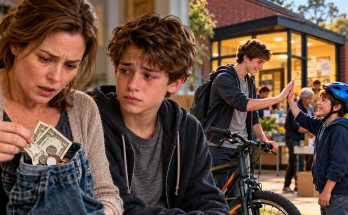
The family arrived just before midnight.
The mother was named Rachel.
Her daughter was seven.
Her son was four.
They carried two backpacks between them.
The little boy was asleep against his mother's shoulder.
Rachel stood in the doorway, exhausted and embarrassed.
“I was told this was free.”
“It is,” I said.
She looked behind me.
“There are no hidden fees?”
“No.”
“What do I have to do?”
“Nothing.”
She stared at me.
“Nothing?”
“You need somewhere safe tonight.”
Her eyes filled.
She turned away.
I knew that posture.
The instinct to hide tears before anyone could decide they were inconvenient.
“Your room is ready,” I said.
Marisol came down the hall.
“I'll show you.”
Rachel followed her.
Her daughter stopped beside me.
“Do you live here?”
“Sometimes.”
“Are you the boss?”
I smiled.
“No.”
She looked confused.
“Then who is?”
I glanced toward Marisol.
“Everybody.”
The girl considered that.
Then she smiled.
That was the final piece.
Harbor House no longer belonged to me.
It belonged to everyone who showed up.
The next morning, Dad came downstairs slowly.
He was still recovering.
Mom followed with his medication.
He saw Rachel and her children at breakfast.
He didn't ask who they were.
He simply sat down and began buttering toast.
The little boy watched him.
Dad pushed the plate across the table.
“Want some?”
The boy nodded.
“Thank you.”
Dad looked at me.
I smiled.
He had learned.
Not perfectly.
But enough.
Over the next several months, Harbor House grew.
The Open Line received calls from hospitals across the region.
Families came from different towns.
Some stayed one night.
Some stayed months.
Some left without saying goodbye.
Some returned years later to volunteer.
We never required anyone to tell their story.
That became one of our rules.
Need was enough.
My mother became one of the regular volunteers.
She organized books.
She folded blankets.
She answered phones.
Sometimes she and I worked side by side without discussing the past.
Other days we talked about it.
Not every conversation ended well.
Some ended with silence.
That was okay.
My father continued repairing furniture.
He became particularly attached to broken chairs.
“Everything can be repaired,” he once told me.
I looked at him.
“Not everything.”
He smiled.
“Fair.”
Lauren changed too.
She stopped calling only when something went wrong.
She called to tell me Emma had taken her first steps.
She called because she had found a new job.
She called because she was tired.
She called because she wanted to hear my voice.
Those ordinary calls mattered more than any apology.
Tessa remained Tessa.
She still criticized my coffee.
She still threatened to hide my laptop when I worked too late.
She still arrived whenever I called.
Julian retired from active legal work two years later.
Before he left, he gave me the original estate folder.
“You should keep this.”
I looked at it.
“I don't want it.”
“You don't need it.”
He smiled.
“That's the point.”
I placed it in a drawer.
Then I closed it.
The estate that had once seemed like the center of my family's conflict became irrelevant.
There was no lake house to fight over.
No emergency account to misuse.
No inheritance to divide.
Harbor House belonged to the foundation.
The foundation belonged to its mission.
And my life belonged to me.
One autumn morning, I received a call from the hospital where the accident had happened.
I almost didn't answer.
Then I did.
“Hello?”
A coordinator introduced herself.
She said she had found my name while reviewing the Open Line partnership records.
“We wanted to thank you.”
“For what?”
“For helping families who don't know where to go.”
I looked through my office window.
The lake was covered in orange leaves.
“I should thank you.”
“Why?”
“Because your hospital taught me something.”
She laughed softly.
“What?”
“That someone can be terrified and still survive.”
There was a pause.
Then she said, “That's a good lesson.”
I ended the call.
My phone remained in my hand.
I thought about the ninth unanswered call.
Then the first answered call.
Then all the calls that came afterward.
The difference wasn't the phone.
It was the people on the other end.
My mother had once let my calls go unanswered because she believed someone else needed her more.
My father had turned his phone over because he believed I could handle myself.
Lauren had once assumed I would solve her problems.
I had accepted all of it because I believed being needed was the same as being loved.
None of us understood what we were doing.
Not completely.
But we learned.
Slowly.
Painfully.
Honestly.
That evening, my entire family gathered at Harbor House.
Dad brought a repaired wooden table.
Mom brought soup.
Lauren brought Emma.
Tessa brought dessert.
Marisol brought six volunteers.
Camille brought bread.
Sofia and Mateo decorated the dining room with paper leaves.
Rachel sat near the window with her children.
Nobody knew that I had planned something.
After dinner, I stood.
Everyone quieted.
“I want to say something.”
Dad looked nervous.
Mom smiled.
I held up a phone.
“This is the phone I had the night of the accident.”
Tessa frowned.
“You kept it?”
“For a while.”
I placed it on the table.
“It contains the call log.”
Nobody spoke.
“I used to think these nine calls were proof of what my family had failed to give me.”
I looked at my parents.
“They were.”
Mom lowered her eyes.
“But they were also proof of something else.”
I looked around the room.
“People can fail you and still learn.”
Dad's eyes filled.
“People can hurt you and still change.”
Lauren reached for Emma's hand.
“And sometimes the people who show up later are not replacing the people who should have shown up first.”
I paused.
“They're simply showing you what showing up can look like.”
Marisol smiled.
I looked at the children.
“At some point, you have to stop asking who didn't answer and start noticing who is answering now.”
No one clapped.
I didn't want them to.
The room remained quiet.
Then Dad stood.
He walked to me.
He didn't hug me immediately.
He waited.
I opened my arms.
He hugged me.
Mom joined us.
Lauren came next.
Tessa complained that nobody had invited her, then joined anyway.
Everyone laughed.
It wasn't perfect.
It wasn't supposed to be.
Later, after everyone had gone to bed, I walked outside.
The lake was black beneath the stars.
I sat on the dock.
My phone rang.
I looked at the screen.
It was Dad.
I answered.
“What's wrong?”
“Nothing.”
“Then why are you calling?”
“I couldn't sleep.”
I smiled.
“Me neither.”
There was a pause.
“Goodnight, Mira.”
“Goodnight, Dad.”
I ended the call.
A few seconds later, another call came.
Mom.
I answered.
“Hi.”
“I forgot to tell you something.”
“What?”
“I love you.”
I looked across the lake.
“I love you too.”
The call ended.
I sat there for a long time.
The night was quiet.
Not empty.
Quiet.
I thought about the woman I had been in that hospital bed.
Afraid.
Alone.
Waiting for nine people to answer the phone in the ways I had always needed them to.
She deserved better.
But she also deserved to know that her life would become larger than that room.
She would build something.
She would forgive without surrendering.
She would establish boundaries without becoming bitter.
She would learn that independence was not the same as isolation.
She would discover that family could be repaired without pretending it had never broken.
And she would learn that sometimes the most important call was not the one you spent years waiting to receive.
It was the one you finally chose to answer.
The next morning, I changed the Open Line's founding statement.
I removed the language about emergency response.
I added one sentence.
No one should have to face the worst moment of their life believing they have nobody to call.
Then I signed my name.
Not as owner.
Not as founder.
Not as beneficiary.
Just Miranda.
A woman who had once made nine unanswered calls.
A woman who had survived.
A woman who had learned to answer.
And somewhere beyond the office window, the Harbor House doors opened for another family.
This time, someone was already waiting.
The End
Read more original stories on Feel Every Story.
Nine unanswered calls, one hospital room, and a decision that would force Miranda to finally confront what her family had taught her to accept
Part 10 of 10