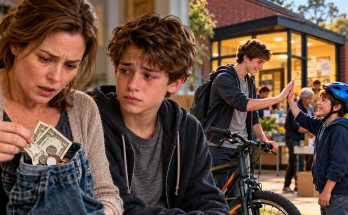
The envelope was still warm from the dryer when I found it.
I had been folding Evan’s work clothes at the kitchen table, matching socks and smoothing the wrinkles from his dark diner shirt, when a stiff rectangle slipped from the pocket of his jeans and landed beside my coffee mug. I almost put it back without looking. Then I noticed the handwriting.
BIKE MONEY.
Three words, written in the uneven block letters I knew as well as my own.
I stared at them longer than I should have.
For months, that bicycle had been the one thing my thirteen-year-old son talked about with complete certainty. He had a picture of it saved on his phone, knew the exact model, knew the color he wanted, and had memorized the price down to the last few dollars. He had even measured the narrow space beside our front steps where he planned to keep it.
Matte black frame. Orange lettering. Thick tires.
He called it his first real bike.
I smiled despite myself and reached for the envelope. I expected cash. Instead, it was almost empty. There were only a few folded bills inside, along with a receipt from the diner where he worked every Saturday afternoon.
Seven dollars and fifty cents.
I checked the jeans again.
Nothing.
For a moment, I wondered whether he had spent some of his savings without telling me. That wouldn’t have been unusual. Thirteen-year-olds change their minds. One week they save for a bicycle; the next, they discover headphones or video games or some new thing everyone at school seems to have.
But Evan wasn’t usually careless with money.
Since his father died, he had become almost painfully deliberate about it.
Michael had been gone three years, but there were mornings when the absence still sat at our breakfast table. Evan didn’t talk about his father much anymore. He had learned the strange habits grief teaches a child: remembering privately, swallowing questions, and pretending certain birthdays did not hurt.
I had become both mother and father by necessity, and I knew I worried too much.
Maybe that was why I noticed small things.
The muddy shoes left outside the back door.
The torn sleeve he insisted was nothing.
The way he had started coming home on Saturdays with a different expression on his face—quiet, thoughtful, almost distracted.
And lately, the cash.
I put the envelope back exactly where I had found it and finished folding his clothes.
When Evan came downstairs, he was already dressed.
He stopped when he saw me.
“You’re up early.”
“So are you.”
He glanced at the clock.
“I’ve got work.”
“You don’t leave for another forty minutes.”
He shrugged and reached for a piece of toast.
That was when I noticed the small rip along the cuff of his sweatshirt.
“Again?”
He looked down.
“Oh. That.”
“You said you fixed it.”
“I did.”
“You fixed it with what, a lawn mower?”
A reluctant smile appeared.
“I’m fine, Mom.”
I pointed at the chair.
“Sit.”
He sat.
I took his wrist gently and turned the sleeve toward the light. The tear wasn’t fresh, but there was dried brown dirt along the seam.
“What happened?”
“Nothing.”
“Evan.”
He looked away.
“I fell.”
“Where?”
“Outside.”
“That clears everything up.”
He gave me the expression teenagers use when they know their mother is being annoying but haven’t decided whether it’s safe to laugh.
“I tripped behind the diner.”
“Behind the diner?”
“Yeah.”
“You’re working in a restaurant, not a construction site.”
“I know.”
His answer came too quickly.
I released his sleeve.
“Are you sure you’re okay?”
“I’m okay.”
He took another bite of toast.
Then he looked at me.
“Can I have the envelope?”
My stomach tightened.
“What envelope?”
He froze.
Only for a second.
But I saw it.
“The one in my jeans.”
“Oh.”
“You found it.”
“I found it in the laundry.”
He held out his hand.
I handed it over.
His fingers closed around it immediately.
“You have almost nothing in there.”
“I know.”
“You’ve been saving for that bike.”
“I am saving.”
“Then where did the money go?”
He looked toward the window.
“Mom, I have to go.”
“Evan.”
He stood.
“I’ll be late.”
“You still have twenty minutes.”
“I know.”
He grabbed his backpack.
I watched him head for the door.
Just before he opened it, I asked the question that had been sitting behind all the others.
“Are you in trouble?”
His hand stayed on the doorknob.
“No.”
He didn’t turn around.
Then he left.
I stood alone in the kitchen, listening to his footsteps disappear down the porch.
Something about the way he had answered bothered me.
Not because I thought he was lying.
Because I thought he believed he had a reason to.
That Saturday afternoon, I drove past Sal’s Diner without telling him I was coming.
I had never met his boss properly. I had spoken to Sal once when Evan first started working there, when I had filled out the paperwork and made sure they understood Evan could only work limited hours. Sal had seemed like a decent man with a permanent crease between his eyebrows and flour on his forearms.
Evan washed dishes, wiped tables, carried supplies, and occasionally helped the cooks during the afternoon rush.
He had begged for the job.
I had said yes because he wanted to save for his bicycle.
That was the story we both understood.
The diner sat on a corner beneath an old striped awning. Cars lined the curb, and the windows were fogged slightly from the heat inside.
I parked across the street.
Through the glass, I could see Evan moving between tables.
He looked small among the adults.
Too small, suddenly.
A waitress handed him a stack of plates. He balanced them against his forearm and disappeared through the swinging kitchen doors.
I smiled.
Then a man at a nearby table waved Evan over.
The man was older, with gray hair and a work jacket hanging from the back of his chair.
Evan listened.
He nodded.
Then he reached into his backpack.
I leaned forward in the driver’s seat.
He pulled something out.
An envelope.
The older man shook his head.
Evan said something I couldn’t hear.
The man pushed the envelope back.
Evan pushed it toward him again.
My smile disappeared.
I opened the car door.
Before I could cross the street, Evan noticed me through the window.
His face changed.
He looked frightened.
He shoved the envelope back into his backpack.
The older man looked toward me.
Evan hurried into the kitchen.
I stopped on the sidewalk.
For several seconds, I simply stood there.
Then the diner door opened.
Sal stepped outside.
He wiped his hands on a towel.
“Mrs. Carter?”
I nodded.
“Is Evan okay?”
Sal looked toward the kitchen.
“Yes.”
His answer wasn’t reassuring.
“What was he giving that man?”
Sal’s jaw tightened.
“Maybe you should come inside.”
I followed him.
The diner was loud, crowded, and smelled of coffee, onions, and frying potatoes. Plates clattered. Someone laughed near the counter. A child dropped a fork.
But all I could hear was the question in my own head.
What had my son been doing with his money?
Sal led me toward the back.
“Evan doesn’t know you’re here?”
“No.”
He nodded slowly.
“That’s probably better.”
“Why?”
He stopped beside the kitchen doors.
For a moment, he seemed to be deciding how much to say.
Then he lowered his voice.
“I think you need to talk to him yourself.”
“About what?”
Sal looked at me.
“About where he thinks his money should go.”
Before I could ask anything else, Evan appeared.
He stopped when he saw us.
“Mom?”
I looked at his backpack.
He looked at me.
Neither of us spoke.
Then Sal said quietly, “Take him home.”
Evan’s face went pale.
“Am I fired?”
“No,” Sal said.
“Then why is she here?”
I turned toward my son.
“Because I think we need to talk.”
He swallowed.
For the first time since Michael died, I saw the same expression on Evan’s face that I remembered from the funeral.
Not fear of punishment.
Fear of being unable to protect someone.
I just didn’t know who he was trying to protect.
Click here to continue reading: PART 2: My Son Kept Saying the Bicycle Was Almost Within Reach, Yet Every Saturday He Came Home Looking Like He Had Lost Something
The Saturday Morning I Realized My Son’s Bicycle Dream Was Hiding Something I Had Never Thought to Ask About
Part 1 of 15