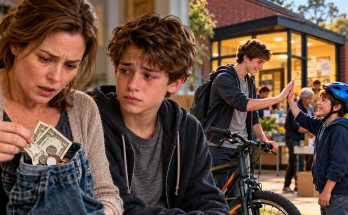
I opened the backpack slowly.
Evan didn't look at me.
Sal stood beside the counter with his arms folded, watching the floor rather than either of us.
Inside were envelopes.
More than I had seen at home.
Some were marked with names. Others had dates. A few contained nothing but receipts folded into quarters.
I pulled out the first.
Mrs. Alvarez — September.
The blue marker was Evan's handwriting.
I opened it.
Two hundred and forty dollars.
All in twenty-dollar bills.
I stared at the money.
“What is this?”
Sal answered.
“That is what I've been trying to explain.”
I looked at Evan.
His cheeks were wet.
He had been crying without making a sound.
“For six months,” Sal said, “your son has been giving away most of what he earns.”
I looked back at the bills.
“Most?”
“Nearly all of it.”
Evan shook his head.
“I wasn't giving it away.”
I turned toward him.
“Then what were you doing?”
He swallowed.
“Helping.”
The word landed heavily in the small kitchen.
I sat down.
Sal began sorting the papers.
“Medicine.”
He placed one receipt on the counter.
“Groceries.”
Another.
“Electricity.”
Another.
“School meals.”
The pile grew.
Different names.
Different addresses.
Different problems.
None belonged to us.
I looked at my son.
“How did you even meet all these people?”
He wiped his face with his sleeve.
“I met one.”
“Mrs. Alvarez?”
He nodded.
Then he told me about the woman who came to the diner every Saturday afternoon.
She always ordered vegetable soup.
Nothing else.
A glass of water.
Sometimes she would quietly tuck the crackers served with the soup into her purse.
Evan had noticed.
He hadn't thought she was stealing.
He thought she was saving them.
“When I saw her do it,” he said, “I thought about Grandma.”
His grandmother had died before Evan was born, but photographs of her covered the hallway wall upstairs.
He knew her face without ever having heard her voice.
The next Saturday, Mrs. Alvarez didn't come.
Someone mentioned that she was having trouble paying her electric bill.
Evan asked where she lived.
Apparently, people laughed.
They assumed he was simply being curious.
He walked there after his shift.
Nearly two miles.
He found Mrs. Alvarez sitting outside her apartment.
She told him she enjoyed the fresh air.
But the apartment was dark.
The power had been disconnected.
Evan gave her his paycheck.
Every dollar.
“She wouldn't take it at first,” he said.
“So I told her it was money I'd set aside for the bike.”
“You lied again.”
He nodded.
“She believed me.”
I covered my mouth.
Sal continued sorting.
“I didn't know about all of it at first.”
“When did you find out?”
“A month later.”
He explained that Evan always requested his pay in cash.
Sal assumed it was because the boy liked seeing his savings grow.
Then one evening, he watched Evan walk past the sporting-goods store.
The bicycle shop was across the street.
Evan didn't even glance at it.
Instead, he crossed toward a pharmacy.
Sal followed.
Inside, Evan bought insulin.
It wasn't for him.
It was for a retired mechanic named Mr. Henderson.
His insurance had lapsed.
“You confronted him?”
Sal nodded.
“He begged me not to call you.”
I looked at Evan.
“You asked him to keep this from me?”
“I knew you'd worry.”
“You lied to me.”
“I know.”
“Why?”
He looked directly at me.
“Because you already lost Dad.”
I stopped breathing for a moment.
Evan stepped closer.
“I didn't want you worrying about more people.”
My eyes filled.
He continued.
“You always tell me we can't fix everything.”
“I know.”
“But I kept thinking…”
He swallowed.
“Maybe I could fix one thing.”
Sal reached for another envelope.
This one held photographs.
The first showed Evan carrying grocery bags toward a small trailer.
The second showed him shoveling mud from a flooded porch.
The third was the photograph I had found at home.
Lily.
Her wheelchair.
The cupcakes.
The laughter.
I turned the photograph over again.
“Was this after you helped her family?”
“Yes.”
“Why didn't you tell me?”
He shrugged.
“She was happy.”
That answer broke something inside me.
Not because it was grand.
Because it was so simple.
Sal placed another receipt on the table.
“That's when I realized this wasn't occasional.”
“How many families?”
He hesitated.
“Twenty-three.”
I stared at him.
Twenty-three.
My thirteen-year-old son had somehow become a secret source of help for twenty-three families.
And I had been asking him whether he had enough money for a bicycle.
Then I remembered the torn sleeve.
“The mud.”
Evan nodded.
“You weren't hurt?”
“No.”
“What happened to your sleeve?”
“I climbed a fence.”
“To help Mr. Brooks?”
“Yes.”
I closed my eyes.
For weeks, I had imagined possibilities I was ashamed to admit.
Drugs.
Older kids.
Trouble.
Something dangerous.
Instead, the truth was sitting across from me with dirty fingernails and a thirteen-year-old's narrow shoulders.
He had been carrying problems that belonged to grown-ups.
“Why did you keep doing it?” I asked.
He looked at the floor.
“I didn't want people to know.”
“Why?”
“Because then they'd thank me.”
I didn't understand.
“What's wrong with that?”
He shrugged.
“Then it becomes about me.”
Sal looked away.
I knew then that he had probably heard versions of this before.
I turned toward him.
“So why did you call me today?”
Sal was silent.
Then he pointed at the backpack.
“Because this morning he tried to give away the rest.”
I frowned.
“The rest of what?”
“The bike money.”
I stared at Evan.
“I thought there wasn't any.”
“There wasn't much,” Sal said.
He reached into the backpack and pulled out a thick envelope.
BIKE FUND.
The words were written in Evan's handwriting.
Inside was $1,146.
I looked at Sal.
“You said he wasn't saving.”
“I said he wasn't saving for most of those months.”
He nodded toward Evan.
“He finally started.”
For seven weeks, Evan had kept his paychecks.
He had stopped giving money to Mrs. Alvarez.
Stopped buying groceries.
Stopped helping strangers.
Stopped walking into the pharmacy with cash.
He had walked past people who needed help because he had decided, reluctantly, to save something for himself.
The bicycle had been within reach.
Then came that morning.
Sal explained.
A little boy named Noah had entered the diner with his older sister.
Noah was eight.
Their mother had collapsed the night before and was in intensive care.
The sister had four dollars.
She asked if they could share one meal.
Evan heard her.
He disappeared into the restroom.
When he came back, he went straight to the counter.
He opened the bike envelope.
And emptied every dollar onto it.
All $1,146.
Sal had pushed the money back.
“I told him no.”
Evan looked at me.
“I was only going to help them stay near the hospital.”
“You were going to give them everything.”
He nodded.
I stared at him.
“And the bike?”
He looked almost embarrassed.
“I can walk.”
Those four words broke whatever control I had been holding.
I crossed the kitchen.
I pulled him against me.
He resisted for half a second.
Then his arms wrapped around my waist.
He cried into my shoulder.
Not quietly.
Not carefully.
Like a thirteen-year-old boy who had finally run out of strength.
“I lied to you, Mom.”
“I know.”
“I'm sorry.”
“I know.”
“I just wanted to help.”
I held him tighter.
“You don't have to carry everybody.”
He cried harder.
Behind us, Sal wiped his eyes with a kitchen towel and pretended he wasn't.
After a moment, he cleared his throat.
“There is one more thing.”
I looked up.
He reached beneath the counter.
A thick white envelope appeared in his hands.
Dozens of signatures covered the front.
Employees.
Customers.
People I didn't recognize.
“What is that?”
Sal handed it to me.
“Open it.”
I did.
Inside was a cashier's check.
I read the amount once.
Then again.
Seven thousand five hundred dollars.
At the bottom was a handwritten message.
For the boy who believed kindness should stay invisible.
My fingers tightened around the paper.
“Where did this come from?”
Sal didn't answer.
Instead, the bell over the front door rang.
Once.
Then again.
Footsteps moved across the dining room.
Evan lifted his head from my shoulder.
“What is happening?”
Sal looked toward the kitchen entrance.
“Everyone he helped.”
Click here to continue reading: PART 4: The People My Son Had Helped Walked Through the Diner Door, Carrying Proof That His Secret Had Never Been as Secret as He Believed
The Saturday Morning I Realized My Son’s Bicycle Dream Was Hiding Something I Had Never Thought to Ask About
Part 3 of 15