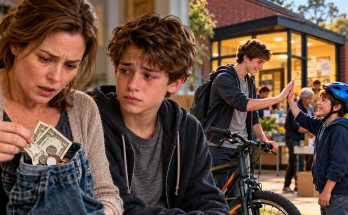
For the first few months after the Saturday Table opened, life became almost peaceful.
Not easy.
Peaceful.
There was a difference.
Evan still worked at Sal's Diner on Saturdays, though Sal had gradually given him fewer hours once the community center became busier. Evan complained about it at first, insisting he could handle both.
Sal had looked at him over a cup of coffee.
“You're thirteen.”
“I know.”
“You say that like it's a temporary condition.”
Evan had laughed.
But he stayed involved.
He kept the records, helped repair bicycles, stocked shelves, and spent afternoons in the study room when younger children needed help with homework. He had stopped trying to solve every problem himself.
That was the biggest change.
If someone needed groceries, Evan checked the shelves.
If the shelves were empty, he asked Sal.
If Sal didn't have enough, they called the volunteers.
If the volunteers couldn't solve it, they connected the family with another organization.
Evan had learned the difference between helping and carrying.
I had learned something too.
I stopped watching him every time he opened his wallet.
That might sound small.
It wasn't.
For months, every time I saw Evan reach into his pocket, part of me wondered whether he was about to give away everything he had again.
Then one afternoon he came home carrying a paper bag.
“What's that?”
“Shoes.”
“For you?”
“Yes.”
I smiled.
“New shoes?”
He nodded.
“I needed them.”
“How much?”
He gave me a suspicious look.
“Mom.”
“I'm just asking.”
“I saved for them.”
I raised both hands.
“Okay.”
He laughed.
“I knew you were going to do that.”
“Do what?”
“Look worried.”
“I don't look worried.”
“You absolutely do.”
He disappeared upstairs.
I stood in the kitchen smiling.
Then the phone rang.
It was Daniel.
His voice sounded different.
More serious.
“Can you come to the office tomorrow?”
“Is something wrong?”
“I don't know yet.”
That sentence had become one I disliked.
“Is Evan involved?”
“Yes.”
My smile disappeared.
“What happened?”
“I found something in Robert Whitmore's archived files.”
“What?”
“A document that was never included in the estate inventory.”
I sat down.
“What kind of document?”
“A trust agreement.”
I waited.
“It names Michael.”
My fingers tightened around the phone.
“What does it say?”
“I'd rather show you.”
The next morning, Evan came with me.
Daniel placed a thin folder on the conference table.
The document was older than the other papers.
The corners were worn.
There were handwritten notes in the margins.
At the top was a name.
Michael Carter.
Below it was the name of Robert Whitmore.
Then another name.
Richard Bell.
Evan leaned forward.
“Why is Richard here?”
Daniel turned the page.
The agreement established the original charitable fund.
But it contained a clause we had never seen.
If Robert died before the fund had established a permanent community center, the building and remaining assets were to be transferred according to a succession plan.
I looked at Daniel.
“Who was next?”
He turned another page.
Michael.
Then, beneath Michael's name, Evan's.
Evan stared.
“Why me?”
Daniel looked at him.
“Because your father changed the agreement.”
“When?”
“After you were born.”
Evan sat back.
I felt something tighten in my chest.
Michael had known.
He had apparently believed that one day Evan might continue the work.
But there was something else.
The trust required that the person receiving control of the project demonstrate a specific condition.
They could not use the fund for personal benefit.
That part made sense.
But another clause required that the person maintain an active relationship with the community the fund served.
Evan looked confused.
“What does that mean?”
“It means,” Daniel said, “you can't simply inherit the money and walk away.”
“I don't want the money.”
“I know.”
“Then why does this matter?”
Daniel tapped the document.
“Because someone has challenged the trust.”
My stomach dropped.
“Who?”
Daniel hesitated.
“The challenge was filed by a distant relative of Robert Whitmore.”
“Why?”
“She claims the trust is invalid.”
Evan looked at the building plans.
“Can she take the Saturday Table?”
“She is asking the court to dissolve the trust and liquidate the assets.”
“Why?”
Daniel gave him a tired smile.
“Money.”
Evan looked away.
I could see the old instinct returning.
Fight.
Fix.
Protect.
I put my hand on his shoulder.
“Slow down.”
He nodded.
Daniel continued.
“The challenge is based on Robert's mental capacity when he amended the trust.”
Evan looked at him.
“Was he sick?”
“He was elderly.”
“That doesn't mean he didn't know what he was doing.”
“No,” Daniel said. “It doesn't.”
“But?”
“But she has produced a medical record suggesting he was confused during that period.”
I looked at the document.
“Is it real?”
“We don't know.”
Daniel slid a copy across the table.
The record had a doctor's signature.
But the date bothered me.
I looked at it again.
“This date.”
Daniel leaned forward.
“What about it?”
“Michael was dead by then.”
“Yes.”
“So how could Michael have signed this acknowledgment?”
Daniel's face changed.
He took the paper from me.
He checked the date.
Then he checked another page.
He looked at Evan.
“That's impossible.”
“What?”
“The document says Michael confirmed the amendment six months after his death.”
The room went silent.
Evan stared at the papers.
“So somebody changed the date.”
“Possibly.”
Daniel stood.
“I need to verify the original.”
He gathered the documents.
Before he could leave, Evan asked a question.
“Who filed the challenge?”
Daniel stopped.
“A woman named Margaret Whitmore.”
“Robert's daughter?”
“Yes.”
Evan looked confused.
“Why would his own daughter want to destroy what he built?”
Daniel didn't answer immediately.
“I don't know.”
But I did.
At least, I understood one possibility.
Maybe she didn't know what her father had wanted.
Maybe all she saw was a valuable building, a charitable fund, and a complicated trust.
Maybe the Saturday Table meant nothing to her.
Or maybe she knew exactly what it meant.
Daniel called us later that afternoon.
The original document existed.
The amendment was valid.
And the suspicious medical record had been altered.
Someone had deliberately inserted a false date.
We thought that would end the matter.
It didn't.
Because Margaret Whitmore requested a meeting.
She arrived at the Saturday Table the following Saturday morning.
She was an elegant woman in her late fifties, wearing a dark coat and carrying a leather folder.
She looked around the building.
At the shelves.
The bicycles.
The children studying upstairs.
The volunteers.
Then she looked at Evan.
“You look like your father.”
Evan had heard those words before.
But this time, he didn't smile.
“Did you know him?”
Margaret nodded.
“Very well.”
“Did you like him?”
Her expression changed.
“That is a complicated question.”
Evan waited.
She looked at me.
“I'd like to speak with you both.”
We sat at the long wooden table.
Margaret placed the folder in front of her.
“My father believed Michael was the only person who understood what he was trying to build.”
I looked at her.
“Then why are you challenging the trust?”
“Because I believe my father changed his mind.”
Evan frowned.
“Did he?”
“I don't know.”
She opened the folder.
Inside was another letter.
Written by Robert.
But unlike the other documents, this one was addressed to Margaret.
She handed it to Evan.
He read silently.
Then he looked up.
“What does this mean?”
Margaret answered.
“My father was afraid that the fund would become dependent on one person.”
“That sounds like the opposite of what he wanted.”
“It is.”
She sighed.
“He wanted the community center to continue without Michael's family controlling it.”
I looked at Daniel's trust document.
“That isn't what the agreement says.”
“I know.”
“Then why show us this?”
“Because I found it after the lawsuit began.”
Evan stared at her.
“You were trying to take the building.”
“Yes.”
“Why?”
“Because I thought my father had been manipulated.”
“By Dad?”
Margaret shook her head.
“By grief.”
That word stopped me.
She looked at Evan.
“My father lost people he loved. Your father became the person who knew how to make that grief useful.”
Evan didn't speak.
Margaret continued.
“He admired Michael.”
“But?”
“But he worried that one day someone would inherit the mission without understanding why it existed.”
Evan looked toward the shelves.
“I understand.”
Margaret's eyes softened.
“I think you might.”
She closed the folder.
“I withdrew my challenge this morning.”
I stared at her.
“You did?”
“Yes.”
“Why?”
She looked at Evan.
“Because I came here expecting to find a boy using my father's money.”
She smiled faintly.
“I found a boy who had already built the thing my father wanted.”
Evan looked uncomfortable.
“I didn't build it alone.”
Margaret nodded.
“That is exactly the point.”
She stood.
Before leaving, she handed Evan the letter.
“Keep that.”
He took it.
“What should I do with it?”
“Read it when you are older.”
She walked toward the door.
Then she stopped.
“There is one more thing.”
We waited.
“My father left another box.”
“Where?”
“At the old house.”
“What is in it?”
Margaret looked at Evan.
“I don't know.”
Then she left.
Evan turned toward me.
“Should we go?”
I looked at the box in my son's hands.
“Yes.”
Because after everything we had learned, one truth had become impossible to ignore.
Michael had left behind more than a lesson.
He had left clues.
And we had only just learned how to read them.
Click here to continue reading: PART 10: The Box From Robert’s Old House Contained a Photograph That Forced Evan to Question What His Father Had Never Told Him
The Saturday Morning I Realized My Son’s Bicycle Dream Was Hiding Something I Had Never Thought to Ask About
Part 9 of 15