The judge did not decide that day.
Instead, he ordered the parties to return the following week with complete financial records.
The developer's claim remained unresolved.
But the freeze on the fund was lifted temporarily.
The Saturday Table could continue.
Evan came home exhausted.
He took off his shoes and left them by the door.
Then he sat on the bottom stair.
“I thought court would feel different.”
“How?”
“More dramatic.”
I laughed.
“You watch too many movies.”
He smiled.
Then he became quiet.
“Did I say the right thing?”
“There wasn't a right thing.”
“But I wanted the building.”
“I know.”
“I didn't want to sound selfish.”
“You weren't selfish.”
He looked at me.
“Wanting something doesn't make you selfish.”
That lesson had taken him months to understand.
Maybe years.
The next week, Daniel discovered the final missing piece.
The former law-office employee had not disappeared.
He had gone to the police.
He confessed that Thomas Bell's business partner had paid him to alter the estate records.
Thomas had known nothing about it.
The purpose was to create doubt around the fund.
The developer wanted the building because it sat on valuable land.
The charity was simply standing in the way.
The confession changed the case.
The altered records were thrown out.
The original documents were authenticated.
The handwriting analysis confirmed the disputed signature was not Robert's.
And Thomas Bell withdrew his family's claim.
The building was finally transferred to the charitable fund.
When Daniel called us, Evan didn't celebrate.
He just sat down.
“It's really ours?”
“Not yours personally,” I reminded him.
He smiled.
“Right.”
“It's everyone's.”
He nodded.
That Saturday, the doors opened.
There was no ribbon cutting.
No newspaper.
No speech.
Evan refused all of it.
Instead, we carried boxes inside.
Food went on the shelves.
Books filled the study room.
Bicycles leaned against the wall.
The repair bench was assembled near the back.
A small sign hung above the entrance.
Saturday Table.
Nothing else.
No donor names.
No photographs.
No recognition.
Exactly what Michael had wanted.
Mrs. Alvarez arrived first.
She brought a basket of knitted blankets.
Mr. Henderson brought tools.
Emma brought notebooks.
Sal brought coffee.
Thomas Bell came too.
He stood outside for several minutes before entering.
Evan saw him.
“Do you want to help?”
Thomas smiled.
“I'd like that.”
He carried boxes.
Nobody mentioned the lawsuit.
Nobody mentioned the money.
Nobody needed to.
The building itself was enough.
Later that afternoon, a little boy came in holding his mother's hand.
He was nervous.
His mother looked embarrassed.
She whispered something to Sal.
Sal pointed toward Evan.
Evan walked over.
“Hi.”
The boy stared at him.
“Do you have bikes?”
Evan smiled.
“Sometimes.”
The boy looked at his mother.
She was trying not to cry.
Evan understood immediately.
He didn't reach for his wallet.
He didn't promise anything.
He asked, “What do you need?”
The mother explained that her son had lost his bicycle in a storm.
The boy's birthday was the following week.
Evan looked toward the repair area.
There was an old blue bicycle leaning against the wall.
It needed work.
He smiled.
“We can fix that.”
The boy's face lit up.
Evan knelt beside the bicycle.
“Can you help me?”
The boy nodded.
Together they carried it to the repair bench.
I watched them from across the room.
That was when I realized how much my son had changed.
He wasn't giving away everything.
He wasn't trying to become responsible for someone else's life.
He was making space for people to participate.
That was what Michael had meant.
Help should give someone room to stand.
Not make them dependent on the person who helped.
Months passed.
The Saturday Table grew.
But it remained deliberately ordinary.
No cameras.
No fundraising events.
No giant signs.
People came when they needed something.
People brought things when they had something to spare.
The bicycle repair program became popular.
The study room filled every afternoon.
Sal began teaching cooking classes on Sundays.
Mrs. Alvarez organized blankets.
Mr. Henderson repaired appliances.
Thomas helped manage the building.
And Evan kept the records.
He still worked at the diner.
But he saved money differently.
He opened a bank account.
He kept an emergency fund.
And he bought himself things without apologizing.
One afternoon, he came home carrying a small box.
“What is that?”
He grinned.
“Open it.”
Inside was a new watch.
Not expensive.
Just simple.
“I bought it.”
“With your money?”
“Yes.”
“Good.”
He smiled.
Then he took out another envelope.
“This is for you.”
I opened it.
Inside was enough money to cover one of our old utility bills.
I stared at him.
“What is this?”
“You always wanted to replace the broken washing machine.”
I laughed.
“You remembered?”
“You complain about it every Tuesday.”
He smiled.
I pushed the envelope back.
“No.”
He frowned.
“Why?”
“Because you earned it.”
“I know.”
“You should keep it.”
He shook his head.
“I want to help.”
I looked at him.
Then I understood the difference.
He wasn't giving because he was afraid.
He wasn't giving because he needed to prove something.
He wasn't giving because he thought my problems were his responsibility.
He was giving because he loved me.
That was different.
I took the envelope.
“Thank you.”
He hugged me.
“You're welcome.”
That evening, we went through Michael's things.
There weren't many.
His old watch.
A wallet.
Some photographs.
The letter from Robert.
The note Michael had written for Evan.
And the photograph of the three men outside the company office.
Evan picked it up.
“Do you think Dad would like the building?”
I smiled.
“I think he would have complained about the plumbing.”
Evan laughed.
“Definitely.”
We sat together in silence.
After a while, Evan placed the photograph beside the letter.
Then he said something that surprised me.
“I used to think Dad died and left us with nothing.”
I looked at him.
“What do you think now?”
He looked toward the window.
“I think he left us a way to keep going.”
I reached for his hand.
“Maybe.”
He squeezed my fingers.
“But I don't have to become him, right?”
“No.”
He smiled.
“I can just be me.”
“That would make me happy.”
The next morning, we opened the Saturday Table.
There was already a line outside.
People waited quietly.
A woman carried canned food.
A teenager held two bags of school supplies.
A man brought a repaired toaster.
Someone had left a bicycle helmet by the door.
Evan unlocked the building.
He looked at me.
“Ready?”
I nodded.
He opened the door.
Sunlight spilled across the floor.
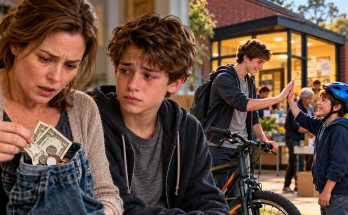
For a moment, I thought about the envelope I had found in his jeans months earlier.
Seven dollars and fifty cents.
I had thought the missing money was the problem.
I had been wrong.
The money had only been a clue.
The real problem was that my son had convinced himself he had to earn his place in the world by taking care of everyone else.
He had learned that lesson from grief.
He had inherited it from his father.
And, without realizing it, he had turned it into something larger than either of them.
But the greatest thing he learned was not how to give.
It was how to receive.
He learned that accepting help did not erase dignity.
That asking for help was not weakness.
That kindness didn't require sacrifice every time.
That a bicycle could be just a bicycle.
That a boy could want something for himself and still care about someone else.
And that coming home was not a failure.
It was part of being cared for.
Years later, the Saturday Table still stood on that same corner.
The paint had been replaced.
The shelves had been repaired.
The study room had grown into a small library.
The bicycle area had expanded.
But the sign above the door remained the same.
Saturday Table.
No names.
No trophies.
No photographs of the people who started it.
Only a place where people could walk in without having to explain why they needed help.
On the anniversary of the opening, Evan found me outside.
He was taller than me by then.
He had a bicycle helmet under one arm.
“You remember this place when it was empty?” he asked.
“I remember.”
“And when I thought I had to save everybody?”
“I remember that too.”
He smiled.
“I was kind of ridiculous.”
“You were thirteen.”
“That explains it.”
We laughed.
Then he looked through the window.
A mother was helping her daughter choose school supplies.
An old man was repairing a bicycle.
A teenager was studying upstairs.
Nobody was being photographed.
Nobody was being thanked.
Nobody was made to feel small.
Evan watched for a while.
Then he said, “Dad would like this.”
I nodded.
“I think so too.”
He put on his helmet.
“I'm going to ride home.”
I smiled.
“Still making me walk?”
He laughed.
“Not today.”
He rode ahead.
I followed slowly.
And for once, I didn't worry about where his money was going.
I didn't worry about who he was helping.
I didn't worry about whether he was carrying too much.
Because he had finally learned the lesson I had been trying to teach him from the beginning.
He was allowed to have a life of his own.
He was allowed to accept love.
He was allowed to come home.
And the boy who had once emptied his bicycle savings to keep someone else's lights on had finally understood something his father had known all along:
You don't help people by becoming responsible for everything they carry.
You help them by making sure they don't have to carry it alone.
Click here to continue reading: PART 9: The Life Evan Built After the Saturday Table Changed Again When a Familiar Face Returned With a Question About Michael
The Saturday Morning I Realized My Son’s Bicycle Dream Was Hiding Something I Had Never Thought to Ask About
Part 8 of 15