
Evan stood inside the storage unit with Michael's final note folded between his fingers.
The fluorescent light above us flickered every few seconds, making the old boxes appear to move in and out of shadow.
Daniel was the first to speak.
“If you mean what I think you mean, we need to be very careful.”
Evan looked at him.
“I mean it.”
“You want to give control away?”
“I want there to be no control for one person to keep.”
Daniel leaned against the metal door.
“That sounds admirable, but legally it isn't simple.”
“I didn't say it was simple.”
I watched my son.
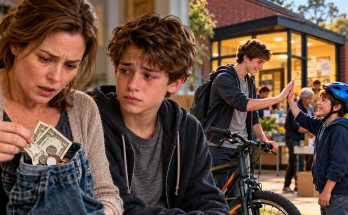
He was no longer the thirteen-year-old who had emptied his bicycle savings because he believed every problem belonged to him.
He had learned something harder.
Helping people did not mean deciding everything for them.
He turned toward the wooden chest.
“Dad didn't leave this to me.”
He held up the note.
“He left instructions for all of us.”
Daniel took the paper and read it again.
“The work was never meant to be inherited,” he said.
Evan nodded.
“Then we shouldn't treat it like an inheritance.”
We carried the chest out of the storage unit.
Back at the Saturday Table, Evan placed Michael's papers in the locked cabinet.
He didn't open them again.
Instead, he called everyone together.
Sal arrived first.
Then Mrs. Alvarez.
Mr. Henderson.
Emma.
Thomas Bell.
Margaret Whitmore.
Samuel Price.
Daniel came last.
They gathered around the long table beneath the window.
Evan stood at one end.
He looked nervous.
I could tell.
His fingers kept touching the edge of the notebook.
But he didn't step away.
“I found something,” he said.
He explained the storage unit.
The list of twenty-four names.
The note.
The phrase about the work being shared.
Nobody interrupted.
When he finished, Margaret looked at the floor.
“My father believed exactly that.”
Evan looked at her.
“Then why did he put Dad's name on the trust?”
“Because he trusted him.”
“But he shouldn't have had to.”
Margaret smiled.
“No.”
She looked around the room.
“Perhaps your father was never meant to be the owner.”
Daniel nodded.
“That is consistent with the original documents.”
Evan sat down.
“So let's change it.”
Daniel looked at him.
“You can't simply change the trust.”
“Then what can we do?”
“We can establish a nonprofit structure.”
“How?”
“With an independent board.”
Evan thought about it.
“Who chooses the board?”
“That is the important question.”
Nobody answered immediately.
Then Mrs. Alvarez raised her hand.
Everyone laughed.
She looked offended.
“I have been waiting for someone to ask.”
Evan smiled.
“What do you think?”
She leaned forward.
“People who use the center should have a voice.”
Mr. Henderson nodded.
“People who volunteer too.”
Emma added, “And young people.”
Thomas looked at her.
“How young?”
“Old enough to be ignored,” she replied.
That made Sal laugh.
The discussion lasted three hours.
They argued.
They compromised.
They crossed names off lists.
They wrote new ones.
They decided that no single donor could control the fund.
No family could permanently control the board.
No employee could approve payments alone.
Every major expense would require two approvals.
Every year, the finances would be made public.
And most importantly, anyone receiving assistance would never be required to publicly explain why.
Evan listened more than he spoke.
When he did speak, it was usually to ask a question.
“What happens if somebody needs help immediately?”
“What happens if there's no money?”
“What happens if the board disagrees?”
“What happens if someone on the board is related to a donor?”
Daniel wrote everything down.
By evening, the basic structure existed.
Not finished.
Not perfect.
But real.
The next challenge was the money.
The fund held enough to operate the building for several years.
But the legal restructuring would cost money.
So would repairs.
So would insurance.
So would keeping food on the shelves.
Evan looked at the account statement.
“We have enough.”
“For now,” Daniel said.
He wasn't trying to discourage him.
He was teaching him what Michael had once taught Robert.
A good intention still needed a durable system.
Evan nodded.
“What would Dad do?”
I smiled.
“Probably make a spreadsheet.”
Sal laughed.
“That sounds right.”
They began building a five-year budget.
Evan wanted to include everything.
Food.
Utilities.
Repairs.
School supplies.
Bicycle parts.
Emergency transportation.
A small reserve.
Daniel added legal expenses.
Mrs. Alvarez added blankets.
Mr. Henderson added tools.
Emma added books.
The list became enormous.
But nobody panicked.
They divided the responsibilities.
For the first time, Evan wasn't standing in the middle of the problem.
He was standing inside a circle of people.
The distinction mattered.
Two weeks later, the nonprofit paperwork was filed.
The new organization needed a name.
Everyone suggested one.
The Whitmore Center.
The Carter Foundation.
The Community Table.
Michael's Place.
Evan rejected all of them.
“No names.”
“Why?” Thomas asked.
“Because then somebody becomes more important than the people we're helping.”
Margaret smiled.
“What about Saturday Table?”
Evan thought about it.
“It doesn't belong to anybody.”
Daniel nodded.
“That may be exactly why it works.”
So the name stayed.
Saturday Table Community Center.
No person's name above the door.
No statue.
No plaque.
Only a small wooden sign.
The day the paperwork was approved, Evan came home with the certificate.
He put it on the refrigerator.
I stared at it.
“You're really proud of that.”
He smiled.
“Yeah.”
“You should be.”
He shook his head.
“Not just me.”
I understood.
That was the whole point.
Then something unexpected happened.
The local newspaper called.
Someone had told them about the center.
They wanted an interview.
Evan immediately said no.
I asked why.
“Because the story isn't about me.”
The reporter wanted photographs.
Evan refused.
They offered to interview me instead.
I refused too.
The Saturday Table stayed quiet.
But the community had already begun talking.
Families told other families.
Volunteers brought other volunteers.
A grocery store donated surplus food.
A bicycle shop offered parts.
A school donated desks.
A nurse offered two afternoons a month.
The center became something larger without becoming louder.
And Evan kept riding his bicycle.
That mattered.
He still rode to school.
He still complained about homework.
He still forgot to put his laundry away.
He still wanted pizza on Fridays.
He was still a kid.
That was one of the rules I quietly insisted on.
The center could be serious.
His life couldn't be only serious.
One Saturday, he came home furious.
“What happened?”
“Someone stole a bike.”
“From the center?”
He nodded.
“A kid borrowed it and didn't bring it back.”
“Do you know who?”
“Yes.”
“What are you going to do?”
“I don't know.”
He looked genuinely angry.
“They needed it.”
“Then why are you angry?”
“Because they lied.”
I waited.
He paced across the kitchen.
“They said their brother needed it to get to work.”
“And?”
“They sold it.”
I could see the old Evan struggling with the new one.
The old Evan would have given them another bicycle.
The new Evan wasn't sure.
“What do you think should happen?” I asked.
He sat down.
“I don't want to punish them.”
“But?”
“They can't just take things.”
“Right.”
“So maybe they need to repay it.”
“With what?”
“I don't know.”
He thought.
Then he smiled.
“They can volunteer.”
I raised an eyebrow.
“That's punishment.”
“No.”
He shook his head.
“They can help repair the bikes.”
“Why?”
“So they understand what it takes to keep them available.”
That was different.
They met the boy the following week.
He admitted what he had done.
He had sold the bicycle because his family needed money.
Evan listened.
Then he asked him to help at the repair bench.
The boy agreed.
Three months later, he was one of the most reliable volunteers.
That evening, Evan told me about it.
“Did you forgive him?”
“I think so.”
“Do you trust him?”
“Not completely.”
I smiled.
“That's okay.”
“I used to think forgiving meant forgetting.”
“And now?”
“It means letting somebody do better.”
I hugged him.
“You're learning.”
“So are you.”
I laughed.
“I hope so.”
The following spring, the Saturday Table held its first community meeting.
Everyone had a vote.
Evan was not the chairman.
He refused.
Instead, he sat at the side with a notebook.
Margaret served as one board member.
Thomas served another term.
Mrs. Alvarez represented families using the center.
Mr. Henderson represented volunteers.
Emma represented youth.
Sal handled operations.
Daniel served as legal adviser but could not vote on financial decisions.
And I served as treasurer.
Evan looked at the board.
Then at me.
“We actually did it.”
I smiled.
“No.”
He frowned.
“What?”
“We started it.”
He looked around.
There were children upstairs.
Adults sorting food.
Someone repairing a wheelchair.
Someone making coffee.
Someone teaching math.
The building was alive.
“Right,” he said.
“We started it.”
He closed his notebook.
Then his phone buzzed.
He checked it.
His expression changed.
“What?”
He handed me the screen.
It was a message from an unknown number.
One sentence.
Your father wasn't the only person who knew where the money went.
I looked at Evan.
His face had gone pale.
The old fear returned.
Not fear for himself.
Fear that the past had found us again.
I looked toward Daniel.
He was already standing.
“Don't respond,” he said.
“Why?”
“Because if this is connected to Victor, we don't know what they want.”
Evan stared at the message.
Then another arrived.
A photograph.
It showed Michael standing outside Robert Whitmore's office.
The picture was old.
But someone had circled a person in the background.
A man none of us recognized.
Except Samuel.
He looked at the photograph.
Then he whispered a name.
“David Mercer.”
Daniel froze.
“That isn't possible.”
“Why?”
Daniel took the phone.
“Because David Mercer died fifteen years ago.”
Evan looked at him.
“Then who took the picture?”
Nobody answered.
And for the first time since the Saturday Table opened, the past no longer felt like something we were simply uncovering.
It felt like something that was watching us back.
Click here to continue reading: PART 14: The Final Photograph Revealed Why Michael Had Kept One Last Secret, and Evan Had to Choose Between Answers and the Life His Father Wanted
The Saturday Morning I Realized My Son’s Bicycle Dream Was Hiding Something I Had Never Thought to Ask About
Part 13 of 15

One Comment on “PART 13 – Evan Refused to Become the Owner of His Father’s Legacy, and His Decision Forced Everyone Involved to Rethink What the Fund Was Really For”