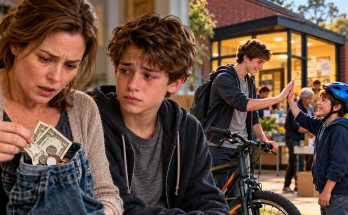
Ten years later, the Saturday Table still stood on the same corner.
The building had changed.
The old paint was gone.
The windows were larger.
The study room had become a proper library.
The bicycle repair area had expanded into a workshop.
There was a small computer room upstairs.
The shelves were always full.
Not because there was always enough.
Because people had learned to keep them full.
Evan was twenty-three.
He had finished university.
He had studied engineering.
He had spent his final year developing low-cost solar systems for community buildings.
And he had not become the director of the Saturday Table.
That had been deliberate.
The board had changed.
The volunteers had changed.
Some of the people who started it had grown older.
Some had moved away.
Mrs. Alvarez still came every Thursday.
Mr. Henderson had retired.
Emma was now a teacher.
Thomas managed several community projects.
Margaret served one final term on the board and then stepped away.
Samuel visited occasionally.
Daniel still handled legal questions.
And I still kept the books.
The center no longer needed Evan.
That was the greatest success of all.
It could survive without him.
He could leave.
He could build something else.
He could live his own life.
That was what Michael had wanted.
One evening, Evan came home carrying a cardboard box.
I knew immediately what it was.
“Where did you get that?”
“Daniel.”
I looked at him.
“What is inside?”
“Dad's remaining files.”
I sat down.
He placed the box on the table.
“There was one document he never gave us.”
“What document?”
Evan opened the box.
Inside was a sealed envelope.
The handwriting was Michael's.
But this time, the envelope wasn't addressed to Evan.
It was addressed to me.
My hands trembled.
“I thought we'd found everything.”
“So did I.”
I opened it.
The letter was short.
Michael wrote that he didn't know whether I would ever read it.
He explained that he had been afraid.
Not of dying.
Of leaving me alone with Evan.
He knew I would try to protect our son from every hardship.
He also knew I couldn't.
The world would hurt him.
People would disappoint him.
He would lose things.
He would make mistakes.
Michael wrote that the only thing he hoped I would teach Evan was that kindness was not a debt.
He didn't owe the world because his father had died.
He didn't owe us because we had raised him.
He didn't owe anyone his future.
He could help because he chose to.
And he could walk away when he needed to.
I couldn't continue reading.
Evan took the letter gently.
He finished it.
Then he looked at me.
“That's exactly what you taught me.”
“No.”
I smiled.
“That's what you learned.”
He folded the letter.
There was one final paragraph.
Michael wrote that if Evan ever discovered the charitable fund, he hoped he would change it.
Not preserve it exactly.
Not worship the past.
Change it.
Make it better.
Then he wrote something that made both of us cry.
If he can make it unnecessary someday, let him.
Evan sat quietly.
“That was the plan.”
“What?”
“To make the fund unnecessary.”
He looked at me.
“That's what I've been trying to do.”
I smiled.
“I know.”
He told me about his solar project.
The systems could power small clinics, schools, and community centers.
The Saturday Table would be one of the first installations.
“No more worrying about the electricity,” he said.
I laughed.
“Mrs. Alvarez is going to love that.”
“She already does.”
“You told her?”
“She found out.”
“Of course she did.”
He smiled.
The following month, the solar system was installed.
The first evening it powered the building, the lights came on without drawing from the grid.
Mrs. Alvarez cried.
Mr. Henderson complained that he didn't understand the controls.
Emma laughed.
The children upstairs kept studying.
Nobody made a speech.
Nobody took credit.
The lights simply worked.
That was enough.
Later that night, Evan and I stood outside.
The sign above the door was illuminated.
Saturday Table.
He looked at it.
“Do you remember when I wanted the bike?”
“How could I forget?”
“I thought that was the biggest thing in my life.”
“You were thirteen.”
“I was very serious about that bike.”
“You still are.”
He laughed.
The bicycle was still in his garage.
Older now.
Scratched.
Repaired dozens of times.
He had never replaced it.
“Do you know what I remember most?” he asked.
“What?”
“The envelope.”
I smiled.
“The one I found in your jeans?”
“Yeah.”
“You had seven dollars and fifty cents.”
“I know.”
“You were terrified.”
“I thought you were going to take the bike away.”
“I thought you were hiding something terrible.”
He looked at me.
“I was.”
“What?”
“A whole life.”
I laughed.
Then he became serious.
“I didn't know how to ask for help.”
“I know.”
“I thought if I gave enough, nobody would ever have to feel the way we did.”
I nodded.
“That was a heavy thing for a kid to carry.”
He looked through the window.
“But I don't regret helping them.”
“Neither do I.”
“I just wish I'd learned sooner that I didn't have to do it alone.”
I put my arm around him.
“That was the real lesson.”
He smiled.
The following year, the Saturday Table board voted to establish a second center.
Not because the first had failed.
Because it had succeeded.
Other communities wanted the same model.
But there was one condition.
No new center could carry the name of Michael Carter.
No center could be controlled by the Carter family.
No center could depend on Evan.
The model would be shared openly.
Food access.
Emergency assistance.
Education.
Repair programs.
Transparent finances.
Community voting.
Dignity.
Independence.
That became the real legacy.
Not a building.
Not a fund.
A method.
A way of helping without making people smaller.
Evan refused to be listed as founder.
When the board insisted on putting his name in the records, he agreed only to one sentence.
He helped begin the work.
Nothing more.
Years later, children who had never met Michael would ride bicycles repaired at the Saturday Table.
Teenagers would study upstairs.
Families would collect groceries.
People would leave donations without knowing exactly where they went.
And sometimes, someone would ask about the old photograph.
The three men.
Robert.
Michael.
Richard.
Three men standing outside an office before any of this existed.
The photograph remained in the archive.
Not on the wall.
Not displayed.
Just preserved.
The note on the back had faded further.
Three men. One promise.
The promise was never about money.
Nobody knew exactly what each man had meant.
Maybe they had understood it differently.
Maybe the promise had changed over time.
But the Saturday Table had given it a meaning.
People would not have to face hardship alone.
That was enough.
As for Victor Hale, his legal case ended years later with convictions related to financial fraud.
The evidence never established that he caused Michael's death.
The accident remained unresolved.
Evan eventually stopped searching for an answer.
Not because he stopped caring.
Because he finally understood what Michael had wanted.
His father's last wish had never been revenge.
It had been freedom.
Evan didn't need to know every detail of the past to live a meaningful life.
He could remember Michael without becoming trapped inside him.
He could honor his father without repeating his choices.
He could help people without sacrificing himself.
And he could walk away.
One Sunday morning, Evan called me.
“Mom?”
“What's wrong?”
“Nothing.”
“You don't call this early when nothing is wrong.”
He laughed.
“I got the grant.”
“For the solar project?”
“Yes.”
“How much?”
“Enough to build systems for thirty community buildings.”
I sat up.
“Thirty?”
“Yes.”
I started laughing.
“What?”
“Remember when you gave away your bicycle money?”
He groaned.
“Please don't.”
“You had seven dollars and fifty cents left.”
“I remember.”
“Now you're giving electricity to thirty communities.”
“I'm not giving it away.”
“What are you doing?”
“Making it easier for people to stand on their own.”
I smiled.
Michael would have understood.
Later that day, Evan came to the house.
He brought the old bicycle.
He had repaired it again.
The orange lettering was faded.
The tires were new.
He wheeled it into the kitchen.
“What are you doing with that?”
“Taking it to the center.”
“For a kid?”
He nodded.
“A little boy asked about it.”
“You're giving away your bike?”
Evan smiled.
“It's not the same.”
“What changed?”
“I know where it goes.”
I looked at him.
He understood now.
Giving didn't have to be dramatic.
It didn't have to cost everything.
It didn't have to erase the person giving.
He could give the bicycle and still have a future.
He could keep the lesson without keeping the object.
We carried the bicycle together.
At the Saturday Table, a little boy stood beside his mother.
He was nervous.
Evan crouched.
“You know how to ride?”
The boy nodded.
“Then let's make sure it fits.”
They adjusted the seat.
The boy climbed on.
He wobbled.
Evan held the back.
“Don't worry.”
The boy looked frightened.
Evan smiled.
“You've got it.”
He let go.
The boy rode across the empty lot.
His mother covered her mouth.
I watched Evan watching him.
There was no sadness in his face.
No need for recognition.
No calculation.
Just pride.
When the boy came back, Evan handed him the helmet.
“Keep it.”
The child hugged him.
Then he rode away.
Evan stood there.
I walked beside him.
“You okay?”
He nodded.
“Yeah.”
“What are you thinking?”
He looked at the old bicycle disappearing down the street.
“I think Dad would have liked that.”
I smiled.
“I think so too.”
He looked at me.
“Mom?”
“Yeah?”
“Thank you for making me come home.”
I understood exactly what he meant.
The diner.
The envelopes.
The Saturday Table.
The courtroom.
The letters.
The secrets.
The photographs.
The old records.
All of it had started with a mother finding seven dollars and fifty cents in her son's laundry.
She had thought she was discovering where his bicycle money had gone.
Instead, she discovered what her son had been carrying inside him.
She discovered a boy trying to make sense of grief.
A father whose kindness had survived him.
A community that could become stronger when people stopped trying to save one another alone.
And a lesson that had taken years to understand.
Evan had once believed kindness meant giving until there was nothing left.
He learned that real generosity could also mean building something that allowed everyone to participate.
Michael had once feared leaving his family without enough.
He left them more than enough.
Not money.
Not certainty.
A direction.
A way forward.
The Saturday Table continued after Evan moved away for work.
It continued after I eventually stepped down from the board.
It continued after Daniel retired.
It continued after Sal sold the diner.
It continued because no one owned it.
That was the ending Michael had wanted.
The work belonged to the people who needed it.
The people who gave.
The people who received.
The people who repaired what was broken.
The people who learned.
The people who passed it forward.
And Evan?
He built his own life.
He married.
He had children.
He taught them how to ride bicycles.
He taught them how to save money.
He taught them that generosity was a choice, not an obligation.
And every year, on the anniversary of the Saturday Table, he returned to that corner.
He would stand beneath the old sign.
Sometimes he brought his children.
Sometimes he came alone.
He never brought the photograph.
He never brought the letters.
He never talked about Victor.
He never spoke publicly about Michael's unresolved death.
He simply walked inside.
He helped where help was needed.
Then he went home.
Because that was the promise.
Not that everyone would be saved.
Not that hardship would disappear.
Not that grief could be undone.
Only that nobody should have to carry everything alone.
And for a boy who had once believed he had to spend every dollar he earned proving that he was useful, that was the greatest inheritance his father could have left him.
Not the money.
Not the building.
Not the fund.
The freedom to care without losing himself.
The freedom to receive without shame.
The freedom to remember without living in the past.
And, most of all, the freedom to come home.
The End
Read more original stories on Feel Every Story.
The Saturday Morning I Realized My Son’s Bicycle Dream Was Hiding Something I Had Never Thought to Ask About
Part 15 of 15