I kept the photograph on my bedside table for three days.
It was only a small picture, creased down the middle and faded around the edges, but I found myself looking at it whenever the room became too quiet.
In the picture, I was eight years old.
My hair was unevenly tied back.
One front tooth was missing.
The blue ribbon in my hand looked enormous.
I remembered that day.
I remembered the poster board.
I remembered the judges.
I remembered standing beside my project waiting for my parents to arrive.
What I hadn't remembered until Dad showed me the photograph was that he had been watching from somewhere in the crowd.
He had kept proof that I mattered.
He simply hadn't known how to act like it.
That distinction hurt.
It also mattered.
Tessa returned from Austin after a few days, and Julian continued sleeping in the waiting room whenever he believed I was too tired to notice.
Camille came with food.
Marisol checked my chart.
The hospital became a strange little version of family.
Not perfect.
Not assigned.
Chosen.
When I was discharged on the twelfth day, I couldn't walk farther than the hospital entrance without getting dizzy.
My recovery was slow.
There were no dramatic breakthroughs.
I learned to stand.
Then walk.
Then climb three steps.
Then four.
I hated needing help.
My physical therapist, Dev Nair, noticed immediately.
“You're trying to hide pain,” he said during one session.
“I don't want to slow down.”
“Pain isn't failure.”
“I know.”
“No, you don't.”
He pointed toward my leg.
“If it hurts, tell me. That's information.”
I looked at him.
“You're very direct.”
“It saves time.”
I laughed.
He smiled.
“You've spent years treating independence like a virtue. Sometimes it is. Sometimes it's just another word for refusing assistance.”
I didn't argue.
Because he was right.
At home, I began asking.
Small things at first.
Tessa refilled my water.
Camille helped me button a shirt.
Julian drove me to an appointment.
Each request felt strangely uncomfortable.
Each time, someone simply said yes.
No score.
No debt.
No reminder that they had done me a favor.
That was new.
My house changed too.
Rooms that had always seemed too large slowly began filling with people.
Tessa stayed for more than a week.
Camille visited twice a week.
Julian came on Sundays.
Marisol came on her days off.
The first time she arrived without her hospital uniform, I barely recognized her.
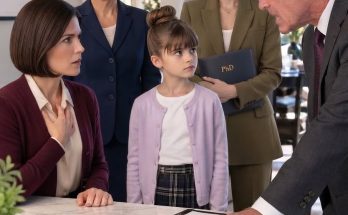
Beside her stood a serious little girl with a long braid.
“This is Sofia,” Marisol said.
Sofia held out a piece of folded construction paper.
“I made you something.”
I opened it.
A purple dog covered most of the page.
One paw had a bandage drawn around it.
Beneath the picture were four words written in careful capital letters.
YOU ARE NOT ALONE.
I stared at the card.
“Did you make this yourself?”
Sofia nodded.
“I used my good markers.”
I laughed through tears.
“That makes it very important.”
“I know.”
Marisol smiled.
Something about that card stayed with me.
A child had seen me once, understood that I was hurting, and decided to bring me something.
No history.
No obligation.
No inheritance.
Just kindness.
Around the third week, my mother's letter arrived.
I recognized her handwriting immediately.
I left it unopened for four days.
When I finally opened it, the first page was filled with explanations.
She loved me.
But she hadn't understood the seriousness.
She regretted everything.
But Lauren's move had been overwhelming.
She never intended to hurt me.
But the situation had affected her badly.
I counted the word.
Eleven times.
But.
I folded the letter and put it away.
It wasn't cruel.
That was the difficult part.
It was sincere in the way some people can be sincere while still protecting themselves from the full weight of what they've done.
She wanted me to understand her.
She had not yet learned to understand me.
A few days later, Julian brought another piece of information.
“My parents are in counseling,” he said.
I looked up.
“Together?”
“And separately.”
I waited.
“Your father called my office.”
“Why?”
“He wanted me to know he wasn't asking for anything.”
“What did he say?”
Julian stirred his coffee.
“He said, ‘I'm not trying to change her mind. I'm trying to change mine.’”
I sat quietly.
That sentence didn't repair anything.
But it was different.
I let it remain different.
I didn't send a message.
I didn't call my parents.
I simply allowed the information to exist.
Weeks passed.
My strength returned.
The lake house became the next problem.
I drove there with Julian and Camille one cold October morning.
The house stood beside the water, its cedar siding darkened by autumn rain. The dock stretched into the lake, and leaves gathered against the shoreline.
My parents had spent years there.
They loved the place.
So did I.
Standing on the porch, I realized I didn't want to sell it.
I also didn't want to keep it as a monument to what my family had done.
“What if it became something useful?” I said.
Julian looked at me.
“What kind of useful?”
“A place for people who have been in hospitals too long.”
Camille turned toward the lake.
“Families who need somewhere quiet.”
“Patients recovering without proper support.”
Julian considered it.
“No expectations?”
“No expectations.”
I looked at the empty rooms.
“A place where nobody has to earn the right to rest.”
Camille squeezed my arm.
“That sounds like something worth keeping.”
We called it Harbor House.
The name came easily.
The purpose took longer.
Around the same time, I asked Marisol to meet me for coffee.
She arrived expecting nothing more serious than a conversation.
Instead I offered her a job.
She stared at me.
“I am a nurse.”
“I know.”
“I like being a nurse.”
“I know.”
“I don't run organizations.”
“You understand patients better than anyone I know.”
She looked uncertain.
“I want you to lead patient advocacy for the foundation.”
She shook her head.
“Miranda, I wouldn't know where to start.”
“You'd build it.”
“Why me?”
“Because you sat beside a frightened stranger when you didn't have to.”
She looked down.
“My mother would have loved something like that.”
“I think she would have.”
Marisol smiled sadly.
Then she accepted.
The first program became the Open Line.
A hospital support service built around one simple idea: nobody should have to sit in a frightening room believing they have no one to call.
I didn't tell my parents about it.
Not yet.
I wanted the work to belong to me before it belonged to the story.
Months passed.
My mother continued writing.
My father called Julian occasionally.
Lauren sent short messages that gradually became less defensive.
Then one evening, Lauren called me directly.
I almost didn't answer.
I did.
“Hello?”
There was silence.
“Miranda?”
“Yes.”
“It's me.”
“I know.”
She breathed out.
“I don't know what to say.”
“Then don't say anything.”
“I want to apologize.”
I closed my eyes.
“You can.”
“I was awful.”
“You were scared.”
“That doesn't excuse it.”
“No.”
Another silence.
Then she said, “I used to think you were lucky because Mom and Dad trusted you to handle everything.”
I said nothing.
“I didn't understand that they trusted you because they had trained you not to need them.”
My throat tightened.
“That was exactly it.”
“I know.”
Her voice broke.
“I'm sorry.”
I didn't forgive her immediately.
But I didn't hang up either.
We talked for eleven minutes.
It was the longest conversation we'd had without our parents in the middle of it.
When we finished, she said, “I hope someday I can be your sister without needing something.”
“I hope so too.”
Neither of us promised more.
That was enough.
Months later, my parents came to the lake house for the first time since everything changed.
It wasn't a reunion.
There were boundaries.
A short visit.
Coffee.
Dessert.
Nothing more.
Mom brought a covered dish.
Dad carried a white envelope.
Inside was a check for $6,412.08.
The exact amount spent from my emergency account.
The memo line read:
For the crib. I'm sorry.
I looked at him.
“You didn't have to do this.”
“Yes,” he said.
His voice was quiet.
“I did.”
I held the check.
“I don't want the money.”
“I know.”
“I'll donate it.”
He nodded.
“To the Open Line.”
He looked surprised.
“In your name.”
His eyes filled.
“I don't deserve that.”
“No.”
I folded the check.
“You don't have to deserve it. You just have to keep showing up.”
Behind us, Sofia's laughter came from the dock.
Mom was with her.
Dad listened to the sound.
For once, he didn't rush to explain himself.
He simply stood there.
And stayed.
Click here to continue reading: PART 5: The money returned to Harbor House opens an old wound, revealing why Lauren once believed Miranda would always rescue her when everyone else walked away
Nine unanswered calls, one hospital room, and a decision that would force Miranda to finally confront what her family had taught her to accept
Part 4 of 10