I had spent years believing the hardest thing a man could do was bury his own child.
That morning, I learned there was something else that could hurt almost as much.
Watching that child's son feel unwanted.
My grandson Caleb was nine years old.
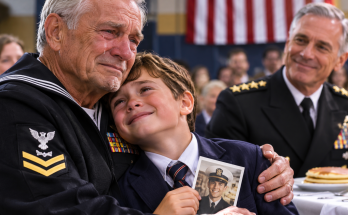
He was standing beside me in a school gymnasium, holding on to my uniform as though the cloth itself might keep him from being sent away.
I could feel his fingers against my back.
Small fingers.
A grip that was stronger than it should have been.
He had already been told he wasn't supposed to attend the father-son breakfast.
His father was dead.
And according to the rules of the academy, having a grandfather beside him did not solve that problem.
I had tried to tell myself that the school had simply made a poor decision.
A thoughtless decision.
Something that could be corrected without making a scene.
But standing there with Caleb, I was beginning to understand how much damage a few careless words could do.
The boy had not chosen to lose his father.
He had not chosen to grow up with stories instead of memories.
He had not chosen to carry a photograph of a man he could barely remember.
Yet somehow, he had been made to feel as though those losses were reasons he should be excluded.
I was angry.
Not the loud kind of angry.
The kind that settled in my chest and made it difficult to swallow.
I had worn a Navy uniform through situations that most people would never experience.
I had seen men make terrible decisions under pressure.
I had seen other men do extraordinary things without expecting recognition.
And I had learned that being in charge did not automatically make a person right.
That lesson was coming back to me in a school gymnasium.
Not aboard a ship.
Not in an emergency.
At a breakfast.
There were roughly two hundred people watching what happened around us.
Fathers.
Sons.
School employees.
The academy's headmaster, Dr. Daniel Prentiss, was there as well.
So was Admiral James Carrick.
I had not expected the admiral to become part of Caleb's morning in the way he did.
In fact, until a few moments earlier, I had not even realized who he was.
He was speaking about an incident from my years in the Navy.
An incident involving a shipboard fire.
One I had carried in my memory for decades.
The admiral mentioned a nineteen-year-old sailor.
And suddenly I could see that young man's face again.
Not clearly.
Not every feature.
But enough to remember the fear.
I remembered smoke.
I remembered the urgency of getting people out of danger.
I remembered a young sailor who seemed unable to move because he was terrified.
I had sent him toward the emergency station.
Then I had gone back to help deal with the fire.
That was how I remembered it.
There had been too much happening to give any one moment the attention it deserved.
People needed help.
There were jobs to do.
And hesitation could have consequences far beyond the person who hesitated.
I knew I had spoken to the sailor.
I could remember taking hold of him.
I could remember trying to get through to him.
But I could not remember his name.
That bothered me as I stood in front of the admiral.
A name seemed like such a small thing.
Until the person who carried it appeared in front of you after all those years.
The admiral watched me for a moment.
He had a slight smile.
Not the polished smile of someone speaking to a crowd.
Something quieter.
Something personal.
Then he told me who he had been.
The frightened young sailor from that day was standing before me now.
Admiral James Carrick.
I stared at him.
For a moment, I could not make those two images fit together.
The young man I remembered had been nineteen.
The man in front of me had spent decades building a military career.
I had known only one brief, frightening part of his life.
He had lived all the years that came afterward.
And there he was.
Looking directly at me.
The gymnasium grew restless with surprise.
I heard people reacting around us.
But their voices seemed far away.
I kept looking at Carrick.
It was difficult to believe that the man before me was the same sailor I had once directed toward safety.
He seemed to understand my confusion.
He told me that I probably had no memory of the exact words I had used that day.
He was right.
There were things from my service I could recall with painful precision.
A sound.
A face.
The location of a piece of equipment.
Other things had faded.
Words disappeared first, sometimes.
Especially words spoken during an emergency.
I asked him what I had said.
I meant it as a simple question.
But I could hear the uncertainty in my own voice.
He paused before answering.
Then he told me.
He remembered me taking him by the shoulders.
He remembered admitting that he was frightened.
And he remembered the lesson I had given him.
Fear itself was not a failure.
What mattered was whether he allowed fear to prevent him from helping the men who needed him.
I had told him to move.
To take action.
To help save the others aboard that ship.
That was the part he had never forgotten.
I listened without interrupting.
It was strange hearing my own younger self described by another man.
Stranger still to realize that something I had said without preparing or planning had remained with him for so long.
At the time, I had not been trying to teach a lasting lesson.
I had been trying to get a frightened sailor moving.
That was all.
I had not known whether he would remember me.
I had not expected to see him again.
And I certainly had not imagined that he would someday stand before a school gathering wearing the rank of an admiral.
He looked at me with an expression I could barely hold.
Gratitude.
Not the polite gratitude people offer when someone holds a door open.
The kind that comes from remembering a day when you thought you might die.
His voice changed as he spoke.
He told me he had believed his life was about to end.
He told me that my words had helped him find the courage to act.
And he told me that I had saved his life.
I wanted to answer.
I opened my mouth.
Nothing useful came out.
What was I supposed to say?
That I had only done my job?
That anybody else would have done the same?
I knew those answers.
I had heard them from other servicemen.
I had given them myself.
But the admiral was not asking for an explanation.
He was telling me what that day had meant to him.
And I owed him the courtesy of listening.
He held out his hand.
I took it.
His grip was firm.
Familiar.
Then he did something that caught me completely off guard.
He drew me toward him.
Not for another handshake.
For an embrace.
A military man holding another military man.
Without ceremony.
Without a speech prepared to explain it.
I stood there for a moment, unsure what to do with the feelings rising in my chest.
Then I returned the embrace.
I had not expected that morning to bring me face-to-face with someone from my past.
I had come for Caleb.
Everything about the day had been about Caleb.
His school.
His exclusion.
His disappointment.
His need to know that someone would stand beside him.
But while the admiral held me, I became aware of another part of my life pressing into that room.
The Navy.
The men I had served with.
The decisions I had made.
The years that had passed.
And my son.
My son, who had also worn a uniform.
My son, who would never have another morning with his little boy.
I felt Caleb's hand against my back.
He was still there.
Holding on.
I had almost forgotten how firmly he was gripping me.
That little touch brought me back to the school gymnasium.
Back to the breakfast.
Back to the reason I had put on my old uniform.
I was not standing there as a chief receiving praise.
I was standing there as a grandfather trying to protect a child.
The admiral stepped away.
For a moment, neither of us said anything.
I looked at him.
He looked at me.
There are times when two men understand something without having to put it into words.
This was one of them.
Then Carrick's attention moved downward.
Toward the little boy beside me.
Until that moment, most of what had happened had been between the admiral and me.
Caleb had watched.
He had listened.
He had held my uniform.
But now the admiral noticed him directly.
I saw the change in Carrick's face.
The seriousness was still there.
So was the emotion from our reunion.
But he softened his expression.
He looked at Caleb the way a grown man should look at a child who is standing in the middle of an uncomfortable situation.
Not as a problem.
Not as an interruption.
As a person.
I glanced down at my grandson.
He was wearing his blazer.
His shoulders were drawn in slightly.
He had been surrounded by people that morning, yet I knew how alone he had felt.
I wanted him to lift his head.
I wanted him to see that he belonged in that room.
But I could not make him feel it simply by telling him.
That was the hard part of being his grandfather.
I could put on my uniform.
I could stand beside him.
I could argue with a headmaster.
I could even face an admiral without losing my composure.
But I could not give Caleb back the father he had lost.
There were limits to what my love could repair.
I hated those limits.
The admiral looked from Caleb to me.
Then he asked about the boy.
Such a small question.
The kind adults ask children every day.
Yet I saw Caleb become even more aware of the room around him.
He had been told he was the wrong kind of guest for this particular breakfast.
Now a man of extraordinary rank was giving him his full attention.
I wondered whether Caleb understood the difference.
I wondered whether any of us truly did.
The admiral had recognized me because of something I had done many years before.
Something I barely remembered in the same way he did.
But my grandson was standing beside me carrying a hurt that had happened that very morning.
A hurt no one at the school seemed willing to acknowledge properly.
Looking back, I think that was the moment the two parts of the morning finally came together.
My past.
Caleb's present.
The men who survived.
And the people who were left behind.
I had spent so many years thinking about the people we had lost.
I had almost forgotten how much those who remained still needed from us.
Caleb lifted his face.
His hand loosened slightly against my uniform.
The admiral waited for him to speak.
And I stood beside my grandson, knowing that whatever happened next, the boy should not have to apologize for being there.
Click here to continue reading: PART 2: When My Grandson Told the Admiral That I Was Not His Father, the Whole Room Finally Heard What the School Had Ignored
I Thought My Old Navy Uniform Would Only Remind Me of My Dead Son, Until an Admiral Recognized My Face
Part 1 of 15