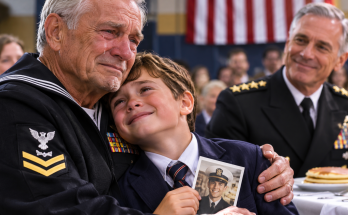
I looked at the sleeve of my uniform.
It seemed strange to see it resting beside a breakfast plate.
For years, I had associated that fabric with formal occasions.
Military duty.
Ceremonies.
And one particular day I had wished never happened.
My son's funeral.
I remembered putting the uniform away afterward.
I had not wanted to look at it again.
I told myself that my service was finished.
There was no reason to wear it.
I had earned the right to leave that part of my life behind.
But that was only part of the truth.
The deeper truth was harder to admit.
The uniform reminded me of my son.
And remembering him hurt.
Not always in the same way.
Some memories brought warmth.
Some made me smile.
Others left me unable to speak.
The funeral belonged to that last group.
I remembered the flag.
I remembered the sound of the ceremonial gunfire.
I remembered the final notes of the bugle.
And I remembered the silence.
That silence had followed me home.
It stayed with me long after the ceremony ended.
I would hear an ordinary sound.
A door closing.
A chair moving.
A familiar voice.
And suddenly I would remember that my son would never walk into the room again.
I had never learned how to make that knowledge easy.
I did not believe anyone could.
People sometimes spoke about healing as though grief were an injury that eventually disappeared.
I had stopped expecting that.
My son was dead.
I would always miss him.
That was not something I needed to overcome.
It was something I needed to live with.
The problem was that I had begun confusing remembering with suffering.
I had treated the uniform as though touching it would reopen every painful moment.
So I kept it in the garment bag.
I avoided looking at it.
I convinced myself that distance was helping.
Perhaps it was.
For a time.
But the morning at Caleb's academy had shown me that the uniform could carry other memories too.
I looked at my grandson.
He was sitting close to me.
The photograph of his father was still in his hand.
I thought about the way he had held my uniform earlier.
His fingers gripping the fabric behind my back.
The admiral had been speaking.
Two hundred people had been watching.
And Caleb had reached for the person he trusted.
He had not reached for my medals.
He had not been impressed by the history of the uniform.
He had simply wanted his grandfather nearby.
That memory meant more to me than the applause.
I thought about the walk toward the stage.
The men standing as we passed.
The father in the navy suit telling Caleb that his grandfather had done something brave.
My grandson's answer.
“He's my grandpa.”
I smiled at the memory.
He had reduced all the ceremony to the one thing that mattered.
I was his grandfather.
Not a legend.
Not a symbol.
Not someone he needed to admire from a distance.
I was the man who told him stories.
The man who had come to breakfast.
The man whose hand he could hold.
I had spent years defining myself partly through the son I lost.
That was natural.
My son's death had changed everything.
But Caleb was reminding me that I still had a place in the lives of people who were here.
I was still needed.
Not because of my former rank.
Because I loved him.
I looked toward Admiral Carrick.
He had finished explaining the veterans' program.
He had invited me to help.
I had accepted.
Caleb had asked to come too.
And the admiral had welcomed him.
It all sounded simple when I thought about it that way.
Yet the decision had required me to face something I had been avoiding for years.
I had to admit that I was afraid of my memories.
That was not an easy thing for an old Navy chief to say.
I had served through dangerous situations.
I had watched men struggle with fear.
I had helped a frightened sailor find the courage to act during a fire.
But grief had left me hesitant in ways I did not always understand.
I could talk about courage.
I could recognize it in other people.
Yet I had spent years unwilling to wear an old uniform because of the memories it brought.
I did not feel ashamed of grieving.
I knew better than that.
But I did feel that I had allowed grief to close a door I might have been able to leave open.
The admiral's invitation helped me see it.
He was not asking me to forget my son.
He was not asking me to celebrate military service without acknowledging its cost.
He was asking me to speak honestly.
About duty.
About leadership.
About sacrifice.
About the ordinary people who wore uniforms and did their best under difficult circumstances.
I could do that.
I had lived those experiences.
I had seen fear.
I had seen courage.
I had seen people help one another.
I had seen decisions made in moments when nobody could know what would happen next.
And I had learned lessons worth passing along.
I thought again about Carrick at nineteen.
He had been frightened.
I had taken hold of his shoulders.
I had told him he could still be useful.
He had remembered.
That was what surprised me most.
Not that he became an admiral.
Not that he recognized my face.
That he had carried a brief conversation through so many years.
I wondered how many things we said or did became part of someone else's life without our knowing.
A warning.
An encouragement.
A small kindness.
A hand offered at the right moment.
Most of those things would never be remembered publicly.
But perhaps they still mattered.
I looked at Caleb.
He was a child who had lost his father.
He would carry memories of this morning.
Some painful.
Some comforting.
I hoped my actions would be among the comforting ones.
I hoped he would remember that I came.
That I did not leave him alone in the library.
That I stood beside him when he spoke.
That I listened when he wanted to know more about his dad.
Those were the things I wanted to give him.
Not a reputation.
Not a story about being brave.
A steady presence.
I knew there would be moments when I could not answer every question.
I knew there would be times when speaking about my son hurt.
But I no longer wanted Caleb to believe those difficulties meant he should stop asking.
He had already lost too much.
I wanted his father's name to remain welcome in our conversations.
His photograph to remain something he could show.
His questions to be met with patience.
And his grief to be accepted without making it the only thing people saw.
I remembered the girl Margaret Ellis had mentioned.
The one excluded from a Mother's Day luncheon.
I did not know her.
I did not know what she had felt.
But I understood the kind of absence she was living with.
I hoped the academy would learn from what happened.
Not simply because an admiral had criticized the headmaster.
Not because the room had applauded.
Because the children deserved better.
I had told Margaret that I did not want special treatment.
I meant it.
I wanted Caleb treated like the other students.
If they could bring someone who loved them, he should be able to do the same.
That was not a complicated demand.
It should not have required a public confrontation.
But now that the issue had been exposed, I hoped the board would address it.
Margaret had arranged an emergency review.
That was the action she had promised.
I did not know what would come from it.
I would not pretend I did.
I had learned to be cautious about promises made in public.
Sometimes people acted because they understood a problem.
Other times they acted because everyone was watching.
The difference became clear later.
I hoped the academy would make lasting changes.
But I had no wish to spend the rest of Caleb's childhood fighting over that morning.
I wanted him to move forward.
To enjoy school.
To make friends.
To talk about baseball.
To learn.
To grow.
And to know that his father's death did not make him unwelcome.
I thought about Ethan.
The boy who had introduced himself at breakfast.
He had asked Caleb about baseball.
Such a small thing.
Yet it had changed the mood at our table.
Caleb had gone from being the child everyone was discussing to being another boy talking with friends.
I remembered how relieved I felt watching him.
That was what belonging looked like.
Not applause.
Not a speech.
A conversation about baseball.
A chair moved to make space.
A plate of pancakes offered without hesitation.
Those details stayed with me.
I wondered whether the people who offered them understood their importance.
Perhaps not.
Perhaps they had simply been kind.
That was enough.
I had learned during military service that ordinary actions could have extraordinary consequences.
Carrick had reminded me of that.
But the breakfast had shown me something else.
Ordinary kindness could help a child recover from a moment of humiliation.
Not erase it.
Not pretend it never happened.
But remind him that one person's decision did not represent everyone.
Caleb had heard the headmaster defend excluding him.
He had also heard an admiral challenge that decision.
He had heard Margaret explain the scholarship.
He had heard people applaud when he spoke about his father.
And he had been invited to sit with other children.
I hoped those memories would balance the painful one.
I looked again at my uniform.
I thought about the garment bag waiting for it.
Eventually I would put the uniform away.
That was obvious.
But I knew it would feel different when I did.
I would not be putting away only the memory of my son's funeral.
I would be putting away the memory of this morning too.
Caleb's hand.
The admiral's embrace.
The applause.
The photograph.
The invitation.
Those memories had become part of the fabric.
Nothing could separate them now.
I found that comforting.
I had spent years believing the uniform belonged to a chapter of my life that had ended.
But perhaps a life did not divide itself so neatly.
My years in the Navy were over.
My son's life had ended.
Yet the things those years had taught me were still useful.
The people I had helped were still living their own stories.
My grandson was still growing.
And I still had something to give.
I did not know exactly what helping with the veterans' program would involve.
Carrick had not laid out every detail.
I had not asked for a schedule.
I had simply agreed to help.
That was enough for the moment.
I could listen to children.
I could answer questions honestly.
I could share stories about service without pretending it was easy.
And perhaps I could help them understand that the people they loved were more than the uniforms they wore.
I wanted that for Caleb.
His father had worn a uniform.
His father had died in service.
Those were important truths.
But they were not the whole measure of his life.
He had been my son.
He had been Caleb's father.
He had loved his family.
That mattered more to me than any formal recognition.
I looked at my grandson.
He was still close enough for me to reach him.
I placed a hand on his shoulder.
He looked up.
I smiled.
He smiled back.
Neither of us needed to say anything.
The morning had been filled with words.
Too many, perhaps.
Rules.
Explanations.
Speeches.
Apologies.
Questions.
But the quiet between us felt different.
It did not feel empty.
It felt comfortable.
I had spent years associating silence with the moment after the bugle stopped.
Now I was sitting beside my grandson in another kind of silence.
One that held no finality.
One that allowed life to continue.
I looked down at the uniform once more.
I could still remember the funeral.
I always would.
But now, when I touched the fabric, I could also remember Caleb holding my hand.
And for the first time in years, that felt like enough reason not to hide from it.
Click here to continue reading: PART 15: My Grandson Never Got His Father Back That Morning, but He Left Knowing His Family Belonged and His Father’s Stories Would Continue
I Thought My Old Navy Uniform Would Only Remind Me of My Dead Son, Until an Admiral Recognized My Face
Part 14 of 15