I had heard a lot of excuses during my years in the Navy.
Some were foolish.
Some came from fear.
And some sounded so reasonable that you had to listen twice to understand what was missing.
Dr. Prentiss's explanation belonged to that last group.
He spoke calmly.
He used the kind of language people expect from a headmaster.
He explained that the father-son breakfast had been created to celebrate a particular family relationship.
He said the academy had guidelines.
He said those guidelines needed to be applied consistently.
And he said that my participation as Caleb's grandfather did not meet the event's requirements.
I listened.
I tried not to show what I was feeling.
I had learned long ago that anger could make people stop hearing the point you were trying to make.
But there was something deeply wrong with the way he was describing the situation.
The headmaster kept talking about the event.
I kept thinking about the boy.
An event could be adjusted.
A rule could be rewritten.
A breakfast could accommodate another chair.
Caleb could not change the fact that his father had died.
That difference seemed so obvious to me that I struggled to understand why it needed explaining.
The admiral remained still.
He asked for clarification.
Had Caleb's father died while serving his country?
Dr. Prentiss acknowledged that he had.
I felt my stomach tighten.
Hearing someone else confirm my son's death was never easy.
Even after years had passed.
It was a fact I lived with every day.
But hearing it spoken aloud could still catch me by surprise.
My son had died.
That was the simple truth.
He had left behind a child who missed him.
A family that continued without him.
And a father who sometimes found it difficult even to look at his old uniform.
I could stand there with my shoulders straight.
I could answer an admiral.
I could keep my voice steady.
None of that meant the loss had become small.
The admiral asked another question.
Was it true that I had offered to attend so my grandson would not be left out?
The headmaster looked toward me.
I did not move.
There was nothing to explain.
I had come because Caleb needed someone.
I was his grandfather.
And if he wanted me beside him at school, that was where I intended to be.
Dr. Prentiss acknowledged the circumstances.
But he returned to the same point.
The academy could not simply disregard its policies because a situation was emotional.
I remember that word.
Emotional.
He did not say it cruelly.
At least, I did not hear cruelty in his voice.
But the effect was the same.
My grandson's grief had become an inconvenience that needed to be handled without disturbing an established procedure.
Looking back, that was the part that stayed with me.
It was not the headmaster's tone.
It was the distance between his words and the child standing beside me.
I had seen that distance before.
Not at a school.
In other places.
In situations where a written instruction became more important than the human being it was supposed to help.
Good rules mattered.
I believed that then.
I believe it now.
A ship cannot function if everyone decides for himself which order to follow.
There must be structure.
There must be accountability.
People must know what is expected of them.
But any experienced leader understands that a rule must have a purpose.
And when following that rule causes unnecessary harm, the leader must be willing to examine it.
That is not weakness.
It is responsibility.
I watched the admiral listening to Dr. Prentiss.
I knew enough about military leadership to recognize that Carrick was not impressed by a polished explanation.
He was trying to find out whether the headmaster understood the result of his decision.
Not whether he could defend the wording.
Not whether he could name the policy.
Whether he understood what had happened to Caleb.
The headmaster's answers made me doubtful.
He seemed more comfortable discussing consistency than compassion.
That was his choice.
But it was a choice being made in front of everyone.
I looked across the gymnasium.
The fathers who had gathered to celebrate their sons were listening.
Some had their children sitting beside them.
Some boys were old enough to understand the conversation.
Others were simply watching the adults.
I wondered how many of those fathers had ever considered what a morning like this might feel like to a child who had lost a parent.
Perhaps they had never needed to.
I could not blame them for that.
A person does not have to experience every kind of suffering to be decent.
But a person does have to be willing to recognize suffering when it is standing right in front of him.
That was what I wanted from Dr. Prentiss.
Recognition.
Not a performance.
Not a promise made only because an admiral was present.
Just the simple admission that the school had hurt a boy unnecessarily.
I glanced at Caleb.
He was looking toward the adults.
His face was serious.
I could not tell how much of the conversation he understood.
Children often understand more than we think.
And sometimes they misunderstand exactly the part we most want them to understand.
I worried he might believe the disagreement was his fault.
That bringing me had created a problem.
That wanting to join the other boys had been asking for too much.
I wished I could tell him, right there, that none of those things was true.
But the admiral was speaking again.
He had reached up to remove his glasses.
It was a small movement.
Unhurried.
He set them down.
Then he addressed Dr. Prentiss directly.
His voice remained controlled.
That made his words carry even more weight.
He spoke about the many years he had spent watching people make decisions.
He had seen leaders face situations that were not easy.
He had seen procedures used wisely.
And he had seen rules turned into excuses by people who did not want to take responsibility for doing the right thing.
I could tell he was speaking from experience.
He was not interested in insulting the headmaster.
He was interested in naming the problem.
He explained that the purpose of a policy was to help the people affected by it.
A policy was not something sacred that had to be protected even when it harmed someone unnecessarily.
He did not have to raise his voice.
The room was already listening.
I felt Caleb move slightly beside me.
His hand was still close to mine.
And I realized something about the conversation that had escaped me earlier.
This was the first time anyone had challenged the school's decision in a way that the headmaster could not easily dismiss.
I had my own objections.
I was Caleb's grandfather.
Of course I wanted him included.
It would have been easy for the administration to see my protest as personal.
The admiral was different.
He had no reason to defend my family except that he believed the school had made the wrong decision.
His rank gave his words authority.
But the truth of what he was saying did not depend on that rank.
That mattered to me.
I did not want Caleb to learn that an injustice only became important when a powerful man noticed.
I wanted him to understand that it had been wrong from the beginning.
Before the admiral spoke.
Before anyone applauded.
Before anybody knew about my years in uniform.
It had been wrong when someone told him he could not attend because his father was dead.
Nothing that happened afterward changed that.
The admiral's words reached the people seated closest to us first.
I saw a father begin to clap.
Just one man.
A simple expression of agreement.
Then someone else joined him.
I did not look around immediately.
I was still watching Dr. Prentiss.
I wanted to see whether he would respond.
Whether he might acknowledge that the situation could have been handled differently.
Instead, the applause grew.
More people joined in.
The sound spread across the gymnasium until it filled the space.
I had attended formal military events.
I knew the sound of a room applauding someone whose achievements people respected.
This felt different.
The people were not responding to a medal.
They were not celebrating a promotion.
They were responding to the idea that a little boy should not have been punished for losing his father.
Such an ordinary principle.
Such a simple thing.
And yet hearing an entire room agree with it affected me more than I expected.
I did not clap.
I could have.
I agreed with every part of the admiral's criticism.
But I was not thinking about the headmaster anymore.
I was looking at Caleb.
My grandson had changed.
Not dramatically.
He had not begun jumping or waving.
He had not forgotten the hurt of the morning.
But his face was different.
The tension around his mouth had eased.
His shoulders were less rigid.
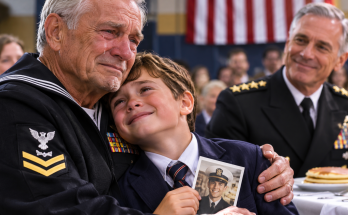
And then I saw it.
A smile.
Small at first.
Almost uncertain.
But real.
It was the first one I had seen from him that morning.
I felt something inside me loosen.
I had been so worried about making the school understand that I had almost forgotten how quickly a child's expression could tell you what mattered.
He felt seen.
That was it.
He had stood in a room full of people who had been invited to celebrate their families.
And for much of that morning, he had been made to feel that his own family did not qualify.
Now those same people were applauding the idea that he should be included.
I could see him trying to understand the change.
He looked toward the clapping adults.
Then toward the admiral.
Then at me.
I gave him the smallest nod I could manage.
I did not want to make a speech.
I did not want to embarrass him.
I only wanted him to know that he was allowed to smile.
His smile stayed.
I remember that more clearly than the applause.
I remember the sound of people clapping.
But I remember the look on his face even more.
My son had missed so many moments like this.
Small moments that did not seem important until you realized how much they meant.
A school breakfast.
A child wearing a blazer.
A smile after a difficult morning.
I had wished, more times than I could count, that my son could have been there for his boy.
I wished it again.
But at least Caleb was no longer standing alone with his hurt.
The room had heard him.
And for the first time that morning, it seemed to understand.
The applause continued.
I kept my eyes on Caleb.
I wanted to preserve that moment in my memory.
Not because an admiral had spoken.
Not because the headmaster had been corrected.
Because my grandson had finally stopped looking as though he had done something wrong.
I thought that might be enough for the morning.
I thought perhaps the adults would return to their tables.
Perhaps someone would invite Caleb to join the breakfast.
Perhaps Dr. Prentiss would reconsider his decision.
I would have been satisfied with something that simple.
But when the applause began to ease, Admiral Carrick did not return to his seat.
He turned toward the podium.
He asked the event coordinator for the microphone.
And I realized he intended to do more than criticize a policy.
He intended to change what the room was celebrating.
Click here to continue reading: PART 4: The Admiral Took the Microphone and Changed the Meaning of Father-Son Breakfast Before Asking My Grandson to Stand Beside Him
I Thought My Old Navy Uniform Would Only Remind Me of My Dead Son, Until an Admiral Recognized My Face
Part 3 of 15