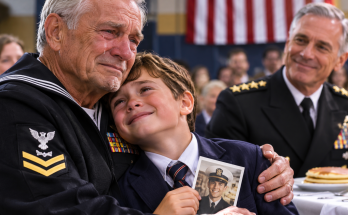
Admiral Carrick pulled a chair toward our table.
He sat down without asking anyone to make a fuss.
That was the first thing I noticed.
A man with four stars on his uniform had spent the morning commanding the attention of an entire gymnasium.
Now he was sitting across from a nine-year-old boy who had just finished eating pancakes.
He looked comfortable there.
Almost relieved.
I had known officers who carried their rank into every conversation.
Carrick did not seem interested in doing that.
At least, not with Caleb.
He rested his hands on the table and looked from my grandson to me.
I waited.
He had asked to speak with both of us.
And after everything that had happened, I was curious about what he had in mind.
Caleb was still sitting beside me.
His father's photograph had been folded again.
He held it carefully.
I could see the crease in the paper.
That little photograph had become part of the morning in a way I never expected.
It had been in his backpack when we arrived.
Then in his blazer pocket.
Then in his hand as he stood before two hundred people.
Now it was resting against his fingers while he listened to an admiral.
I wondered what Caleb would remember most about that day.
The embarrassment?
The applause?
The pancakes?
Or the moment he learned that people still cared about the father he had lost?
I hoped it would not be the embarrassment.
That was the memory I wanted to protect him from.
But I knew I could not choose what stayed with him.
Children have their own ways of remembering.
Sometimes the smallest detail becomes the one they carry for years.
Admiral Carrick glanced at my uniform.
Then he looked back at Caleb.
He said he had been thinking about military families.
Not only the people who served.
The people who waited for them.
The children who grew up listening to stories about parents they could not always see.
And the children whose parents would never return.
I felt my expression change.
I had spent years thinking about those families.
Especially after my son's death.
But I had not always known what to do with the thoughts.
There were memories I could share.
There were things I could explain.
There were questions I could answer for Caleb.
But I could not give him firsthand memories of the father he had lost when he was so young.
That limitation had followed me through every year of his childhood.
Carrick began describing a Navy program.
It connected young people from military families with veterans.
The purpose was simple.
Veterans could speak with children about service.
About responsibility.
About the people behind the uniforms.
About what it meant to depend on others.
I listened closely.
I had heard many people speak about honoring military service.
Sometimes they meant well.
Sometimes they seemed more interested in the appearance of patriotism than in the families who had lived with the consequences.
I had little patience for empty speeches.
Not after burying my son.
Not after watching Caleb grow up without him.
The admiral seemed to understand that concern.
He made it clear that the program was not intended to turn war into something glamorous.
It was not about politics.
It was not about convincing children that military life was an adventure without consequences.
It was about honest conversations.
People telling the truth about service.
About fear.
About courage.
About the responsibility one person can have toward another.
I thought about the frightened sailor Carrick had described earlier.
Nineteen years old.
A shipboard fire.
A young man who had believed he might die.
He had remembered me taking him by the shoulders.
He had remembered being told that fear was not the problem.
What mattered was whether he allowed it to stop him from helping.
I had not thought of those words for decades.
But Carrick had carried them into his life.
Now he was describing a program built around conversations that could have a similar effect.
I looked at him.
It was strange to realize that the young sailor I had helped was now offering a way for other young people to learn from veterans.
I did not want to exaggerate the connection.
One conversation during an emergency had not made him an admiral.
He had lived an entire life after that day.
He had made his own choices.
He had earned his own rank.
But I understood that the memory mattered to him.
And perhaps that was why he believed so strongly in the value of talking across generations.
I glanced at Caleb.
He was listening with unusual concentration.
He had stopped looking toward the other boys.
Even the baseball conversation seemed forgotten.
His eyes remained on the admiral.
I knew that look.
It was the look he wore when someone mentioned his father.
He had always wanted to know more.
Not simply about how his father died.
About who he had been.
What kind of person he was.
What service meant to him.
What the uniform represented before it became part of a funeral.
Those were the questions that mattered.
I had tried to answer them over the years.
But sometimes I worried my stories were too closely tied to my own grief.
There were memories I could speak about easily.
Others caught in my throat.
And sometimes Caleb asked a question that reminded me of something I had spent years trying not to think about.
I never wanted him to feel responsible for that.
He was entitled to ask.
He was entitled to know his father.
As much as any child could know a parent who had died too soon.
The admiral continued.
He said the program allowed veterans to speak to children about the ordinary human experiences behind military service.
Not only achievements.
Not only uniforms.
Not only the ceremonies people remembered.
The real people.
Their fears.
Their decisions.
Their sense of duty.
The relationships that shaped their lives.
I felt something loosen inside me.
That was the kind of conversation I could respect.
I had never liked the idea of presenting service as though everyone involved had been fearless.
The truth was more complicated.
I had been afraid during my years in the Navy.
So had men I respected.
Fear did not make a person dishonorable.
Sometimes it was the thing that reminded you how much was at stake.
I had told a young sailor that once.
Apparently, he had never forgotten it.
Perhaps children deserved to hear that too.
Not every brave person felt brave.
Not every important decision arrived with certainty.
And not every person who served wanted to be called a hero.
I thought about the man in the navy suit who had spoken to Caleb while we walked toward the stage.
He had called me heroic.
Caleb had answered that I was simply his grandfather.
I still preferred Caleb's description.
Grandpa.
That was the role I understood now.
I could not go back and change the day my son died.
I could not restore the years Caleb had lost with his father.
But I could be present.
I could listen.
I could offer what I knew.
Maybe that was enough to make a difference.
Carrick turned toward Caleb.
His expression softened.
He asked whether my grandson would enjoy hearing stories from people who had served during his father's generation.
Caleb's face changed immediately.
He sat straighter.
I saw the interest before he answered.
He nodded.
Then he asked the question I should have expected.
“Would you tell me things about my dad?”
I looked away.
There it was again.
The simplest question in the world.
And one of the hardest for me to hear.
Caleb did not ask whether he could meet famous officers.
He did not ask whether the program included special events.
He did not ask whether there would be medals or uniforms or ceremonies.
He wanted stories about his father.
I had known that desire was there.
Of course I had.
But hearing him ask someone else made me realize something I had been slow to accept.
My stories mattered.
His mother's stories mattered.
But Caleb wanted to know his father through more than the two of us.
He wanted to understand the world his dad had belonged to.
The people who wore the same kind of uniform.
The responsibilities they carried.
The choices they made.
And perhaps the ordinary moments that never appeared in photographs.
I looked at Carrick.
He did not hesitate.
He told Caleb he would be glad to share those stories.
There was warmth in his voice.
Not pity.
That made a difference.
Caleb had received enough sympathy that morning.
He needed something more lasting.
Someone willing to speak with him.
Someone willing to answer questions.
Someone who understood that his father had been a person before he became a memory.
I watched my grandson smile.
It was a different smile from the one he had worn when the gymnasium applauded.
That smile had come from relief.
This one came from interest.
From the thought that he might learn something new about his dad.
I found it difficult to look away.
I had spent years trying to keep my son's memory alive for Caleb.
I told myself that was my responsibility.
A responsibility I accepted willingly.
But perhaps I had begun to believe it was mine alone.
Perhaps I had forgotten that other people could help.
Other veterans.
Other families.
People who understood service from different experiences.
People whose memories were not tied so closely to my son's funeral.
That possibility was unfamiliar.
And unexpectedly comforting.
The admiral looked toward me.
I straightened slightly.
An old habit.
He had something more to say.
I could tell by the way he paused.
He had spoken to Caleb about the program.
He had offered to share stories.
Now he seemed to be considering where I fit into it.
I wondered whether he intended to ask me to speak about the shipboard fire.
I could have done that.
Although I did not particularly want to.
I had always thought of the incident as one difficult day among many.
Carrick saw it differently.
He had carried the memory for decades.
Perhaps he wanted other children to hear about it.
But I hoped he understood that I was not interested in becoming the subject of another ceremony.
I had worn the uniform that morning for one reason.
Caleb.
Not recognition.
Not praise.
My grandson had needed someone beside him.
And I had come.
The admiral met my eyes.
He addressed me by my old rank.
Chief.
It was strange how familiar the word sounded.
I had heard it thousands of times.
During ordinary work.
During emergencies.
During moments I remembered clearly and others that had faded.
But sitting at a school breakfast, the title sounded like a part of my life I had kept locked away.
Carrick asked whether I would consider helping with the veterans' program.
For a moment, I did not answer.
I had expected many things that morning.
An argument.
An apology.
Perhaps a chance to sit down and eat before going home.
I had not expected someone to ask me to return to a part of my past I had spent years avoiding.
I looked down at my uniform.
The same uniform I had brought out for Caleb.
The same one that had remained put away because of the memories it carried.
My son's funeral.
The flag.
The sound of the bugle.
I felt the old heaviness return.
Then I looked at my grandson.
He was watching me.
Waiting.
Not demanding anything.
Just waiting to hear what I would say.
I realized that the admiral's invitation was different from the praise he had given me earlier.
He was not asking me to accept recognition for something I had done long ago.
He was asking whether I would share what I had learned.
With children.
With families like ours.
With young people who might need to understand that the person behind a uniform was still a human being.
I did not know what answering yes would mean for me.
I only knew that I could no longer pretend the uniform belonged exclusively to the worst memory of my life.
Caleb had already given it another meaning that morning.
He had walked beside me.
He had held my hand.
He had stood in front of his school and spoken about his father.
And he had said he was glad I had come.
I looked at Admiral Carrick.
Then at the little boy sitting beside me.
I was not ready to answer immediately.
But for the first time in years, I was willing to consider that something from my military past might still be useful to someone.
Not as a monument.
Not as a ceremony.
As a conversation.
Click here to continue reading: PART 10: The Admiral Asked Me to Help Children Understand Military Service, but My Old Uniform Still Carried the Worst Memory of My Life
I Thought My Old Navy Uniform Would Only Remind Me of My Dead Son, Until an Admiral Recognized My Face
Part 9 of 15