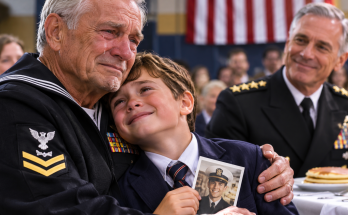
The admiral asked my grandson his name.
Caleb did not answer immediately.
I could feel him standing close to me.
He looked at the man in front of us, then gave his name.
“Caleb Halloran, sir.”
His voice was quiet.
But clear enough.
I felt a little pride at the way he spoke.
He was only nine.
He had already been through a morning that would have unsettled plenty of adults.
And he was doing his best to be respectful.
Admiral Carrick repeated our family connection back to him.
He wanted to know whether Caleb was my grandson.
Caleb nodded.
“Yes, sir.”
The admiral gave him a small smile.
He told Caleb that his grandfather was a remarkable man.
I almost interrupted.
Praise had never sat comfortably with me.
Especially praise delivered in front of a crowd.
I had spent enough time around servicemen to know that most of the good things people accomplished depended on others who rarely received any attention.
But I kept quiet.
This was not really about me anymore.
It was about what Caleb was hearing.
I looked at him.
I expected him to smile.
Maybe stand a little straighter.
Maybe look pleased that someone important was speaking kindly about his grandfather.
Instead, he lowered his eyes.
His expression changed.
It was a small change.
One that could easily have gone unnoticed.
But I knew that look.
It was the expression he wore when something reminded him of what he no longer had.
The admiral had meant to encourage him.
But the word grandfather had brought us back to the reason Caleb had been excluded.
I saw his lips move.
Then I heard him speak.
“He's my grandpa, not my dad.”
He said it so softly that I wondered whether the admiral had heard.
I wished I could take that sentence away from him.
Not because it was wrong.
Because he should never have felt obliged to explain it.
I was his grandfather.
I loved him.
I had come to his school because he needed me there.
But no matter what I wore, or how much I wanted to help, I was not his father.
Caleb knew it.
I knew it.
And the school had made certain we both remembered it that morning.
There was a slight pause.
Then Carrick moved.
He bent down until he was looking directly into Caleb's face.
That simple gesture affected me more than I expected.
The admiral had just been speaking as a highly respected officer.
He had the attention of the room.
He could have continued talking to the adults.
Instead, he lowered himself so a nine-year-old boy would not have to look up at him.
He did not treat Caleb's comment as an embarrassment.
He did not try to distract him.
He did not pretend the boy had said nothing important.
He listened.
I watched Caleb carefully.
He looked uncertain.
Perhaps he thought he had corrected the admiral improperly.
Perhaps he worried that saying I was not his father might hurt my feelings.
I wanted to tell him that it did not.
I wanted to tell him that he was allowed to say the truth.
But the admiral spoke first.
He told Caleb that he understood his father was gone.
He did not suggest that having a grandfather erased that loss.
He did not tell him to be grateful and move on.
He acknowledged that missing a father was a pain much larger than one school event.
And he made it clear that a breakfast could never replace the man Caleb wanted beside him.
I watched my grandson's face.
His lower lip moved slightly.
He tried to keep it steady.
I knew that effort.
I had seen it when he talked about his father.
There were times when he could ask questions calmly.
There were other times when the smallest reminder was too much.
He was still a child.
And children do not carry grief in neat, predictable ways.
Neither do adults.
I knew that better than most.
There were days when I could speak about my son without difficulty.
There were other days when the sight of my old uniform was enough to silence me.
The admiral understood something important in that moment.
Caleb did not need someone to explain why he should be proud of his family.
He needed someone to recognize that he missed his father.
Those were not the same thing.
I had tried to teach myself that after my son's death.
Pride did not cancel grief.
Honor did not replace a voice.
A folded flag did not come home and sit beside a child at breakfast.
I had learned those things the hard way.
Now Caleb was learning them too.
And I wished he didn't have to.
Carrick continued speaking to him.
He talked about the service his father had given.
He spoke of my years in uniform as well.
He wanted Caleb to understand that both generations had made sacrifices for people they might never know.
I watched Caleb listen.
His eyes were still wet.
But he was paying attention.
The admiral was not presenting military service as a way to make the sadness disappear.
He was helping the boy see that the people who loved him had lived meaningful lives.
That mattered.
My son had been more than the day we lost him.
I knew that.
I had known it from the beginning.
But grief has a way of making the final memory feel larger than all the others.
I thought of the picture Caleb carried.
A small photograph.
Folded.
Kept close.
It was one of the things he used to hold on to a father whose face he could not remember as clearly as he wanted.
I could tell stories.
His mother could tell him how loved he had been.
But the photograph was something he could touch.
Something he could keep in a pocket.
Something that belonged to his father and to him.
The admiral rose to his feet.
Then he said something that made me look away for a moment.
He spoke about families that continued to exist even when a person was missing from the room.
He explained that love and responsibility did not end when someone died.
The man might be gone.
His place in the family was not.
I knew what Carrick meant.
I felt it in the way Caleb stood beside me.
My son was not there to see his boy in that school blazer.
He would not hear the admiral speaking to him.
He would not see the courage Caleb was showing simply by standing in that room.
But my son's absence was not proof that Caleb had less of a family.
It was proof that our family had suffered a loss.
Those were very different things.
I looked around the gymnasium.
People were listening.
Really listening.
A short time earlier, the morning had been about a school tradition and the rules attached to it.
Now nobody seemed concerned about whether the boy beside me fit the correct description of a guest.
They were looking at Caleb as a child.
A son.
A grandson.
Someone who had come hoping to share breakfast with a member of his family.
That was all he had wanted.
I thought about how easily the school could have allowed it.
A chair.
A plate.
A place at the table.
There was nothing complicated about that.
No special ceremony required.
No important military officer needed to approve it.
Yet somehow we had reached a point where the boy needed to hear from an admiral that his family mattered.
That troubled me.
It still does.
Carrick let the silence settle.
He was a man accustomed to speaking before groups of people.
I could tell he knew how to let a room absorb something before moving on.
But he did not make the moment theatrical.
He simply spoke plainly.
I appreciated that.
Caleb had already been embarrassed.
I did not want his grief turned into entertainment.
I did not want people admiring him for being brave while forgetting why he had been forced to be brave in the first place.
I wanted the adults to understand.
All of them.
Especially the ones who had decided that a boy whose father was dead should spend the breakfast somewhere else.
Then Carrick shifted his attention.
He turned away from Caleb.
He looked toward Dr. Prentiss.
The movement was small.
But the meaning was obvious.
Until then, the admiral had been speaking to my grandson.
Now he intended to speak to the man responsible for the academy.
I followed his gaze.
Dr. Prentiss was seated among the school's representatives.
His bow tie was neatly arranged.
He looked like a man who was accustomed to formal occasions.
I wondered what he was thinking.
Perhaps he had expected the admiral's remarks to end with the reunion between two veterans.
Perhaps he assumed everyone would applaud and return to breakfast.
I could not know.
But Carrick clearly had another question in mind.
He addressed the headmaster by name.
Dr. Prentiss rose quickly.
His chair made a sharp sound against the gymnasium floor.
I heard it distinctly.
It was an ordinary sound.
Yet it seemed unusually loud after the quiet moment with Caleb.
The headmaster answered the admiral with obvious politeness.
He was ready to listen.
At least, that was how it appeared.
I stood beside Caleb and watched.
My grandson had not moved away.
His hand remained near my uniform.
He had heard people honor his father.
He had heard people honor me.
But the question that brought us there still had not been answered.
Why had the school decided he did not belong at the breakfast?
I knew the explanation I had been given.
The event was for fathers and sons.
The rules were designed around that relationship.
And because Caleb's father had died, the presence of a grandfather did not satisfy the school's requirements.
That was the reasoning.
I could repeat it.
I could even understand how someone might have written such a rule without considering every possible situation.
But understanding how a mistake happened did not make it acceptable.
A child had been hurt.
Someone needed to acknowledge that.
The admiral looked directly at Dr. Prentiss.
He did not raise his voice.
He did not ask a complicated question.
He wanted to know who had decided Caleb was not allowed to take part.
I watched the headmaster's expression.
There was a pause.
Then he began explaining the school's guidelines.
He spoke about the father-son relationship.
About preserving the purpose of the event.
About maintaining the structure the academy had established.
The words were orderly.
Professional.
Carefully chosen.
And as I listened, I felt my frustration returning.
Because somewhere inside that explanation, a real little boy had disappeared.
It was no longer Caleb standing beside his grandfather.
It was a case that did not satisfy a requirement.
A guest who did not qualify.
An exception that could not be accommodated.
I glanced down at Caleb.
He was listening to the headmaster describe the rule that had excluded him.
I wondered what a nine-year-old heard in language like that.
Did he hear that the school was protecting its tradition?
Or did he hear that his father had died and nobody could make room for him?
I feared I knew the answer.
The admiral repeated part of the explanation.
He sounded almost as though he wanted to make sure he had understood correctly.
The headmaster confirmed it.
I had heard officers speak like that before.
A calm question.
A repeated answer.
A chance for the person being questioned to recognize what had just been said.
Sometimes that was all it took.
Not this time.
Dr. Prentiss stood by his reasoning.
The rules existed.
The event had a defined purpose.
My presence did not match that purpose.
I looked at Caleb again.
He was my grandson.
I had come because I loved him.
I had come because his father could not.
And I was beginning to realize that those two facts, which seemed perfectly clear to me, were still being treated as insufficient.
The admiral did not look away from the headmaster.
Neither did I.
For the first time that morning, I felt the people around us waiting for an answer that had nothing to do with military rank.
They were waiting to see whether the school would recognize the harm it had done.
Click here to continue reading: PART 3: The Headmaster Explained Why My Fatherless Grandson Did Not Qualify, and the Admiral Asked the One Question He Could Not Avoid
I Thought My Old Navy Uniform Would Only Remind Me of My Dead Son, Until an Admiral Recognized My Face
Part 2 of 15