Margaret Ellis looked down at the papers in her folder.
Then she told us about another child.
A girl.
Not Caleb.
Not a boy at a father-son breakfast.
A girl whose mother had died while serving the country.
The academy had held a Mother's Day luncheon the previous year.
The girl had wanted to participate.
But because her mother was no longer alive to attend, she had been told she could not take part.
I felt my chest tighten.
The circumstances were different.
The pain was painfully familiar.
A child had lost a parent.
The school had organized an event celebrating that parent-child relationship.
And instead of finding a way to include the child with someone who loved her, the academy had treated the loss itself as a reason to keep her away.
I looked at Caleb.
He was listening.
I wondered whether he was thinking about the girl.
Whether he imagined her waiting somewhere while other children sat with their mothers.
I knew what I imagined.
A child who had already endured something no child should have to endure.
Then being reminded, in a place meant to help her grow, that her family did not match the school's expectations.
I did not know the girl's name.
I did not know her family.
I did not know what she had said when she was excluded.
Margaret did not provide those details.
And I was glad she did not.
That child deserved privacy.
Her pain did not need to become another story for an audience.
The facts were enough.
She had lost her mother during military service.
She had been denied a place at a school luncheon because her mother was gone.
That was enough to understand the problem.
I noticed people shifting at the tables.
A few exchanged looks.
Some lowered their eyes.
The gymnasium had become quiet in a different way.
Earlier, people had been moved by Caleb's speech.
Now they were hearing that the decision made about him had not come from nowhere.
Something similar had happened before.
I felt my anger returning.
I had tried hard not to let it govern me.
I knew mistakes happened.
I knew rules were sometimes written without considering unusual circumstances.
I knew good people could make poor judgments.
But once someone had been hurt by a rule, there was an obligation to examine it.
And here was evidence that the academy had encountered this problem before.
I looked toward Dr. Prentiss.
I wanted to hear what he would say.
Margaret continued.
She reminded the gathering that Caleb had been directed toward the library for the father-son breakfast.
His situation belonged beside the girl's.
Different events.
Different children.
The same failure to understand what losing a parent meant.
It was hard to hear.
Not because the details were complicated.
Because they were so simple.
The scholarship foundation had been created to support children whose families had suffered a particular loss.
Yet those children were being excluded from activities because of the very circumstances that qualified them for the scholarship.
I thought about my son's funeral.
The uniform.
The flag.
The final notes of the bugle.
Then I thought about the years that followed.
Caleb growing older.
His mother telling him how much his father had loved him.
Me telling him stories about a man he could not remember clearly.
All of us trying to help him understand that his father's absence did not mean he had been abandoned.
And now a school rule had made that absence feel like a personal deficiency.
I looked at the scholarship chairwoman.
She had closed the folder for a moment.
She spoke plainly about what the complaints represented.
These were not simply two children disappointed about missing a meal.
They were signs that the academy had failed to honor the purpose of its own scholarship program.
I felt grateful that someone had finally said it.
The problem was not the breakfast.
Not really.
The problem was what the academy seemed to believe a family had to look like before a child could participate.
A boy with a father beside him qualified.
A boy with a grandfather did not.
A girl with her mother could attend a luncheon.
A girl whose mother had died in service could not.
It was an impossible standard for children who had already lost someone.
And no amount of careful language could make it decent.
Dr. Prentiss stood again.
I could see that he wanted to respond.
I had hoped he might apologize.
Not necessarily at length.
Not with a speech prepared to protect the school's reputation.
Just a simple acknowledgment.
We handled this badly.
We should have done better.
The children should not have been excluded.
I would have accepted that as a beginning.
But those were not the words he chose.
He addressed Margaret.
He said the school had not intended to discriminate against anyone.
He insisted that the employees had been following the guidelines established for the events.
I listened.
And I felt the same frustration I had felt earlier.
Intent.
Guidelines.
Consistency.
Those were the words he kept returning to.
I did not doubt that he cared about the academy.
I did not know what kind of headmaster he was on an ordinary day.
I had no reason to decide that every part of his work was wrong.
But on this morning, he seemed unable to face the difference between what the school intended and what the children experienced.
I had learned that difference in the Navy.
A person could follow an instruction with good intentions and still cause harm.
A leader could make a decision believing it was necessary and later discover it had been wrong.
What mattered then was the response.
Would the leader listen?
Would he change course?
Would he accept responsibility?
Or would he keep explaining why the rule had been followed correctly?
I looked at Caleb.
His eyes were on the headmaster.
I wondered what he thought of the explanation.
Did he understand what discrimination meant?
Did he understand why adults were arguing about guidelines?
Perhaps not entirely.
But he understood that the school had told him he could not attend.
And he understood that he had done nothing wrong.
That should have been enough.
Admiral Carrick turned toward the headmaster.
He had been quiet while Margaret explained the complaints.
Now he spoke.
He suggested that if the guidelines had produced these outcomes, the academy needed to change them.
I almost nodded aloud.
There it was.
The practical answer.
Not another defense of what had happened.
Not another description of why the tradition existed.
Change the rules.
Make sure children who had lost their parents could bring another family member or guardian.
Make sure the scholarships meant what they were supposed to mean.
Make sure no child had to sit apart because death had changed the shape of their family.
It seemed straightforward.
But Dr. Prentiss did not accept the suggestion immediately.
He responded that policy decisions belonged to the academy's board.
I watched the admiral.
He did not become angry.
He did not argue about whether the headmaster had the authority to act on his own.
He simply accepted the point.
If the board was responsible, then the board should be involved.
I saw Margaret nod.
She informed us that an emergency review had already been arranged.
Dr. Prentiss's expression changed.
It was the first time I had seen him look genuinely unsettled by the direction of the conversation.
I did not take pleasure in it.
I want to be clear about that.
I had served long enough to know that public embarrassment could make a person defensive.
And I had seen how quickly a crowd could become more interested in punishment than correction.
I did not want that for Caleb.
I did not want his name attached to a spectacle about destroying someone's career.
He had already lost enough.
I wanted him to leave that gymnasium knowing he belonged.
Not believing that the only way to secure a place was to make someone else suffer.
But I also understood that the headmaster's discomfort was not the central issue.
The children were.
Caleb.
The girl from the Mother's Day luncheon.
Any other scholarship student who had been made to feel unwelcome during a celebration of family.
Those children needed a school that understood the responsibility it had accepted.
I looked at Margaret's folder.
The pages represented complaints that had been brought to the foundation's attention.
I wondered how difficult it had been for those families to speak up.
I knew how difficult it had been for me to stand in that gymnasium.
I was a grown man.
I had served in the Navy.
I had faced emergencies where lives were at risk.
Yet arguing for my grandson's place at a breakfast had left me feeling angrier and more helpless than I wanted to admit.
How much harder would it be for a child?
How much harder for a family already carrying the weight of a death?
I thought about what the scholarship promised.
A chance for children to continue their education.
A way to recognize the sacrifice their parents had made.
A practical form of support.
Those were good things.
But money alone was not enough.
A scholarship could pay tuition.
It could provide materials.
It could make certain activities accessible.
But it could not make a child feel welcome if the people administering the school failed to understand that child's circumstances.
Belonging was not printed on an award letter.
It was shown in ordinary decisions.
Who was invited.
Who was allowed to sit down.
Who was treated as part of the group.
And who was told to wait somewhere else.
I looked at Caleb.
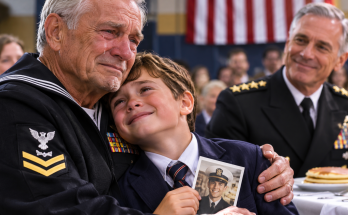
He still held his father's photograph.
The crease in the paper was visible.
I had been looking at that photograph for years.
But on this morning, it seemed to have become a reminder of everything the academy was supposed to respect.
The man in the picture was gone.
The boy holding it was still here.
And it was the boy who needed the school's care now.
I thought about my son.
I imagined how he would have felt knowing his child had been told he could not attend a family breakfast because his father had died.
I could not know exactly what my son would have said.
But I knew he loved Caleb.
And I knew he would have wanted his boy treated with kindness.
That was enough for me.
Margaret remained beside the podium.
The admiral stood nearby.
Dr. Prentiss had little more to say at that moment.
I felt the room waiting.
Waiting for an argument.
Waiting for an apology.
Waiting to see what would happen to the headmaster.
I realized that the conversation was drifting toward a place I did not want it to go.
The morning had begun with a boy being excluded.
Now the adults were discussing authority and an emergency review.
Those matters were important.
But they were not why Caleb had come.
He had come for breakfast.
I looked down at him.
His hand was warm in mine.
And I remembered the same thought I had carried through the entire morning.
I did not need anyone to make him famous.
I did not need the academy to honor me.
I did not need the admiral to keep defending my family.
I needed the adults to stop treating Caleb's situation as a complicated exception.
I needed them to let him be a student.
A boy.
Someone who could attend school events without having to explain his father's death.
I leaned slightly toward Admiral Carrick.
He noticed.
I told him I appreciated everything he had done.
I meant it.
His intervention had changed the morning.
He had helped my grandson feel heard.
He had made the headmaster confront a decision that should never have been defended.
But there was something I needed to say.
Something I believed was more important than the applause.
I did not want Caleb growing up thinking that he needed an admiral beside him before people would treat him with basic decency.
Carrick looked at me.
He listened without interrupting.
Then he acknowledged my point.
I saw understanding in his face.
The same understanding he had shown when he crouched to speak with Caleb.
I was relieved.
Because I knew the admiral had meant well.
And I wanted him to understand what I was trying to protect.
My grandson's future.
There would be other school events.
Other classrooms.
Other situations where Caleb's family did not look exactly like everyone else's.
I could not guarantee that an admiral would be present.
I could not guarantee that I would always be able to stand beside him.
But I wanted him to learn that he had the right to be treated fairly without first proving that someone important cared about him.
That was the lesson I hoped the academy would learn too.
I turned toward Margaret.
The folder was still on the podium.
The board review had been arranged.
The headmaster's explanations had been heard.
Now I wanted to say what I had wanted from the beginning.
Not honors.
Not a public tribute.
Not an exception written just for Caleb.
A place for every child whose family did not fit the narrow picture the academy had chosen.
I looked at my grandson.
Then I spoke.
Click here to continue reading: PART 8: I Asked the Academy for Nothing Special, but My Grandson’s Simple Question Brought the Morning Back to What Really Mattered
I Thought My Old Navy Uniform Would Only Remind Me of My Dead Son, Until an Admiral Recognized My Face
Part 7 of 15