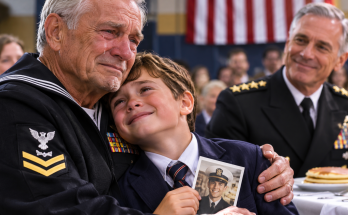
I had never liked being the center of attention.
Not when I was serving.
Not after I retired.
And certainly not when I was standing beside a child who had already been embarrassed in front of his school.
But Admiral Carrick had taken the microphone.
The applause had faded.
People were settling back into their chairs.
And I could tell he had something more to say.
I looked at Caleb.
He was still wearing that small smile.
I did not want anything to take it away.
That was my first thought.
Not whether I would be praised again.
Not whether the headmaster would be embarrassed.
Just whether my grandson could get through the rest of the morning without being hurt.
The admiral stood at the podium.
He looked out across the gathered families.
He did not speak immediately.
He allowed the room to become quiet.
Then he explained that he wanted to make a change to the program.
I felt a flicker of concern.
A change could mean many things.
And I had already seen how quickly a good intention could become uncomfortable for a child.
I did not want Caleb turned into a spectacle.
He was nine years old.
He had not come to school to make a statement about grief or military families.
He had come for breakfast.
With his grandfather.
That was all.
The admiral began by speaking about the tradition itself.
He did not insult it.
He did not suggest there was anything wrong with fathers and sons sharing time together.
He acknowledged that it was worth celebrating.
I appreciated that.
I had spent years watching people argue as though recognizing one person's pain meant dismissing someone else's happiness.
It did not.
The fathers in that room had every reason to enjoy being with their sons.
I did not resent them.
Caleb did not resent them.
We wanted to be part of the morning, not take it away from anybody.
Carrick seemed to understand that.
He spoke of the fathers who helped their children grow.
The fathers who guided them.
The fathers who stood beside them as they learned about life.
I listened.
Every word reminded me of my son.
There had been a time when I assumed he would have years to do those things with Caleb.
Years to answer questions.
Years to teach him.
Years to show up at school events and sit with him at breakfast.
I had not imagined that those ordinary moments would become impossible.
No parent ever wants to imagine that.
And no grandfather wants to find himself standing in for a son he has buried.
But life does not ask permission before it changes.
I had learned that at my son's funeral.
I had learned it again while watching Caleb grow older.
There were things I could give him.
Stories.
Time.
A hand to hold.
There were things I could not give him.
The sound of his father's voice in the morning.
The experience of his father watching him grow.
The simple certainty that the man he called Dad would be there when school sent home an invitation.
I could not give him those things.
But I could show up.
And I had.
The admiral's voice brought me back to the gymnasium.
He explained that the day's celebration should include more than the fathers who were physically present.
He wanted the people who cared for children in a father's absence to be recognized too.
I watched the adults listening.
Some leaned forward.
Others looked toward their sons.
It was as though Carrick had opened a door that had always been there but had never been used.
The school had built its event around one particular picture of family.
A father.
A son.
A table.
But families did not always look that way.
I knew it.
The admiral knew it.
And judging by the expressions around us, plenty of other people knew it too.
He began naming the relatives and guardians who sometimes stood beside children when their fathers could not.
Grandparents.
Uncles.
Older brothers.
Stepfathers.
Other people who had taken responsibility for loving and raising a child.
He spoke of children whose fathers were away serving.
Children whose fathers had died.
Children whose fathers were absent from their lives for other reasons.
And children whose fathers had failed them despite having the opportunity to remain involved.
I could hear how carefully people were listening.
There was no laughter.
No restless conversation.
The room had become still.
I thought about the word family.
It was a word we used so often that we rarely stopped to examine it.
To me, family had always meant people you were responsible for.
People you cared about.
People you did not abandon when things became difficult.
Sometimes those responsibilities were simple.
You showed up.
You listened.
You kept your word.
Other times they were far more painful.
You stood at a funeral.
You accepted a folded flag.
You helped a child understand why someone he loved would never walk through the door again.
I had done those things.
Not perfectly.
I had never pretended to do them perfectly.
There were days when grief made me quiet.
Days when I struggled to answer Caleb's questions.
Days when the memories I wanted to share with him became difficult to speak aloud.
But I had tried.
And I intended to keep trying.
The admiral continued.
He spoke plainly about the danger of judging families by whether they matched a particular arrangement.
He wanted the boys in that gymnasium to understand that losing a father did not make them less worthy of belonging.
He wanted the adults to understand it too.
I glanced toward Dr. Prentiss.
He was still part of the gathering.
I wondered whether he was finally hearing what the morning had meant to Caleb.
The headmaster had defended the event's purpose.
Now the admiral was asking everyone to consider whether that purpose had been understood too narrowly.
There was a difference.
A school could celebrate fathers without excluding children who had lost theirs.
It could honor a tradition without making grief a reason for separation.
It could ask families to gather without insisting they all look the same.
None of that seemed revolutionary to me.
It seemed decent.
But sometimes people need to hear an ordinary truth spoken clearly before they recognize how far they have moved away from it.
Carrick finished making his point.
Then he looked directly toward my grandson.
I noticed it before Caleb did.
The admiral's attention had shifted.
He was no longer addressing the entire audience.
He was looking at the little boy beside me.
I felt Caleb straighten.
Carrick invited us to come to the front.
Both of us.
Grandfather and grandson.
He did not order us.
He did not make it sound like something we were required to do.
He asked.
That distinction mattered.
I looked down at Caleb.
He looked back at me.
I could see hesitation in his eyes.
There were roughly two hundred people in that room.
He knew they would watch him.
He had already endured enough attention for one morning.
The last thing I wanted was to push him into something that frightened him.
I lowered myself toward him.
I told him he could decide.
He did not have to go.
Not for the admiral.
Not for the school.
Not for me.
I wanted him to understand that part of the morning belonged to him.
He had not been given a choice about losing his father.
He had not been given a choice when the school decided he should wait in the library.
But he could choose whether to stand before that crowd.
Caleb studied my face.
For a moment, I thought he might refuse.
And I would have understood.
I would have taken him back to a table.
I would have found him something to eat.
I would have done whatever helped him feel comfortable.
Then his hand found mine.
He squeezed it.
And he told me he wanted us to go together.
I felt that little pressure in my palm.
It was such a small thing.
But it settled my mind.
He was not being dragged toward the front of the gymnasium.
He was choosing to walk there.
With me.
I nodded.
Then we began moving.
I could hear the sound of our shoes against the floor.
The distance to the stage was not great.
Yet I remember the walk as though it lasted much longer.
Perhaps because I was aware of so many people watching.
Perhaps because I was wearing the uniform I had kept put away for years.
Perhaps because my grandson was beside me, holding my hand as though it was the most natural thing in the world.
I looked straight ahead at first.
I did not want to see pity on anyone's face.
That was something I had always struggled with after losing my son.
People meant well.
Most of them did.
But sometimes sympathy made me feel as though my family had become nothing more than a tragedy.
We were not only that.
My son had lived.
Caleb was living.
We still had birthdays, school days, ordinary conversations, and moments of happiness.
The loss belonged to us.
But it was not all that belonged to us.
As we walked, I became aware of movement beside the tables.
A man stood.
Then another.
I turned my head slightly.
More men were rising from their chairs.
At first, I did not understand what was happening.
No one had instructed them to stand.
The admiral had not asked the audience to do it.
There was no announcement.
They were simply getting to their feet as Caleb and I passed.
One after another.
I felt my throat tighten.
I had seen people stand during military ceremonies.
I knew the significance of that gesture.
But this was not a parade.
There were no formal honors being presented.
It was a school breakfast.
And the men were standing for a grandfather and a nine-year-old boy.
I looked at Caleb.
He was watching too.
His expression had changed from uncertainty to surprise.
I wondered whether he understood what the gesture meant.
I hoped he did.
Not because I needed him to think I was important.
But because he needed to see that the people around him were no longer treating his family as something that did not fit.
They were making room.
Without being told.
That was what touched me.
They could have remained seated and clapped politely.
They could have watched without becoming involved.
Instead, they stood.
I could not know what each man was thinking.
Perhaps some were fathers who had never considered Caleb's situation until that morning.
Perhaps others knew what it meant to lose someone.
Perhaps a few were simply moved by what the admiral had said.
The reasons were their own.
But the gesture belonged to the boy walking beside me.
A man in a navy suit leaned toward us.
He spoke to Caleb.
He told him his grandfather had done something heroic.
I felt embarrassed immediately.
There was that word again.
Hero.
It was not a word I liked hearing about myself.
I had spent years surrounded by men who did difficult things because they had to be done.
Some had survived.
Others had not.
I had never known how to accept praise without remembering those who could no longer receive it.
I wanted to wave the compliment away.
But Caleb answered before I could.
He looked at the man.
Then he said I was only his grandpa.
I almost laughed.
Not because he was being funny.
Because he was telling the truth exactly as he understood it.
To him, I was not a retired chief with stories from the Navy.
I was not the man an admiral had just embraced.
I was Grandpa.
The person who told him about his father.
The person standing beside him at school.
The person whose hand he was holding.
That was the identity that mattered to him.
I would not have traded it for anything.
The man in the navy suit smiled at Caleb.
Then he told him that an ordinary grandfather could also be a hero.
I looked away.
I needed a moment.
I had spent years trying not to think about the uniform hanging in my closet.
The uniform I wore now.
The one that brought back the funeral.
The flag.
The final honors.
The silence that followed.
And here was my grandson, standing beside me, showing me that the same uniform could be part of a very different memory.
A school.
A breakfast.
A room full of people standing.
It did not erase what the uniform had meant on the worst day of my life.
Nothing could erase that.
But perhaps it did not have to carry only one meaning forever.
We reached the front of the gymnasium.
Admiral Carrick was waiting.
I could see that he was pleased Caleb had chosen to come.
He looked at my grandson with patience.
He did not hurry him.
Then he offered Caleb the microphone.
I watched the boy's eyes widen.
Until that moment, he had only needed to walk beside me.
Now he was being invited to speak.
In front of everyone.
The admiral asked whether he wanted to share a few words.
It was a gentle invitation.
But I knew how much courage it would take for Caleb to accept.
I looked at him.
He looked toward the crowd.
Then back at me.
I did not tell him what to say.
I did not try to put words in his mouth.
The last thing he needed was another adult deciding how he should respond to his own loss.
So I stayed beside him.
Quiet.
Ready to help if he needed me.
He held the microphone.
His hands looked small around it.
And I suddenly remembered the first reason we had come to the academy that morning.
He had wanted breakfast with someone who loved him.
Nothing more.
He had not asked for the attention of a four-star admiral.
He had not asked for a room full of fathers to rise from their chairs.
He had not asked to stand before his school and explain why his family deserved a place at the table.
But now he had been given an opportunity to speak for himself.
I knew whatever he said would matter.
Not because the words had to be impressive.
Not because he needed to sound grown-up.
Because they would be his.
For a few seconds, he remained silent.
I watched him.
I waited.
And when Caleb finally brought the microphone closer to his mouth, I stayed exactly where I belonged.
Beside my grandson.
Click here to continue reading: PART 5: My Nine-Year-Old Grandson Held His Father’s Photograph Before the Entire School and Said Something That Left Me Unable to Speak
I Thought My Old Navy Uniform Would Only Remind Me of My Dead Son, Until an Admiral Recognized My Face
Part 4 of 15