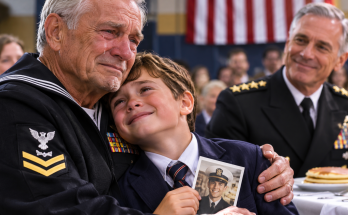
I had spent years believing that silence was the best way to live with some memories.
Not every memory.
I could speak about my service.
I could discuss the Navy.
I could tell Caleb about his father.
But there were certain subjects I approached carefully.
My son's funeral was one of them.
The last time I wore my uniform before that morning was another.
Now Admiral Carrick was sitting across from me.
He had asked me to help with a program for children from military families.
And I was realizing that the thing I feared most was not speaking to strangers.
It was remembering aloud.
I looked at Caleb.
He was waiting to hear my answer.
There was no pressure in his expression.
He was curious.
Hopeful.
A little tired from the morning.
But he was listening.
I thought about the way he had stood on the stage.
He had held his father's photograph.
He had told the room that he could not remember everything about his dad.
He had explained that his mother and I helped him keep those memories alive.
And he had told everyone how much it meant that I had come.
I had listened to him without interrupting.
Now I wondered whether I had understood the full meaning of what he said.
He did not need me to be a perfect storyteller.
He did not need every memory arranged neatly.
He needed the truth.
He needed to know his father had lived.
That he had loved him.
That people still remembered him.
And that his family could speak about him without treating his name as something too painful to mention.
I had tried to provide that.
But perhaps there was room for more.
I could admit that now.
It was not an easy admission.
I had loved my son.
I still did.
Nothing about death changed that.
But sometimes the strength of that love made remembering difficult.
I could describe the folded flag.
I could describe the salute.
I could describe the sound of the bugle ending.
Those memories came quickly.
Too quickly.
But when I tried to remember ordinary things about my son, grief sometimes pushed the funeral back into the center.
I hated that.
I did not want Caleb to inherit only my sadness.
I wanted him to inherit the knowledge that his father had been loved.
That his life mattered.
That he had been more than a loss.
The admiral's program seemed built around that idea.
Not around ceremonies.
Not around turning military service into something children were expected to admire without questions.
It was about conversations.
Real ones.
The kind where someone could ask what a sailor felt when he was afraid.
Or why people chose to help one another.
Or what duty meant when the situation was difficult.
I knew those questions.
I had lived with them.
I thought about the nineteen-year-old sailor Carrick had once been.
He had been frightened during a fire.
I remembered directing him toward the emergency station.
I remembered going back to help contain the danger.
I had not known what became of him afterward.
I had not remembered his name.
Yet he had remembered mine.
More importantly, he had remembered what I told him.
He said my words had helped him move when he believed he could not.
I had not spoken to him because I expected gratitude.
I had spoken because he needed help.
That was the truth.
Now, decades later, he was offering to help my grandson.
And he was asking me to help other children.
I wondered whether the lesson from that day had returned to me in a form I needed to hear.
Fear was not the end of usefulness.
I had said something like that to him when he was young.
And perhaps I had forgotten it while grieving my son.
I was afraid of reopening painful memories.
That was true.
I was afraid of speaking about military service and being reminded of the funeral.
Also true.
But the fear did not mean I should refuse every opportunity to help.
I had spent too many years treating those memories as if they were dangerous objects.
Something to leave untouched.
Something that belonged in a garment bag with an old uniform.
I had believed distance would make them easier to carry.
Sometimes it did.
But distance also kept me away from memories that mattered.
I looked at the photograph in Caleb's hand.
He had folded it again.
He held it between his fingers.
I could see how carefully he treated it.
That photograph had become an object he trusted.
A way to keep his father nearby.
I had my own version of that.
The uniform.
I had treated it differently.
Caleb carried his photograph.
I hid my uniform.
He unfolded his memory whenever he needed to.
I kept mine covered.
The comparison made me uncomfortable.
Not because Caleb was doing anything wrong.
Because he was showing me something I had not been willing to see.
Remembering could hurt.
But it could also keep love present.
The photograph did not bring his father back.
Neither would the uniform.
But both could connect us to the man we had lost.
I sat with that thought.
It was simple.
I wondered why it had taken me so long to accept it.
Then I reminded myself that grief does not follow a schedule.
There is no correct number of years after which a father should be able to speak about burying his son without feeling the pain again.
I knew that.
I had told myself that many times.
But I had also used the pain as a reason to keep certain memories locked away.
Now I was being offered a different possibility.
I could speak.
I could remember.
I could help.
And I could still miss my son.
Those things did not contradict one another.
I looked toward Carrick.
He had not said anything while I considered his offer.
I appreciated his patience.
He knew enough about service to understand that some memories were not easily brought into conversation.
I suspected he understood more than he had chosen to say.
But he did not try to explain my feelings to me.
He simply waited.
I wanted to tell him that I had kept the uniform put away because of the funeral.
I wanted him to understand why the invitation mattered.
But I did not know whether I could explain it without making Caleb uncomfortable.
My grandson knew about his father's death.
He knew I missed him.
He knew the uniform had been difficult for me to wear.
Still, I did not want him to believe his questions caused me pain.
That was something I had always tried to avoid.
He had every right to ask about his father.
Every right to remember him.
Every right to want stories.
The grief was mine to manage.
Not his.
I looked at Caleb again.
He was watching me.
I saw the question in his face.
Would I say yes?
I considered what helping with the program might look like.
The admiral had not described a schedule.
He had not asked me to sign anything.
He had not demanded a commitment beyond helping share stories with young people.
It was an invitation.
And I could accept it in the spirit in which it had been offered.
I did not need to know every detail before deciding whether the purpose was worthwhile.
I believed it was.
Children from military families often lived with experiences their classmates did not fully understand.
Some had parents serving far away.
Some had parents who returned carrying memories they struggled to describe.
Some had parents who never came home.
Those children deserved to hear honest accounts of service.
They deserved to know that a uniform belonged to a person.
A person who felt fear.
A person who loved family.
A person who could make mistakes.
A person who sometimes did something important without ever knowing how much it meant to someone else.
I thought about Carrick.
He had remembered my words for decades.
I had almost forgotten saying them.
That difference reminded me how little control we had over the effect of our actions.
A brief conversation could matter.
A small act could remain with someone.
And a simple invitation could change how a child remembered a difficult morning.
I looked toward the gymnasium.
Most of the breakfast gathering had begun settling into ordinary conversation.
The intensity of the earlier confrontation was fading.
People were talking.
Children were laughing.
Plates were being cleared.
The academy was returning to its routine.
But my grandson's experience would not simply disappear when the tables were put away.
He would remember being told he did not qualify.
He would remember standing before the room.
He would remember the admiral speaking about his father.
He would remember the photograph.
And perhaps he would remember this invitation.
I hoped he would.
Not because it would make the morning worthwhile.
I did not believe children needed to suffer humiliation in order to receive a lesson.
The school had been wrong.
The fact that something good might follow did not excuse that.
But I could still recognize the good.
I could still accept an opportunity that had come from an unexpected meeting.
The admiral's recognition had brought my past into the room.
The scholarship chairwoman's intervention had revealed the need for change.
Caleb's words had reminded the adults what mattered.
And now Carrick was offering a way to keep those conversations going.
I thought about the word duty.
It had meant many things during my years in the Navy.
Orders.
Responsibility.
People depending on one another.
Actions taken because they needed to be taken.
But duty did not end when a man stopped wearing a uniform.
It changed shape.
For me, it had become the responsibility of loving my grandson.
Of helping him remember his father.
Of standing beside him when he needed me.
Perhaps helping with the veterans' program would be another form of that responsibility.
I did not need to return to active service to be useful.
I did not need a rank to have something worth sharing.
I simply needed to be willing to speak honestly.
I felt my decision becoming clear.
Not suddenly.
Not like a grand revelation.
More like a door opening slowly.
I had spent years believing I needed to leave the uniform behind.
But that morning had shown me something different.
The uniform had been part of my son's funeral.
Yes.
It would always carry that memory.
But it had also been part of his life.
Part of mine.
And now part of a morning when his son had found a place among other children.
I could not choose which memories came when I looked at it.
But perhaps I could stop insisting that only the painful ones were allowed.
I thought about my son's face.
Then Caleb's.
I thought about the admiral at nineteen.
Then the man sitting across from me now.
The years between those moments seemed enormous.
Yet here we were.
Connected by service.
By memory.
And by a child who wanted to know more about his father.
I looked at Carrick.
I knew what I wanted to say.
I wanted to help.
Not because I believed I had extraordinary wisdom.
Not because I wanted people to call me a hero.
Because I had stories.
And because there were children who might need to hear them.
I could not promise that every story would be easy.
I could not promise that I would never become emotional.
But I could promise to be truthful.
I could tell them what I knew.
I could help them understand that duty was not an empty word.
And I could remind them that the people behind uniforms were more than the circumstances in which they were remembered.
I looked at Caleb one more time.
He was still waiting.
His father's photograph rested in his hand.
I felt the old grief.
Of course I did.
But for once, it was not the only feeling there.
There was pride.
There was gratitude.
There was a quiet sense that I still had something worthwhile to give.
I raised my head.
The admiral met my eyes.
And I knew I was ready to answer him.
Click here to continue reading: PART 12: My Grandson Had Asked Only for Stories About His Father, but the Admiral’s Invitation Made Me Face the Memories I Had Hidden for Years
I Thought My Old Navy Uniform Would Only Remind Me of My Dead Son, Until an Admiral Recognized My Face
Part 11 of 15