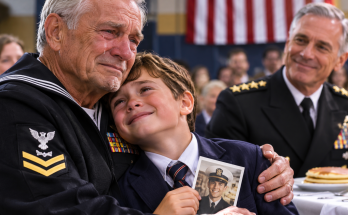
I looked down at the front of my uniform.
It was strange how a piece of clothing could hold so much.
To most people in the gymnasium, it represented military service.
Years of duty.
A rank I had earned.
A history they knew almost nothing about.
To Admiral Carrick, it had brought back the memory of a fire and a young sailor who had been frightened.
To Caleb, it connected me with the father he had lost.
But to me, the uniform had meant something different for years.
My son's funeral.
That was the memory I could never separate from it.
I remembered the folded flag.
I remembered the military honors.
I remembered the twenty-one-gun salute.
And I remembered the bugle.
The notes had sounded clear.
Then they had ended.
The silence afterward had been worse.
I had known silence at sea.
I had known the silence that followed an emergency when everyone was too exhausted to speak.
But I had never heard anything quite like the silence after my son's funeral honors ended.
It seemed to fill everything.
The space around me.
The thoughts I could not finish.
The years I had expected to have with my son.
I had worn the uniform that day because it was part of who I was.
Part of who he had been.
But afterward, I could hardly bear to look at it.
I put it away.
I told myself there was no reason to take it out.
I was no longer serving.
My days in the Navy were behind me.
There were no duties requiring me to put it on.
And if I was being truthful, I was relieved to have an excuse.
I did not want to wear it.
I did not want to see myself in it.
Not because I was ashamed of my service.
I was not.
I knew the work I had done.
I knew the people I had served beside.
I knew the responsibility that came with the rank I had held.
But the uniform had become tangled with grief.
And I did not know how to separate the two.
So I left it in its garment bag.
Year after year.
I told myself I was preserving it.
Keeping it properly.
Protecting something that had been important to my life.
That was partly true.
But there was another truth beneath it.
I was avoiding it.
Looking back, I can admit that.
I could discuss my years in the Navy if someone asked.
I could tell Caleb certain stories.
I could explain what my son had meant to me.
But putting on that uniform required something else.
It required me to look directly at a part of my life that still hurt.
That morning had changed my routine.
Caleb needed someone to attend the breakfast with him.
His father was gone.
And the school had decided that a grandfather did not meet its definition of an appropriate guest.
I had chosen to wear the uniform.
Not because I thought it would impress anyone.
Not because I expected the academy to treat us differently.
I wore it because it connected my son and me.
And because I wanted Caleb to understand that his family had not abandoned him.
His father could not come.
I could.
That had been the whole decision.
Simple.
Painful.
Necessary.
But once I put the uniform on, I discovered the memories had not faded as much as I had hoped.
I remembered the funeral more vividly than I wanted to.
The flag.
The salute.
The bugle.
I could still feel the weight of that day.
And when I entered the gymnasium beside Caleb, I carried it with me.
Then everything happened.
The headmaster's refusal.
The admiral's recognition.
The story of the frightened nineteen-year-old sailor.
The applause.
Caleb's speech.
The photograph.
The scholarship foundation's revelations.
By the time Carrick sat at our table, I felt as though I had lived through several different mornings.
I was tired.
Not physically.
Emotionally.
There had been too much to absorb.
And now he was asking me to do something I had not considered in years.
Speak with young people about military service.
Help them understand the human beings behind the uniforms.
I knew I had stories.
I knew there were things I could teach.
But I was not certain I could speak about them without returning to the grief I had worked so hard to contain.
I looked at Carrick.
He was waiting patiently.
I respected that.
He did not pressure me.
He did not tell me it was my duty.
He did not suggest that refusing would disappoint Caleb.
He simply made the offer.
That gave me room to think.
And I needed it.
I glanced at the photograph in my grandson's hand.
The paper was folded again.
I wondered how many times he had opened and closed it.
How often he had looked at his father's face.
How often he had wished the picture could tell him something new.
I had told him stories.
His mother had told him stories.
But the photograph remained the same.
One captured moment.
One image.
A reminder of someone he loved without having enough memories of his own.
I thought about the admiral's program.
Children speaking with veterans.
Veterans telling them about service.
About the ordinary people behind the uniforms.
Perhaps that was exactly what Caleb needed.
Not only another picture.
Not only another ceremony.
Conversations.
People who could help him understand a world his father had been part of.
I had never wanted Caleb to grow up believing military service was only about funerals.
Or flags.
Or medals.
Those things were part of it.
But they were not the whole story.
Service had also been about people.
The young sailor who froze during a fire.
The men who depended on one another.
The decisions made when nobody knew what would happen next.
The responsibility of helping someone who was afraid.
And the quiet understanding that a person's actions could affect lives far beyond a single moment.
Admiral Carrick was proof of that.
I had spoken to him during an emergency.
I had not known whether he would remember my name.
I certainly had not expected him to become an admiral.
Yet he had remembered what I told him.
He had carried those words for decades.
And now he was sitting across from me, offering to help my grandson learn about his father.
I could not ignore the connection.
I thought about the way Carrick had crouched to speak with Caleb.
He had not dismissed the boy's grief.
He had not suggested that a grandfather could replace a father.
He had told Caleb that the people who loved him remained part of his family even when they were absent.
That was the sort of wisdom children needed.
Not the kind delivered in a grand speech and forgotten the next day.
The kind that stayed.
The kind that helped someone make sense of a difficult moment.
I had once told Carrick that fear did not mean he was useless.
He had remembered.
Perhaps now I needed to listen to something similar myself.
I was afraid of what returning to military memories might bring.
Afraid that talking about service would lead me back to the funeral.
Afraid that I would lose the composure I had spent years trying to maintain.
I was not afraid of standing before people.
I had done that before.
I was afraid of being asked a question about my son and finding that I could not answer.
I was afraid of the silence afterward.
The same silence I remembered from the funeral.
But I could hear Carrick's earlier words in my mind.
He had described the young sailor he once was.
A frightened boy, barely older than a child.
And he had remembered being told that fear was something a person could move through.
Not something that had to decide everything.
I wondered whether I had forgotten my own lesson.
Perhaps I had.
Grief had changed me.
I could admit that.
It had made certain memories difficult to approach.
It had taught me how quickly ordinary life could disappear.
It had made me cautious about things that once seemed simple.
And sometimes it had made me retreat.
I did not like admitting that last part.
But it was true.
I had kept the uniform in a garment bag.
I had kept some stories to myself.
I had convinced myself that avoiding the memories was the safest way to live with them.
But the memories had not disappeared.
They were still there.
Waiting in the fabric.
Waiting in the sound of a bugle.
Waiting whenever Caleb asked another question about his father.
The only thing my avoidance had changed was how often I allowed myself to face them.
I looked at Caleb again.
He was watching the admiral with interest.
He seemed hopeful.
I could see it in the way he sat.
The way he held the photograph.
The way he kept listening even though breakfast had ended.
He wanted to know more.
That was clear.
And I could not blame him.
If I had been nine years old and someone had offered to tell me stories about a father I barely remembered, I would have wanted to listen too.
I thought about my son as a young man.
Before the funeral.
Before the loss.
Before his life became something people described in the past tense.
I remembered that he had lived an entire life before Caleb was old enough to understand it.
There were good memories.
Ordinary memories.
Things that had nothing to do with dying.
I wanted Caleb to know those things.
I wanted him to understand that his father had been more than the circumstances of his death.
I had always believed that.
But perhaps I had not done enough to help Caleb see it.
Not because I did not love him.
Because sometimes remembering his father hurt.
And I had allowed that hurt to decide which stories I told.
I felt ashamed of that.
Only for a moment.
Then I reminded myself that grief was not something I could handle perfectly.
I was his grandfather.
Not a man who had somehow escaped human weakness.
I could make mistakes.
I could struggle.
And I could still choose to do better.
The admiral's invitation was not a demand.
It was an opportunity.
I did not have to become someone else.
I did not have to pretend I was fearless.
I did not have to speak as though service had been nothing but glory.
In fact, Carrick had made it clear that he wanted honest conversations.
That was something I could offer.
Honesty.
I could tell children that people serving in uniform were still people.
They became frightened.
They missed their families.
They made difficult decisions.
They depended on one another.
And sometimes they carried memories long after the uniforms were put away.
I could tell them that courage was not the absence of fear.
I could tell them that doing the right thing was not always comfortable.
I could tell them that responsibility sometimes meant standing beside someone when nobody else was willing to make room.
I looked at Caleb.
That last lesson had nothing to do with a ship.
It had everything to do with the breakfast we had just attended.
I had come because my grandson needed me.
I had not known the school would refuse us.
I had not known an admiral would recognize me.
I had not known the scholarship foundation would reveal earlier complaints.
I had simply shown up.
And perhaps that was the kind of service I understood best now.
Not the service that came with a rank.
The service of being present for someone who needed you.
I felt the thought settle.
It was quiet.
Not dramatic.
But it changed something.
The uniform did not have to represent only the day my son was buried.
It could also represent the years he had lived.
The people he had loved.
The service he had given.
The connection between him and the grandfather now raising memories for his son.
I looked down at the fabric again.
For the first time that morning, I did not immediately think of the funeral.
I thought of Caleb walking beside me.
His hand in mine.
His small voice speaking into the microphone.
His photograph held in front of the room.
I thought of a father making space at the table.
I thought of Ethan asking about baseball.
I thought of the admiral speaking kindly to a child who had been made to feel unwelcome.
The uniform had been part of those memories too.
And those memories were worth keeping.
I raised my eyes toward Carrick.
He was still waiting.
I could see that he would accept whatever answer I gave.
That made the decision easier.
I did not feel trapped.
I did not feel obligated by his rank.
I felt invited.
I looked once more at my grandson.
The boy had been through a difficult morning.
But he had found something he had not expected.
A room that listened.
A school representative willing to acknowledge the problem.
An admiral who wanted to tell him stories.
And perhaps a grandfather who was finally ready to speak about his past without allowing grief to silence every memory.
I took a breath.
I was not certain that every conversation would be easy.
I knew there would be moments when my voice failed.
There would be memories I had to approach carefully.
There might be questions I could not answer.
But none of those things meant I had nothing to offer.
I could try.
I had asked Caleb to be brave that morning.
Not with those exact words.
But by standing beside him and giving him the choice to speak.
He had taken that chance.
Now it was my turn to consider taking one.
I looked at Admiral Carrick.
And I finally understood what his invitation was offering.
Not a return to military life.
Not a chance to relive old achievements.
A way to help children see the people behind the uniforms.
A way to keep stories alive.
And perhaps a way for me to remember my son through more than the day I lost him.
Click here to continue reading: PART 11: I Finally Understood That Helping Other Military Families Would Not Replace My Son, but It Might Give His Memory a Different Meaning
I Thought My Old Navy Uniform Would Only Remind Me of My Dead Son, Until an Admiral Recognized My Face
Part 10 of 15