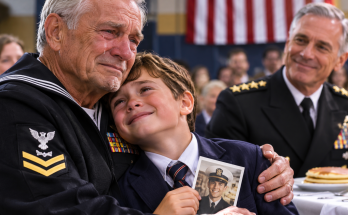
Caleb leaned forward in his chair.
His father's photograph was still between his fingers.
He looked at Admiral Carrick.
Then he looked at me.
I could see that he wanted to ask something.
The admiral noticed too.
He stopped speaking.
He waited.
Caleb seemed uncertain for a moment.
Then he asked whether he could come along.
Not just hear about the veterans' program.
Actually take part.
I looked at him.
After everything that had happened that morning, his question was painfully familiar.
He wanted to know whether there was a place for him.
Again.
I wished he had never been given a reason to doubt that.
Admiral Carrick smiled.
He leaned slightly toward my grandson.
“Of course you can, Caleb. You're the one who helped bring us to this conversation.”
Caleb's face brightened.
It happened so quickly that I almost missed the change.
One moment, he was waiting nervously.
The next, he was smiling.
I felt my own shoulders relax.
I had spent the entire morning trying to help that boy feel included.
And now he was being welcomed into something without having to defend himself.
No rules were being recited.
No one was checking whether his family met a particular description.
No one was asking him to explain why his father could not attend.
The admiral simply wanted him there.
That was how it should have been from the beginning.
I looked at Carrick.
He was watching Caleb with quiet amusement.
The man had spent nearly four decades in military service.
He had reached a rank few people ever attain.
He had stood before a crowded gymnasium and challenged the headmaster of a respected academy.
Yet the expression on his face now was not the expression of a man concerned with authority.
He looked like someone pleased to have made a child happy.
I respected him for that.
More than I could easily explain.
Caleb looked down at his photograph.
Then back at the admiral.
I could see that he was still thinking about the offer.
He wanted stories about his father.
Not stories about ceremonies.
Not speeches about sacrifice.
He wanted to understand the man in the picture.
I had known that for years.
But the morning had reminded me how deep that need ran.
Caleb was only nine.
He had lost his father before he could build the kind of memories other children took for granted.
He could not recall every conversation.
Every expression.
Every ordinary moment.
His mother told him how much his father had loved him.
I told him stories about the man I had raised.
Those things mattered.
But they did not replace the memories he wished he had.
I watched him smooth the folded photograph.
The paper had been handled many times.
That crease had become familiar to me.
I wondered whether Caleb noticed it anymore.
Perhaps it was simply part of the picture now.
The way his father's absence had become part of our family.
Always there.
Even when nobody mentioned it.
I thought about how he had held that photograph on the stage.
His small fingers.
The microphone.
The room full of people listening.
I remembered him telling everyone that he sometimes wished his father could come to school.
And that I had come instead.
It had taken everything I had to remain composed.
Not because I was ashamed of being his grandfather.
I was proud of it.
But because I knew exactly what he meant.
He had wanted his dad.
He had accepted me.
Those were two separate truths.
I never wanted him to feel guilty about the first.
The admiral's invitation seemed to recognize that.
He was not offering to replace Caleb's father.
He was offering to help him understand the life his father had lived.
That distinction mattered.
I could see it in Caleb's expression.
The boy was not asking for another father.
He was asking for stories.
He wanted to know what service meant.
What the people wearing uniforms were like.
Why they depended on one another.
What his own father might have understood about that world.
I could help answer some of those questions.
The admiral could help too.
And perhaps the veterans' program could give Caleb opportunities to hear from people whose experiences were different from mine.
I had spent years thinking I needed to carry every memory myself.
I had never said that aloud.
But I had felt it.
I was my son's father.
I was Caleb's grandfather.
I believed it was my responsibility to preserve the connection between them.
Every story mattered.
Every detail felt precious.
Sometimes I worried that forgetting a small thing meant losing another piece of my son.
That was not reasonable.
I knew it.
But grief does not always obey reason.
I could remember the funeral with painful clarity.
The folded flag.
The salute.
The bugle.
The silence afterward.
Those memories never seemed to fade.
Yet some ordinary details required more effort.
And that frightened me.
I did not want Caleb to lose his father a second time through the gradual fading of memory.
I looked at Carrick.
He had remembered an encounter from decades earlier.
A frightened nineteen-year-old sailor.
A shipboard fire.
A few words spoken during an emergency.
I had almost forgotten that conversation.
He had carried it through an entire career.
That difference had surprised me.
It still did.
Perhaps memories survived in more places than I realized.
Perhaps the people we met carried pieces of our lives without our knowing.
I could not claim that Carrick had known my son personally.
He had not said that.
And I did not want to promise Caleb stories the admiral might not be able to tell.
But he could speak about the Navy.
About service.
About the generation of men and women who had worn uniforms during my son's lifetime.
He could help Caleb understand the world around his father's story.
Sometimes that was how a child began to understand a person.
Not through one perfect account.
Through many small pieces.
A photograph.
A family memory.
A conversation.
A question answered honestly.
I looked at my grandson again.
He seemed content simply to know he could participate.
He was no longer asking whether he qualified.
No one was explaining a policy to him.
No one was suggesting that the invitation belonged to children with a different kind of family.
He had asked to come.
And the answer was yes.
I thought about how different that was from the beginning of the morning.
At the father-son breakfast, the school had treated his grandfather's presence as a problem.
Now a four-star admiral was inviting both of us into a program meant to connect generations.
The contrast was almost difficult to believe.
But I did not want to turn it into another lesson for Caleb.
He had heard enough speeches.
Enough explanations.
Enough adults discussing his circumstances.
I wanted him to enjoy the simple pleasure of being included.
I leaned back slightly.
The chair felt solid beneath me.
The table was ordinary.
There were no microphones between us now.
Just three people talking.
An old chief.
An admiral.
And a little boy holding his father's photograph.
I liked that better than the stage.
I had never felt comfortable standing before a room while people praised me.
I knew that military honors had their place.
I respected them.
But the things I valued most rarely happened in front of an audience.
A frightened sailor finding the courage to act.
A grandfather holding his grandson's hand.
A child asking a question.
Someone answering with kindness.
Those were the moments that stayed.
I looked toward the gymnasium.
The breakfast gathering had settled.
People were still talking quietly.
The tension from the earlier confrontation had faded.
I did not know what Dr. Prentiss was thinking.
I did not know what the scholarship board would decide.
Margaret Ellis had arranged an emergency review.
That much was clear.
The academy had serious questions to answer.
It had excluded Caleb.
It had previously excluded a girl whose mother died during military service.
The scholarship foundation had received complaints.
Those facts mattered.
But I did not want my grandson to spend the rest of his morning worrying about the headmaster's future.
I wanted him to understand something simpler.
He had not done anything wrong.
His family was not defective.
His father's death did not make him less deserving of a place among his classmates.
The school had made a mistake.
And adults were responsible for correcting it.
I looked back at Carrick.
He was still talking with Caleb.
I listened without interrupting.
I liked seeing my grandson comfortable with him.
Earlier, the admiral's rank had seemed enormous.
Caleb had addressed him carefully.
He had stood straight.
He had seemed almost afraid of saying the wrong thing.
Now he was simply a boy speaking with an older man who had offered to tell him stories.
The rank had not disappeared.
But it no longer stood between them.
That was a kind of leadership I understood.
Real authority did not always need to announce itself.
Sometimes it was shown by the way a person listened.
I remembered Carrick crouching in front of Caleb.
He had lowered himself to the boy's eye level.
He had acknowledged the pain of losing a father.
He had not tried to make it disappear with praise.
That moment had told me as much about him as his uniform did.
I thought about the young sailor I had once helped.
I had told him to move despite his fear.
He had done it.
He had survived.
And now he was using his position to make room for a child who had felt excluded.
I did not believe my words had created the man Carrick became.
That would have been foolish.
He had built his own life.
Made his own choices.
Earned his own rank.
But perhaps he had remembered something important from that day.
That a person in authority could help someone who was frightened without making him feel small.
I hoped Caleb would remember that too.
Not the rank.
The kindness.
Not the applause.
The invitation.
I looked at the photograph one more time.
The crease remained.
It would always remain.
No matter how carefully Caleb unfolded the paper.
I found myself thinking that the crease did not ruin the picture.
It showed how often the boy had held it.
How often he had wanted to see his father's face.
How much the photograph mattered.
I felt the old sadness rise.
But it was quieter now.
I could look at the picture without thinking immediately of the funeral.
I could think about the child holding it.
The life continuing in front of me.
The stories still waiting to be told.
That was new.
Or perhaps it was something I had forgotten how to do.
I looked down at my own uniform.
The fabric had remained folded away for years.
I had believed putting it on would bring only pain.
It had brought pain.
I would not pretend otherwise.
But it had also brought me into a moment I would never have expected.
An old sailor recognizing me.
My grandson speaking before his school.
A room full of people standing.
A father moving his chair to make space.
And now an invitation to help children understand service.
I had entered the academy hoping to get through breakfast.
I was sitting there considering a role I had never imagined for myself.
Not returning to the Navy.
Not reliving the past.
Sharing it.
That was different.
And for the first time, I felt ready to try.
Caleb looked at me.
He was still smiling.
I smiled back.
I did not need to explain everything I was feeling.
He would not have understood all of it at nine years old.
And he should not have needed to.
He had asked whether he could come.
He had received his answer.
That was enough for the moment.
I reached for his hand.
He gave it to me without hesitation.
I held it.
And I felt something I had not expected to feel when I walked into that gymnasium.
Peace.
Not complete peace.
Not the kind that erased grief.
The quieter kind.
The kind that came from knowing I had done what I could for the person who needed me.
I had stood beside my grandson.
I had allowed him to speak for himself.
I had listened when other people offered help.
And I had accepted that loving my son did not mean keeping every painful memory locked away.
Caleb was still holding his photograph.
I was still wearing my uniform.
The admiral was still sitting with us.
Nothing about my son's death had changed.
But something about the way I carried his memory had begun to change.
Click here to continue reading: PART 14: I Had Kept My Navy Uniform Hidden Since My Son’s Funeral, but That Morning Taught Me It Could Hold More Than Grief
I Thought My Old Navy Uniform Would Only Remind Me of My Dead Son, Until an Admiral Recognized My Face
Part 13 of 15