I looked directly at Margaret Ellis.
I had spent the morning listening to other people explain what they thought should happen to my grandson.
The headmaster had defended the rules.
The admiral had challenged them.
The scholarship chairwoman had revealed that another child had suffered something similar.
All of those conversations mattered.
But now I needed to say what I wanted.
And I wanted to say it without anger.
I took a moment before speaking.
I knew how easily emotion could change the meaning of a few words.
I did not want to sound as though I was demanding special treatment.
I did not want to use the attention of the room to ask for favors.
That was not why I had put on my old uniform.
I told Margaret that I was not asking the academy to make an exception only for Caleb.
I did not want a special honor.
I did not want a plaque with his name on it.
I did not want the school arranging a ceremony every time he entered the building.
I could hear my own voice becoming firmer.
It surprised me.
I had felt uncertain for much of the morning.
Not about whether the school had been wrong.
About whether I could make anyone understand why it mattered.
Now the words came plainly.
I wanted my grandson treated like the other children.
If they were allowed to bring someone who loved them to a family event, he should be allowed to do the same.
It should not matter whether that person was a father, grandfather, uncle, brother, stepfather, or another guardian.
The important thing was the relationship.
The care.
The person willing to be there.
I looked at Caleb.
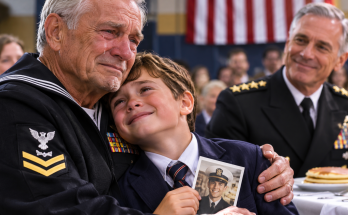
He was standing beside me with the photograph in his hand.
He did not need a new title for me.
I was his grandfather.
That was enough.
He did not need me to pretend I could replace his father.
I could not.
And I would not insult my son's memory by pretending otherwise.
But I could still be the person who came when Caleb needed someone.
The academy should have been able to recognize that without turning it into a question of eligibility.
Margaret listened carefully.
She did not interrupt.
I could tell that she understood.
When I finished, she agreed.
Not cautiously.
Not with another explanation about procedures.
She acknowledged that what I was asking for was reasonable.
The school should have handled the situation that way from the beginning.
I felt a quiet relief.
It was not the relief of winning an argument.
I had no interest in that.
It was the relief of finally hearing someone say something simple and correct.
Caleb belonged.
Children with absent parents belonged.
Children who had lost mothers or fathers belonged.
Their families did not become less real because someone had died.
I looked toward the admiral.
He gave me a small nod.
I appreciated that.
He had spent much of the morning speaking on our behalf.
Now he seemed content to let my words stand.
That mattered to me.
I did not want to be remembered only as the old chief an admiral had recognized.
I wanted to be remembered, if anyone remembered me at all, as a grandfather who had asked for his grandson to be treated fairly.
Nothing more.
Dr. Prentiss remained nearby.
I did not know what the board would decide.
Margaret had said an emergency review was arranged.
I understood that the academy would need to examine the complaints.
Perhaps the headmaster would have to explain his decisions.
Perhaps the guidelines would be rewritten.
Those were matters for the people responsible for the school.
I had made my position clear.
I hoped they would listen.
Then I felt a tug against my sleeve.
I looked down.
Caleb was watching me.
His expression was serious.
Not frightened.
Just thoughtful.
I bent slightly toward him.
He had been quiet while the adults discussed the scholarship and the rules.
I wondered whether he wanted to ask about his father.
Perhaps Margaret's words had raised new questions.
Perhaps he wanted to know more about the scholarship.
I was ready to listen.
He leaned closer.
“Grandpa?”
I answered him.
“What is it, son?”
He looked toward the tables.
Then back at me.
“Are we still going to have breakfast?”
For a moment, I could not speak.
It was such an ordinary question.
So ordinary that it nearly undid me.
After everything that had happened, that was what he wanted to know.
Could we eat?
Could we sit down?
Could the morning finally become what it was supposed to be?
I looked at the tables.
The plates.
The people waiting.
The children who had come expecting to share a meal with someone they loved.
And I realized how far we had traveled from that simple purpose.
We had discussed military service.
We had heard an admiral remember a fire aboard a ship.
We had talked about my son's death.
We had watched a nine-year-old hold up a photograph and explain how much he missed his dad.
We had heard about a scholarship program.
We had learned that another child had been excluded from a family luncheon.
We had listened to an argument about policies and the authority of the board.
All Caleb wanted was breakfast.
I felt an ache in my throat.
I wanted to laugh.
I wanted to cry.
Mostly, I wanted to hug him.
Admiral Carrick heard the question.
He smiled.
Then he laughed.
Not at Caleb.
With the relief of a man who had suddenly been reminded what the entire morning was supposed to be about.
He told the gathering that the boy had finally asked the question everyone should have been considering.
People began to laugh.
The sound spread across the room.
It was different from the earlier applause.
There was no anger in it.
No tension.
Just people responding to the honesty of a child.
I looked at Caleb.
He seemed surprised by the reaction.
I squeezed his shoulder.
He smiled.
And this time, the smile stayed.
I felt some of the heaviness leave the room.
The academy's problems had not vanished.
The board still had work to do.
The headmaster still had questions to answer.
But my grandson did not need to spend the rest of the morning standing on a stage while adults debated his circumstances.
He needed to eat.
So we returned to the breakfast.
I walked beside him.
No grand entrance.
No more speeches.
Just the two of us moving toward the tables.
I was still wearing my old Navy uniform.
Caleb still carried his father's photograph.
But something about the room had changed.
People were making space.
Not because an admiral had instructed them.
Not because someone had written a new policy in front of us.
Because they understood what should have happened in the first place.
A father sitting nearby shifted his chair.
He made room for us.
I thanked him.
It was a small gesture.
But after the morning we had experienced, it meant a great deal.
We had been told there was no proper place for a grandfather at the father-son breakfast.
Now someone was simply making room.
No questions.
No explanations.
A chair moved.
That was all.
I wished it had happened earlier.
I wished Caleb had never needed to stand before the school and speak about his dead father.
But I was grateful that it was happening now.
Another father offered Caleb a plate of pancakes.
I watched my grandson's expression.
He looked pleased.
A child being offered breakfast at a breakfast event.
There was something almost painfully ordinary about it.
Yet I had spent the morning hoping for exactly that.
Caleb accepted the food.
He sat down.
I took the chair beside him.
For the first time since entering the gymnasium, I felt we were where we belonged.
Not at the front.
Not under everyone's gaze.
At a table.
Among other families.
I looked around.
The conversation was beginning to return.
The room sounded like a school breakfast again.
Voices overlapping.
Children speaking.
Adults answering questions.
The small noises of people eating.
I had never expected those sounds to feel comforting.
But they did.
I looked at Caleb.
He was focused on his plate.
I almost laughed again.
He had been the subject of an entire room's attention.
He had spoken into a microphone.
He had been praised by a four-star admiral.
And now he was interested in pancakes.
That seemed exactly right.
A little boy should be allowed to be a little boy.
Even one who had lost his father.
Especially one who had lost his father.
I did not want grief to become the only thing people saw when they looked at him.
He had interests.
Questions.
Friends.
Things he enjoyed.
A whole life still unfolding.
His father was part of that life.
An important part.
But Caleb was more than the loss he had suffered.
I hoped the academy would remember that.
A boy approached our table.
He introduced himself as Ethan.
He asked Caleb whether he liked baseball.
I watched my grandson look up.
The conversation shifted almost immediately.
Caleb answered.
Ethan had something else to say.
Before long, two more children were involved.
I heard them discussing baseball statistics.
Numbers.
Players.
The sort of details children can argue about with complete seriousness.
I leaned back.
I did not need to join in.
In fact, I was relieved that nobody expected me to.
This was what I had wanted.
Caleb talking with other boys.
Not explaining why his father was absent.
Not defending the person he had brought to breakfast.
Not standing in front of adults who were treating his family as a problem.
Just talking about baseball.
I watched him become animated.
His hands moved as he spoke.
He listened to Ethan.
Then answered something another boy said.
He looked comfortable.
I had not seen him look that comfortable all morning.
I thought about the moment he had been told to wait in the library.
I thought about how different the day could have been.
He might have spent the breakfast alone, wondering what the other boys were doing.
He might have returned to class carrying the belief that his father's death made him different in a way the school could not accept.
He might have kept that feeling to himself.
Children often do.
They do not always tell adults when something has wounded them.
Sometimes they simply stop asking to be included.
That thought troubled me.
I did not want Caleb to stop asking.
I did not want him to learn that the safest way to avoid rejection was to expect nothing.
He had already lost his father.
He should not have to lose the ordinary confidence of childhood too.
I watched him laugh at something Ethan said.
The sound was brief.
Natural.
Unforced.
I felt grateful for it.
I looked down at my uniform.
The fabric still carried the weight of old memories.
My son's funeral.
The flag.
The bugle.
The silence afterward.
Those memories would always be there.
I could not change them.
But I was beginning to understand that the uniform might also carry this morning.
Caleb's hand against my back.
The admiral recognizing me.
A room standing as we walked past.
My grandson holding up his father's photograph.
And a father moving his chair so we could sit.
Those were memories I wanted to keep.
Not because they made the loss easier.
Because they reminded me that life had continued around it.
My son was gone.
Caleb was here.
And I still had work to do as his grandfather.
Not military work.
Nothing dramatic.
I needed to listen.
To show up.
To tell stories when he asked.
To help him understand that the person he had lost would always belong to his family.
And to make sure he knew he belonged too.
I looked at the plate in front of me.
I realized I had barely thought about eating.
Caleb noticed me watching him.
He smiled.
Then he turned back to the other boys.
I did not mind.
That was another good sign.
He did not need me to hold his hand every second anymore.
He was comfortable enough to give his attention to other children.
I sat quietly.
I let him enjoy the moment.
I had not come for applause.
I had not come hoping to meet someone important.
I had not come seeking recognition for my years of service.
I had come because my grandson wanted someone beside him.
And finally, after everything, I was sitting at a breakfast table with him.
That should have been ordinary.
I hoped that someday it would be.
I looked across the room.
The adults were talking.
The boys were eating.
The morning was moving forward.
I thought the difficult part was behind us.
Perhaps the board would address the rules later.
Perhaps Margaret would contact our family.
Perhaps the academy would make certain no other child experienced what Caleb had.
Those questions mattered.
But they could wait.
For now, my grandson was eating breakfast with his friends.
I was content to watch.
Then, after the meal had ended, I noticed Admiral Carrick approaching our table.
He was no longer carrying the microphone.
He looked relaxed.
Almost thoughtful.
He stopped beside me and asked whether we could speak.
I stood slightly from my chair.
Of course I was willing.
The admiral glanced toward Caleb.
Then he made it clear that he wanted my grandson included in the conversation.
I looked at the boy.
He had spent the morning learning that adults were finally willing to listen to him.
I was glad the admiral had not forgotten that.
Carrick pulled out a chair and sat with us.
There was none of the ceremony I might once have expected from a man of his rank.
He had something he wanted to discuss.
Something connected to military families.
And this time, he wanted Caleb to be part of the decision from the beginning.
Click here to continue reading: PART 9: After Everything That Happened at the School Breakfast, the Admiral Sat Beside My Grandson and Offered Something I Never Expected
I Thought My Old Navy Uniform Would Only Remind Me of My Dead Son, Until an Admiral Recognized My Face
Part 8 of 15