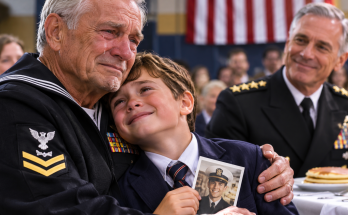
Caleb stood beside me with the microphone in his hands.
I could see how nervous he was.
His fingers moved around the handle.
He looked toward the tables, then down at his shoes.
For a few seconds, he said nothing.
I wanted to tell him that he did not have to speak.
He had already done enough.
He had walked across a gymnasium filled with people who had seen him turned away from an event meant to celebrate families.
He had stood beside an admiral.
He had listened while grown men argued about whether he belonged there.
That was more than a nine-year-old should have been asked to handle before breakfast.
But I stayed quiet.
It was his decision.
Admiral Carrick waited beside him.
The admiral did not reach for the microphone or offer to speak in his place.
He simply gave Caleb time.
I appreciated that more than I could say.
Too many adults mistake a child's silence for an invitation to fill it.
Sometimes children need a moment to find their own words.
Caleb finally lifted his head.
He looked out at the room.
Then he began speaking.
He said his father had died when he was very young.
The words were simple.
He did not try to make them sound important.
He was telling the room something he had lived with for most of his life.
I watched his face.
I could see him trying to keep his voice steady.
He explained that he could not remember everything about his dad.
That was the part that hurt me.
His father had loved him.
I knew that.
His mother knew that.
But Caleb had been too little when we lost my son to keep every memory a child deserves to have.
There were things I could describe for him.
Things I could repeat.
Stories I could tell until he knew them almost as well as I did.
But there is a difference between remembering a person and remembering someone else's stories about that person.
Caleb was old enough to understand that difference.
And too young to have to live with it.
He paused.
Then he reached into the pocket of his blazer.
I knew what he was looking for.
The photograph.
He had brought it to school that morning.
He had kept it folded in his backpack before carrying it with him.
Now he took it out in front of everyone.
It was a small, ordinary photograph.
Nothing about it would have attracted attention from a stranger.
But I knew how much it meant to him.
He held it carefully.
The paper had been folded.
I noticed the crease as he opened it.
I had seen that photograph before.
Of course I had.
It was one of the ways Caleb kept his father close.
And now he was showing it to a room full of people who had gathered with their living fathers beside them.
He explained that his mother told him how much his dad had loved him.
Then he mentioned me.
He said I told him stories about his father.
I looked down.
I could not help it.
I had spent years wondering whether those stories were enough.
Whether repeating the good memories helped Caleb or made the missing parts of his life more painful.
Sometimes he asked questions I could answer easily.
Sometimes he wanted to know things that were harder to explain.
And sometimes he simply wanted to hear about his dad without asking anything at all.
Those were the moments I treasured.
A child sitting close.
A story remembered.
A father brought back into the room for a few minutes through the words of someone who loved him.
I had never thought of those conversations as something remarkable.
They were what I had left to give.
But hearing Caleb mention them in front of everyone made me realize he had been listening more closely than I understood.
He continued.
He admitted that sometimes he wished his dad could come to school.
Just once.
Sit beside him.
Share a meal.
Be there when everyone else had their fathers with them.
I felt the familiar pressure in my chest.
There was nothing complicated about his wish.
He was not asking for anything extraordinary.
He wanted something many children received without giving it a second thought.
A father at breakfast.
A father in the audience.
A father who could show up when his school sent an invitation home.
I had spent so much time thinking about my son's death that I sometimes forgot how often Caleb was reminded of it.
The loss was not confined to anniversaries or ceremonies.
It appeared in ordinary places.
At school.
At family events.
At tables where other children had someone he could only remember through pictures.
I thought of the library.
The place he had expected to spend the breakfast.
Away from the other children.
Away from the celebration.
Not because he had behaved badly.
Because his dad was dead.
I looked toward the headmaster.
Then I looked back at my grandson.
This was not the time for anger.
Caleb was speaking.
And he deserved my full attention.
His voice became unsteady.
He stopped for a moment.
No one interrupted him.
The room remained quiet.
I could hear the faint sounds of people shifting in their chairs.
Then Caleb looked at me.
He said that I had come instead.
His grandfather.
The man standing beside him.
And I had worn my old Navy uniform.
He knew the connection between that uniform and his father.
He knew his dad had served too.
To Caleb, the uniform meant more than the rank I had held or the years I had spent in the Navy.
It connected two people he loved.
One he could hold hands with.
One he could only see in a photograph.
I felt my eyes sting.
I tried to keep my expression steady.
It was a habit from years of service.
A habit that had followed me long after I put the uniform away.
But some moments make old habits feel foolish.
My grandson was telling an entire room that he had wanted his father.
And that his grandfather had come because his father could not.
There was nothing I could say that would make those words easier to hear.
I stood there and let them reach me.
Caleb looked down at the photograph again.
Then he spoke about what he had expected that morning.
He had thought he would have to stay in the library while the other boys shared breakfast with their fathers.
I watched several people in the audience lower their eyes.
I could not know what they were thinking.
Perhaps they were imagining how their own sons would have felt.
Perhaps they were remembering someone their families had lost.
Perhaps they were simply realizing what the school had asked of Caleb.
He had not been asking for special treatment.
He had been asking to take part.
And the school had nearly made him spend the morning apart from everyone else.
Caleb continued.
He said that instead of sitting alone, he had been able to sit with his family.
That was how he described it.
His family.
Not a substitute.
Not an exception.
Not a grandfather who had been permitted to attend despite failing to meet the school's expectations.
Family.
I looked at the little boy beside me.
He had found the word I had been searching for all morning.
I did not need another explanation from the headmaster.
I did not need the admiral to tell the room what family meant.
My grandson had just done it.
In the plainest way possible.
He wanted to sit with someone who loved him.
And now he could.
Caleb lowered the microphone.
He looked uncertain.
Almost as though he wondered whether he had said enough.
I wanted to reach for him.
But I knew he needed a moment to finish on his own.
He did not offer another sentence.
He did not turn his father's photograph into a speech about bravery.
He did not ask anyone to feel sorry for him.
He had said what mattered.
That his father was gone.
That he missed him.
That his mother and grandfather helped him remember.
And that he was grateful not to be alone that morning.
I had heard officers address enormous gatherings.
I had listened to speeches about service and sacrifice.
I had attended ceremonies where every word had been carefully prepared.
But nothing had affected me quite like hearing my grandson explain why a school breakfast mattered.
He was nine.
He was holding a folded photograph.
And he had told the truth.
The first claps came from somewhere in the audience.
Then more joined them.
Within moments, the entire gymnasium was applauding.
The sound rose around us.
It was louder than I expected.
People were standing.
Others remained seated but clapped with the same determination.
I could not have counted them.
I only knew that the room was responding to Caleb.
Not to an admiral.
Not to my uniform.
Not to a story about a fire aboard a Navy ship.
To a little boy who wanted his father.
I looked at him.
His expression changed.
He seemed surprised by the response.
Perhaps he had expected the adults to look uncomfortable.
Perhaps he thought they would simply let him return to his seat.
Instead, they were telling him that his words mattered.
I saw his mouth move toward a smile.
A small one.
He looked at me.
I nodded.
There was nothing else I trusted myself to do.
I could feel the tears in my eyes.
I had fought them during the admiral's remarks.
I had fought them when the men stood as we walked toward the stage.
But Caleb's words had reached a place I could not protect.
I remembered the last time I had worn that uniform before this morning.
My son's funeral.
The flag that had been folded.
The ceremonial gunfire.
The bugle.
The silence afterward.
I had carried those memories for years.
And for a long time, I had allowed them to define what the uniform meant to me.
Loss.
Finality.
A day no father should have to endure.
Yet here I stood wearing the same uniform while my grandson received a roomful of applause.
It did not make the funeral memory disappear.
I would not have wanted it to.
My son's death was part of our family's history.
But it was not the only part.
His child was growing.
His child was speaking.
His child was finding the courage to stand before people and say he missed his dad.
I wished my son could have seen him.
That thought came so quickly it almost took the strength out of my legs.
I wanted my son there.
Not to receive recognition.
Not to hear anyone discuss service.
Just to see his little boy holding that photograph.
I imagined how proud he would have been.
Then I stopped myself.
I could not know exactly what he would have said.
I could only remember the love he had for Caleb.
And that was enough.
The applause continued.
I reached toward my grandson.
He moved closer.
I placed a hand against his shoulder.
He did not look away from the audience immediately.
He seemed to be taking in the faces.
The fathers.
The boys.
The teachers.
All the people who had heard him.
I hoped he would remember that part.
Not merely the humiliation that had started the morning.
But the moment when the room understood.
I hoped he would remember how many people wanted him included.
I hoped he would remember that his father had not been forgotten.
Most of all, I hoped he would remember that he did not need to hide the kind of family he had.
His grandfather was not his dad.
We both knew that.
And neither of us wanted to pretend otherwise.
But I could still come when he needed me.
I could still hold his hand.
I could still tell him about the man whose photograph he carried.
That mattered.
I looked toward Admiral Carrick.
He was watching Caleb with an expression I recognized.
The same quiet respect he had shown when speaking about the frightened sailor he had once been.
I thought about that for a moment.
Years earlier, I had helped a young man who believed he could not move.
Now that same man had helped my grandson find the courage to speak.
I would not have imagined such a connection.
Life rarely arranges things so neatly.
But there it was.
I had helped someone in a moment of fear.
Decades later, he was helping my family through a different kind of pain.
I felt grateful.
More grateful than I could explain.
The applause finally began to ease.
People settled.
A few chairs scraped the gymnasium floor.
I heard a low murmur move through the audience.
Caleb was still holding the microphone.
The photograph rested in his other hand.
I thought the difficult part of the morning might finally be over.
The school had heard him.
The admiral had challenged the policy.
And Caleb had been given the chance to speak for himself.
Surely we could return to a table now.
Surely we could eat breakfast like everyone else.
But as I looked toward the front of the room, I noticed Dr. Prentiss.
He was no longer standing.
He had taken a seat near the stage.
His face looked unusually pale.
At first, I assumed he was embarrassed.
The admiral had questioned his decision in front of the entire gathering.
The audience had applauded that criticism.
And now a nine-year-old boy had explained the pain behind it.
Any headmaster would have found that uncomfortable.
But then I noticed where he was looking.
Not at the admiral.
Not at me.
At Caleb.
More precisely, at the photograph in Caleb's hand.
I watched him for several seconds.
Something about his expression bothered me.
He looked troubled in a way I could not explain.
It did not seem to be the applause that concerned him.
His eyes kept returning to the small piece of paper my grandson had unfolded.
I looked down at the photograph.
The same photograph Caleb had carried all morning.
The one that helped him remember his father.
I did not understand why it seemed to affect the headmaster so strongly.
I did not ask.
Not then.
Caleb had just finished speaking, and I wanted to protect that moment.
But I remembered the look.
The pale face.
The fixed eyes.
The discomfort that seemed to deepen as the room settled.
The photograph had meant something to Caleb for years.
That morning, I began to suspect it had made someone else remember something too.
Click here to continue reading: PART 6: After My Grandson Finished Speaking, a Woman From the Scholarship Foundation Approached the Admiral With Information the Headmaster Wanted Kept Private
I Thought My Old Navy Uniform Would Only Remind Me of My Dead Son, Until an Admiral Recognized My Face
Part 5 of 15