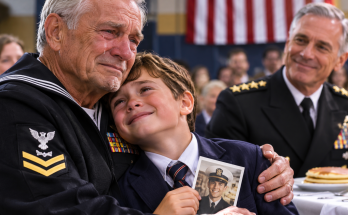
I had gone to the academy hoping to share breakfast with my grandson.
That was all.
I had not expected anyone to recognize me.
I had not expected an admiral to remember a fire aboard a Navy ship.
I had not expected my grandson to speak before two hundred people.
And I certainly had not expected a conversation about a school breakfast to expose problems in a scholarship program.
But by the time Admiral Carrick finished speaking with us, I knew the morning had changed something.
Not the fact that my son was dead.
Nothing could change that.
Not the years Caleb had already spent without his father.
Those years were gone.
And not the memories I carried from the funeral.
The flag.
The salute.
The bugle.
They would remain with me.
But something had changed in the way I understood what I could still do.
I looked at my grandson.
He was sitting beside me.
His father's photograph rested in his hand.
He looked more comfortable than he had at any point since we arrived.
I remembered how tightly he had held my uniform earlier.
He had been afraid of being sent away.
Afraid that he did not belong.
Afraid that having a grandfather instead of a father meant he could not join the other children.
Now he was sitting at the breakfast table.
He had eaten pancakes.
He had talked with Ethan and the other boys about baseball.
He had spoken with Admiral Carrick.
And he had been invited to take part in a program where veterans could share stories with children from military families.
Those things did not erase the humiliation.
I would not pretend they did.
The school had been wrong.
A child should never have been told that his father's death made him ineligible to attend a family celebration.
There was no reasonable way to defend that.
I knew the headmaster had relied on established guidelines.
I had heard his explanations.
I understood the importance of rules.
I had spent years serving in an institution where rules could mean the difference between safety and disaster.
But the purpose of a rule mattered.
And when a rule caused unnecessary harm, someone needed to examine it.
That was what the admiral had insisted upon.
It was what Margaret Ellis had recognized.
And it was what I had tried to explain in my own words.
I did not want special treatment.
I did not want a plaque.
I did not want my grandson to be celebrated every time he entered the building.
I wanted him to be allowed the ordinary things other children enjoyed.
A meal.
A school event.
The presence of someone who loved him.
That was all.
I thought about Dr. Prentiss.
I had seen his face change when Margaret described the scholarship complaints.
I had watched him try to move the discussion into a private setting.
I had listened as he defended the guidelines.
I did not know what the board would decide after its emergency review.
I did not know whether his position would change.
And I had no interest in pretending that I did.
I had not come to the academy hoping to damage a man's career.
I had come because my grandson needed someone beside him.
That remained true.
But I also believed the headmaster had a responsibility to face what happened.
A mistake could be acknowledged.
A policy could be corrected.
A leader could learn.
The real failure came when someone refused to recognize the damage caused by a decision.
I hoped Dr. Prentiss would understand that.
I hoped the academy would change its guidelines.
I hoped the scholarship foundation would continue watching how children from military families were treated.
Especially children who had lost a parent.
The girl Margaret mentioned deserved better.
Caleb deserved better.
And any other student in a similar situation deserved better.
I thought about the scholarship itself.
The Fallen Service Members Scholarship.
It covered tuition and educational materials.
It supported certain school activities.
Those were meaningful benefits.
Families could use that help.
I understood its value.
But the scholarship represented something beyond money.
It was supposed to honor children whose parents had died while serving their country.
It was supposed to recognize sacrifice.
And support the people left behind.
That purpose had to be reflected in how the academy treated its students.
Not only in the financial records.
Not only in the foundation's documents.
In ordinary moments.
At luncheons.
At breakfasts.
At school activities where a child's family might not match the arrangement someone had expected.
I hoped the adults understood that now.
I looked down at Caleb.
He was examining the photograph again.
I wondered how many times he had looked at it during the morning.
It had been there through everything.
The refusal.
The admiral's recognition.
His speech.
The scholarship discussion.
Breakfast.
The final conversation at our table.
A small folded photograph.
A father who was gone.
A boy trying to remember him.
I felt a familiar sadness.
But I did not feel the same helplessness I had felt earlier.
Caleb had asked the admiral for stories about his dad.
Carrick had agreed to share what he could.
He had described a program connecting veterans with young people.
And he had asked me to help.
I had accepted.
That mattered.
For years, I had told myself that my military past was something I needed to keep at a distance.
I had put my uniform away.
I had avoided wearing it.
I had allowed the memory of my son's funeral to define what the uniform meant.
Now I could see that I had been holding on to only part of the story.
The uniform had been there on the worst day of my life.
But it had also been part of years of service.
Years spent working with other men.
Years of responsibility.
Years of learning what courage looked like when people were afraid.
It had been part of my life before my son died.
And now it had become part of a day when my grandson found a place among his classmates.
I could not deny that.
I did not want to.
I thought about the moment Admiral Carrick recognized me.
He had been nineteen during the shipboard fire.
I remembered directing him toward the emergency station.
I remembered returning to help contain the danger.
I had not remembered his name.
But he had remembered mine.
He had remembered what I told him.
He had remembered being frightened.
And he had remembered being encouraged to act despite that fear.
I had not thought of the moment as anything extraordinary.
It had been an emergency.
People needed help.
I had done what seemed necessary.
But Carrick had carried the memory for decades.
He said it had saved his life.
I believed him.
Not because I wanted the credit.
Because I could see what that moment meant to him.
And I realized something.
We do not always know which things we do will matter most to another person.
We cannot measure every act of kindness.
We cannot predict which words someone will remember.
We cannot know how a brief moment might follow another person through the years.
I had learned that from Carrick.
And then I had seen it again with Caleb.
I had come to breakfast wearing my old uniform.
I had thought of it as a simple way to stand beside my grandson.
He had seen something more.
He had seen a connection to his father.
He had seen his grandfather show up when the school expected him to remain in the library.
And when he stood before the room, that was what he talked about.
Not my rank.
Not the fire.
Not the admiral's praise.
The fact that I came.
I felt my throat tighten as I remembered it.
I had spent so much of my life thinking about duty in large terms.
Orders.
Responsibility.
Service.
Sacrifice.
But that morning, duty had meant something very small.
A grandfather showing up for breakfast.
I smiled to myself.
Perhaps it was not small at all.
Perhaps ordinary love was one of the most important responsibilities a person could accept.
I looked at the admiral.
He had been kind to my grandson.
He had listened.
He had spoken honestly.
He had challenged the headmaster without turning the morning into a display of his own authority.
He had made room for Caleb's feelings.
Then he had offered something practical.
A chance to hear stories.
A chance to understand service through people who had lived it.
I was grateful.
I did not need to say it with a long speech.
I had already accepted his invitation.
And I knew he understood what that meant.
I thought about the program.
I did not know every detail.
I did not know when the conversations would begin.
I did not know which children I might meet.
But I knew what I wanted to offer.
Honesty.
I wanted to tell them that people in uniform were still people.
They could be afraid.
They could make mistakes.
They could need help.
They could miss their families.
They could do something important without ever understanding how much it meant.
And I wanted them to know that military service was not measured only by ceremonies.
It was measured by people.
The ones who served.
The ones who depended on them.
And the families who loved them.
I could speak about those things.
I had lived them.
I could also speak about grief.
Carefully.
Without pretending that every painful memory had become easy.
I wanted children to know that loving someone who had died did not mean they had to spend their lives trapped in sadness.
They could miss that person.
They could remember them.
They could ask questions.
They could laugh.
They could enjoy breakfast with friends.
Those things were allowed to exist together.
Caleb had shown me that.
He had spoken about his father's death with tears in his eyes.
Then he had sat at a table discussing baseball.
Both moments were real.
Neither made the other less important.
I thought about the way he had smiled when the admiral said he could join the program.
He had not asked for anything grand.
He had simply wanted to come along.
That question had reminded me of the morning's central problem.
He wanted to belong.
He wanted to be included.
He wanted the adults around him to recognize that his family was still a family.
And now he had heard someone answer without hesitation.
Yes.
He could come.
I wished the academy had given him that answer at the beginning.
I wished we could have avoided the confrontation.
The speeches.
The embarrassment.
The need to explain his father's death before a crowd.
But I could not change what happened.
I could only decide what to carry forward from it.
I did not want to carry only anger.
The anger had been justified.
But it was not what I wanted Caleb to inherit.
I wanted him to remember that people stood for him.
That a father moved his chair.
That someone offered him pancakes.
That Ethan talked with him about baseball.
That Margaret Ellis acknowledged the school's failure.
That Admiral Carrick recognized his grief without treating him as helpless.
And that his grandfather stayed beside him.
Those were the memories I wanted to keep.
I looked down at my uniform.
The fabric felt familiar.
But it no longer seemed like something belonging only to the past.
It had been part of the morning.
Part of Caleb's story.
Part of a connection between generations.
I knew I would eventually put it back in its garment bag.
But the act would be different now.
I would not be hiding it simply because it reminded me of the funeral.
I would know it also belonged to another memory.
A school gymnasium.
A little boy holding a photograph.
An admiral remembering a frightened sailor.
And a room full of people learning what family could mean.
I thought about my son again.
I missed him.
That was still the truth beneath everything.
I wished he had been there to sit beside Caleb.
I wished he could have heard his son speak.
I wished he could have answered the boy's questions himself.
No amount of recognition would change those wishes.
No program would replace him.
No kind words would bring him back.
But the fact that he was gone did not mean his place in the family had disappeared.
Caleb remained his son.
I remained his father.
His mother and I would continue helping Caleb know the man he had been.
And perhaps other veterans could help us give that understanding more depth.
I felt grateful for the possibility.
Not because it solved grief.
Because it gave us a way to keep living with love.
I looked at my grandson.
He was nine years old.
He still had so much growing to do.
There would be more questions.
More school events.
More moments when he missed his father.
I could not promise to protect him from every hurt.
I could not make the world understand his family perfectly.
But I could keep showing up.
I could listen.
I could tell stories.
I could admit when something was difficult.
And I could remind him that he had never been less deserving of love because his father was gone.
That was the promise I could keep.
I reached toward him.
He placed his hand in mine.
I thought about the first time he had gripped the back of my uniform that morning.
He had been frightened.
Now he seemed calm.
The difference mattered.
I held his hand for a moment.
I did not say anything.
Neither did he.
We had heard enough speeches for one morning.
The quiet felt right.
Admiral Carrick had made his offer.
I had accepted.
Caleb had been welcomed.
The scholarship foundation had promised an emergency review.
And the breakfast had finally become a breakfast.
I did not need to invent anything beyond those facts.
They were enough.
I looked at the photograph one final time.
The fold remained.
The image remained.
My son's face was still there.
And so was his child.
Growing.
Learning.
Asking questions.
Finding people willing to listen.
I had spent years believing the uniform represented the day my son's life ended.
But that morning taught me another way to understand it.
It represented a connection between the lives that had come before and the life still unfolding in front of me.
My son's life had mattered.
My own service had mattered.
And Caleb's life mattered just as much.
Not because of a rank.
Not because of a scholarship.
Not because of anyone's sacrifice.
Because he was a child who deserved love and belonging.
I looked at him.
He smiled.
I smiled back.
And for once, I did not feel the need to explain everything.
He had his photograph.
He had his stories.
He had his family.
And when he needed his grandfather, I would be there.
The End
Read more original stories on readstoryus.
I Thought My Old Navy Uniform Would Only Remind Me of My Dead Son, Until an Admiral Recognized My Face
Part 15 of 15