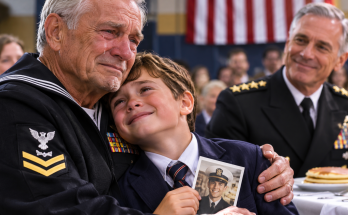
I was still thinking about the photograph when I noticed the woman approaching the stage.
She wore a navy-blue academy blazer.
She carried a folder.
She moved with the purpose of someone who had something specific to discuss.
I had not paid much attention to her earlier.
There had been too many people in the gymnasium.
Too many things happening at once.
But now she was walking directly toward Admiral Carrick.
The applause had faded.
Caleb stood close beside me.
I wanted to return to our table.
He had been through enough.
I could see the effort the morning had taken from him.
He was not crying.
He was not complaining.
But he was only nine, and he had just spoken about his dead father in front of a crowded school gathering.
I wanted him to sit down.
Have something to eat.
Talk about ordinary things.
That was what we had come for.
The woman stepped near the admiral.
She leaned toward him and spoke quietly.
I could not hear what she said.
I was close enough to see his expression.
That was what caught my attention.
A moment earlier, he had been looking at Caleb with warmth.
Now his face became serious.
He glanced toward me.
Then toward my grandson.
Then back at the woman.
I felt a familiar uneasiness.
It was the expression of someone who had just received information he had not expected.
I had seen that look many times during my service.
A routine conversation changes.
Someone reports something important.
The person in charge has to decide what to do next.
The admiral asked the woman whether the information was definite.
She nodded.
I did not know what they were discussing.
I only knew that the mood had changed.
Caleb noticed it too.
He moved closer to me.
I put my hand against his back.
The admiral looked down at the microphone.
Then he raised it again.
I felt disappointed.
Not because I doubted his intentions.
He had already shown my grandson more consideration than the headmaster had.
But I wanted the attention to end.
Caleb had done his part.
He had spoken honestly.
And I did not want anything else to make him feel exposed.
The admiral addressed the gathering.
He explained that there was another matter the academy needed to consider before the breakfast ended.
A matter connected to the scholarship program.
The program that had allowed Caleb to attend the school.
I looked at him sharply.
Scholarship?
That word brought a different kind of worry.
The morning had already been difficult enough.
I did not want Caleb's place at the academy questioned.
I did not want him standing before an audience while adults discussed his education as though he were not there.
I knew his father had died while serving.
I knew Caleb attended through a scholarship recognizing children of fallen service members.
But I had not expected that scholarship to become part of the breakfast.
I looked down at my grandson.
His hand had found mine again.
He gripped it.
I squeezed back.
The admiral continued.
He said the family deserved an explanation about something connected to the scholarship program.
I looked toward Dr. Prentiss.
The headmaster remained seated.
His face still lacked color.
I wondered whether the woman had told Carrick something about the school's decision.
Perhaps there had been a misunderstanding.
Perhaps someone had discovered that the event guidelines did not apply to scholarship families.
I did not know.
And I did not want to guess.
I had spent enough years listening to incomplete reports to understand the danger of filling in missing details yourself.
The woman stepped forward.
She introduced herself as Margaret Ellis.
She was the chairwoman of the academy's scholarship foundation.
I watched her place the folder on the podium.
It was an ordinary folder.
Nothing impressive about it.
But the way she handled it told me that she had come prepared to discuss something serious.
She looked toward Caleb.
Then toward me.
The first thing she did was apologize.
Not to the audience.
Not to the admiral.
To my grandson and our family.
I felt myself become still.
I had heard apologies that were really explanations.
I had heard apologies followed immediately by excuses.
I did not know which kind this would be.
But Margaret's voice sounded steady.
She seemed to understand that something had gone wrong.
Caleb looked up at me.
I gave him a small nod.
He did not need to answer.
He had already said enough for one morning.
Margaret began to continue.
Then Dr. Prentiss rose.
His movement was quick.
I saw him look toward her.
He addressed her by name.
He suggested that the matter should be handled somewhere private.
His voice was polite.
But I heard the urgency beneath it.
I understood the argument for privacy.
I had made similar arguments myself in different circumstances.
Some matters should not be discussed in front of a crowd.
Children should not have their private lives turned into public business.
People deserve a chance to answer concerns without being humiliated unnecessarily.
Those were reasonable principles.
But there was another side to it.
Caleb had already been humiliated in front of other people.
He had already been told that his family did not qualify for the breakfast.
The school had not protected him from embarrassment.
It had caused it.
Now the headmaster wanted the response moved behind closed doors.
That difference was difficult to ignore.
Margaret turned toward him.
She did not raise her voice.
She did not appear surprised by his objection.
She answered him firmly.
She explained that a private conversation should have happened before Caleb was separated from the other children.
Before he was expected to spend the breakfast in the library.
Before his family was placed in the position of having to ask for basic consideration.
I watched Dr. Prentiss.
He said nothing immediately.
Margaret continued.
The room became quiet again.
This was the third time that morning I had felt the attention of the entire gymnasium settle around my family.
I did not enjoy it.
I wanted Caleb to be able to disappear into the ordinary noise of breakfast.
To be another boy among boys.
To stop being the subject of a discussion.
But Margaret had raised a point I could not dismiss.
The school had treated our problem as something to be managed privately only after people began questioning the decision.
That was not the same as caring about Caleb's privacy.
It was caring about the school's discomfort.
At least, that was how it felt to me.
I looked at the headmaster.
I wanted to believe he was capable of understanding that difference.
I had no desire to see him humiliated for its own sake.
But I also did not want the adults to leave the room believing the matter had been settled simply because the admiral had spoken kindly to my grandson.
A kind speech was not a policy change.
Applause was not accountability.
And a child's smile did not erase the decision that had hurt him.
Margaret opened her folder.
I heard the faint movement of paper.
She explained the scholarship program.
It had been established for children whose parents died while serving the country.
Its purpose was to support their education.
Tuition.
Learning materials.
Certain school activities.
Practical things that could make a difference to families who had already paid a terrible price.
I knew the program existed.
But hearing its purpose described aloud, in that room, gave it a different weight.
The academy had welcomed Caleb because of his father's service.
It had accepted him as a scholarship student because his family had lost someone in uniform.
Yet that same loss had been used to justify keeping him out of a school event.
I could not stop thinking about the contradiction.
The school recognized my son's sacrifice when it came to Caleb's education.
But when it came to breakfast, the absence of his father became a reason to exclude him.
I looked at Margaret.
She was speaking directly to that problem now.
Caleb listened.
I could see him trying to understand how his scholarship related to the morning.
Then Margaret said something that made him raise his head.
She connected the scholarship to his father.
Not merely to the fact that his father had died.
To the service he had given.
To the reason the program existed.
She wanted Caleb to understand that the academy's support was meant to honor families like ours.
I watched my grandson's face.
His eyes moved toward the photograph he was still holding.
I could almost see him trying to connect the man in the picture with the school around him.
His father.
His classroom.
His education.
The place where he had been told to wait in the library.
He looked at Margaret.
Then he asked whether his father was the reason he had been able to attend the academy.
It was a child's question.
Direct.
Without any of the complicated language adults had used all morning.
Margaret's expression softened.
She explained that his father's service was indeed the reason he qualified for the scholarship.
Caleb looked down at the photograph again.
I wondered what he was thinking.
Perhaps he was imagining his father making a decision that reached into his life years later.
Perhaps he was simply pleased to learn another way his dad was connected to him.
I could not know.
But I saw the way he held the photograph.
Carefully.
As though the paper had become more important.
I felt a painful mixture of pride and sadness.
My son had not chosen to leave his child.
He had died while serving.
And now that sacrifice was helping provide his son with an education.
I wished the scholarship were unnecessary.
I wished Caleb could attend any school with his father alive.
There was no amount of tuition that could replace what he had lost.
But I was grateful that people had tried to create something useful for children in his position.
That was what the scholarship was supposed to represent.
Care.
Recognition.
Support.
Not pity.
Not special privilege.
An acknowledgment that these children deserved opportunities and understanding.
I looked around the room.
The contradiction was becoming harder to avoid.
The very institution that benefited from having a scholarship honoring fallen service members had nearly excluded one of those children from a family event because his parent was gone.
I wondered how long Margaret had been aware of the issue.
I wondered whether other families had complained.
But I did not need to wonder for long.
She turned another page.
Her expression became more serious.
She explained that the foundation had received concerns about the treatment of scholarship students during certain academy activities.
Not merely about Caleb.
Other concerns.
Other families.
Other occasions.
I felt my stomach tighten.
Until that moment, I had hoped our situation might have been an isolated mistake.
A badly written rule.
A headmaster who had failed to think through the consequences.
Something that could be corrected once someone pointed out the harm.
But Margaret was describing a pattern of complaints.
I glanced at Dr. Prentiss.
He stood very still.
His eyes were fixed on the podium.
I did not know what he had been told before that morning.
I did not know which complaints had reached his office.
And I did not want to invent blame without hearing the facts.
But I could see that the situation was no longer limited to the breakfast invitation.
There were other children.
Other families.
Other people who had expected the academy to understand what its scholarship represented.
I looked at Caleb again.
He had put the photograph closer to his chest.
I touched his shoulder.
I wanted him to know that nothing Margaret said would change the reason we had come.
He belonged at the breakfast.
He belonged at his school.
And he did not owe anyone an apology for having a father who had died.
Margaret continued looking through the papers.
I could hear the room settling into an uncomfortable silence.
The admiral stood beside her.
He did not interrupt.
He was allowing the person responsible for the scholarship foundation to explain what she knew.
That seemed right to me.
The problem was no longer something that could be solved by one veteran's recognition of another.
It was an institutional matter.
And the academy needed to face it as one.
I looked at the folder.
The paper inside it contained more than the story of my grandson's morning.
I could tell that much.
But I did not yet know how many other children had been hurt by the same kind of thinking.
When Margaret began describing the previous year's complaint, I listened carefully.
Because I had finally understood that Caleb had not been the first child asked to pay for a school tradition with his dignity.
Click here to continue reading: PART 7: The Scholarship Chairwoman Revealed Another Child Had Been Excluded After Losing Her Mother, and the Headmaster Still Defended the Rules
I Thought My Old Navy Uniform Would Only Remind Me of My Dead Son, Until an Admiral Recognized My Face
Part 6 of 15