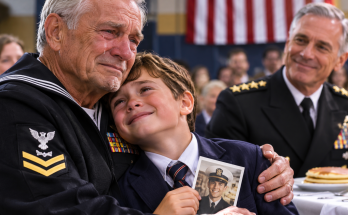
I looked at Admiral Carrick.
He was still sitting across from me.
Waiting.
I had taken longer than I intended to consider his invitation.
But he had not rushed me.
That mattered.
He had asked whether I would help with the Navy's program connecting veterans with children from military families.
He had explained what the program was meant to do.
Real conversations.
Honest stories.
A chance for young people to understand service through the experiences of those who had lived it.
I respected the purpose.
I also knew why the decision had been difficult.
My son's death had changed the way I looked at my own military past.
It had made the uniform difficult to wear.
It had turned certain memories into things I avoided.
And it had left me uncertain whether I could speak about service without returning to the funeral.
I knew I could not spend the rest of my life pretending those memories did not exist.
They did.
They always would.
The question was whether I could allow them to be part of something useful.
I glanced at Caleb.
He was sitting close beside me.
His father's photograph remained in his hand.
I could see the fold.
That little crease had caught my attention several times during the morning.
It had become one of the details I knew I would remember.
A small piece of paper.
A child's fingers.
A photograph of a father who could not come to breakfast.
I had watched Caleb hold that photograph before the entire school.
He had spoken about missing his dad.
He had said he could not remember everything.
And he had explained how his mother and I helped him keep those memories alive.
I had felt proud of him.
And terribly sad.
Both feelings had arrived together.
I did not know how to separate them.
Perhaps I did not need to.
I looked down at my old uniform.
I thought again about the garment bag.
The years it had remained closed.
The way I had avoided looking at the fabric because it reminded me of the day we buried my son.
I had told myself that was simply how I lived with the loss.
But now I wondered whether I had been allowing one terrible day to stand in for an entire life.
My son's life had contained far more than his funeral.
I knew that.
I had memories of him that had nothing to do with death.
And Caleb deserved to hear them.
Not only from me.
From people who could help him understand the world his father had served in.
The admiral's invitation offered that possibility.
It did not promise to replace what Caleb had lost.
Nothing could.
But it offered something real.
Connection.
Conversation.
Memory.
Those were things I could respect.
I looked at Carrick.
I thought about the young sailor he had been.
Nineteen.
Afraid during a fire.
Convinced he might not survive.
He had remembered me taking him by the shoulders.
He had remembered being told that fear should not stop him from helping his shipmates.
I had not known those words would stay with him.
I had simply been doing what needed to be done.
Yet here he was.
Decades later.
An admiral.
A man who had carried one brief conversation through an entire career.
And now he wanted to create opportunities for other young people to hear the experiences of veterans.
I could see why it mattered to him.
I could see why he had asked me.
Still, there was a part of me that resisted the idea of being honored for something I had done long ago.
I did not want to become a symbol.
I did not want every conversation to begin with the story of the fire.
I did not want children looking at me as though I had never been afraid.
That would not be honest.
I had been afraid many times.
I had made difficult choices.
I had lived with memories I did not always understand.
And I had spent years grieving my son.
If I helped with the program, I wanted those truths to remain part of what I shared.
I wanted children to understand that military service was performed by ordinary people.
People with families.
People with fears.
People who made decisions under pressure.
People who sometimes lost more than anyone could measure.
I did not believe children needed polished stories that made every person in uniform sound invincible.
They needed human stories.
Stories that helped them understand their parents and grandparents.
Stories that allowed them to ask questions without feeling ashamed.
Stories that made room for pride and sadness together.
I glanced toward the gymnasium.
The breakfast had continued.
The earlier tension was fading.
Children were talking.
Adults were finishing their conversations.
The ordinary sounds of the morning had returned.
I remembered how much I had wanted that for Caleb.
A chance to sit down.
A chance to eat.
A chance to belong.
He had finally received it.
And now the admiral was offering him something that might last beyond the breakfast.
I felt grateful for that.
I also felt cautious.
I did not want Caleb to believe that a famous officer's attention made him more deserving than other children.
That had been the concern I raised earlier.
He should not need an admiral to secure fair treatment.
He should not need to point to his father's service every time he wanted to participate in school.
He was a child.
He belonged because he was part of the school community.
Not because of anyone's rank.
Not because of a uniform.
Not because of the applause.
I still believed that.
But accepting Carrick's invitation did not mean abandoning that belief.
The program was not an excuse for the academy's mistake.
It was a separate opportunity.
Something that could help Caleb learn more about his father.
Something that might help other children as well.
I could distinguish between those things.
The school still needed to correct its policies.
The scholarship foundation still needed to address the complaints.
Dr. Prentiss still had to face the consequences of decisions made under his administration.
Those responsibilities remained.
But my grandson did not have to reject kindness simply because it arrived after an injustice.
I looked at him.
He was watching the admiral again.
The hope in his expression was unmistakable.
I thought about how much he wanted to hear stories.
That was what he had asked.
Not for an award.
Not for a ceremony.
Stories about his dad.
I knew that desire would not disappear.
He would grow older.
His questions would change.
He would want to understand things he was too young to ask now.
He might want to know more about the decisions his father made.
About what military service required.
About the kind of people he served beside.
I could help with some of those questions.
Others might be better answered by veterans who had different experiences.
I realized I did not have to carry every answer alone.
That thought brought an unexpected relief.
I had never resented telling Caleb about his father.
But sometimes I had felt an enormous responsibility.
As though forgetting a detail meant losing another piece of my son.
As though failing to answer a question meant letting Caleb down.
I knew that was not reasonable.
But grief is not always reasonable.
It can turn love into pressure.
It can make every memory feel precious enough to break.
I had carried that pressure quietly.
Now I could imagine a different way.
People sharing what they knew.
Stories passing from one generation to another.
A boy learning about service through conversations rather than only through photographs and ceremonies.
I wanted that for Caleb.
And I could imagine helping other children find something similar.
Perhaps a child whose father was serving overseas.
Perhaps one whose parent had died.
Perhaps one who simply wanted to know what life in uniform was really like.
I did not need to know their names.
I did not need to imagine their entire lives.
The program existed because there were young people who could benefit from those conversations.
That was enough.
I looked back at Carrick.
I had been silent for a while.
He seemed to understand why.
I appreciated that he had not tried to persuade me with another speech.
He had already explained the program.
The decision was mine.
I knew what I wanted to do.
I was still afraid of certain memories.
That had not changed.
The funeral would always hurt.
The folded flag would always mean something painful.
The bugle would always take me back to a day I wished had never happened.
But I no longer believed those memories had to keep me silent.
I could speak about service and still grieve.
I could remember my son and still smile.
I could wear the uniform without pretending the funeral had not happened.
And I could help children without needing to become someone extraordinary.
I was a grandfather.
A retired chief.
A father who had buried his son.
Those were all parts of me.
I did not need to choose only one.
I looked toward Caleb.
His eyes met mine.
I thought about the way he had answered the man in the navy suit earlier.
He had said I was simply his grandfather.
That memory made me smile.
He had been right.
And I was beginning to understand that being his grandfather was not a smaller role than anything I had done in uniform.
It was simply a different one.
One that required patience.
Honesty.
And the willingness to show up.
I had shown up that morning.
Now I had a chance to show up in another way.
I turned toward Admiral Carrick.
I told him I would be glad to help.
The words were simple.
I did not give a long explanation.
I did not describe the funeral.
I did not tell him how difficult the decision had been.
He did not need all of that.
I had made up my mind.
And I wanted him to know.
His expression softened.
He seemed genuinely pleased.
I felt the familiar discomfort of accepting gratitude.
But this time I did not look away.
I had agreed because I believed in the purpose.
Because I wanted Caleb to learn more.
Because I thought other children might benefit.
And because I was finally willing to let my memories serve something beyond my own grief.
I looked at my grandson.
He was smiling.
I had seen that smile several times during the morning.
Each time, it meant something slightly different.
Relief.
Pride.
Belonging.
Now it seemed to carry excitement.
He had heard the admiral offer stories about his father's generation.
He had heard me agree to help.
I wondered what he imagined would happen next.
Perhaps he pictured sitting with veterans and asking questions.
Perhaps he was thinking about his father.
Perhaps he was simply pleased that the adults had included him in the conversation.
I could not know.
But I was glad he was smiling.
Admiral Carrick looked at him.
He had been speaking to me.
Now he returned his attention to the boy who had brought us together.
I appreciated that too.
Too often, adults discussed children as though they were not sitting in the room.
That morning had contained far too much of that.
Carrick seemed determined not to repeat the mistake.
He spoke to Caleb directly.
The program would allow young people to learn from veterans.
He had already offered to tell him stories.
And now his grandfather had agreed to help.
I watched Caleb listen.
His eyes moved between us.
I could see him taking in the idea.
His grandfather.
The admiral.
Stories about service.
Stories connected to his father.
It was a lot for one little boy to absorb after such a difficult morning.
But he looked pleased.
I felt relieved.
I had worried that the day would leave him remembering only rejection.
Now he had something else to carry.
Not a promise that every future day would be easy.
Not a guarantee that no one would ever misunderstand his family again.
But the knowledge that people were willing to listen.
That his father's memory mattered.
And that there were adults who wanted to help him understand it.
I looked down at the photograph.
The crease was still there.
The picture was still small.
Nothing about it had changed.
But the conversation around it had changed.
Earlier that morning, Caleb had carried it because he missed his dad.
Now it was part of a connection reaching beyond our family.
Not replacing us.
Not taking anything away.
Adding voices.
Adding memories.
Making space for questions.
I felt the weight of the day settling into something quieter.
I had entered the gymnasium worried about whether my grandson would be allowed to eat breakfast.
I was leaving the argument behind with a different understanding of what he needed.
He needed fairness.
He needed love.
He needed stories.
And he needed people willing to see him as more than a boy whose father had died.
I thought about my son again.
Not the funeral this time.
Not the flag.
Not the salute.
I thought about the life he had lived.
The child he had loved.
The father Caleb still wanted to know.
I could not give my grandson back that life.
But I could help him understand it.
And for the first time in years, I felt that the old uniform might help me do that.
Caleb looked toward the admiral.
Then toward me.
He leaned forward slightly.
I could tell he had another question.
I waited.
He had been brave enough to speak before the entire school.
Now he seemed comfortable enough to ask something small.
Something personal.
Something that belonged only to the three of us sitting at the table.
I smiled at him.
Whatever he wanted to ask, I was ready to listen.
Click here to continue reading: PART 13: When My Grandson Asked Whether He Could Come Along, I Finally Understood What the Admiral’s Invitation Meant to a Boy Who Missed His Father
I Thought My Old Navy Uniform Would Only Remind Me of My Dead Son, Until an Admiral Recognized My Face
Part 12 of 15