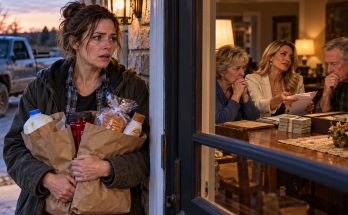
Part 1: My Family Thought Grandpa Was Deaf for Six Years—Then He Exposed Their Cruel Plans at Christmas Dinner
“For six years, my family thought Grandpa couldn’t hear a word they said. Then, at Christmas dinner, my aunt announced that his death would finally pay off her mortgage.”
I was sitting beside him when she said it.
My grandfather, Henry Whitaker, was eighty-two years old. He quietly placed his fork beside his plate, looked directly at his daughter, and said something that made twenty-two relatives fall silent.
“Linda, I’ve heard everything you’ve said since 2020.”
My name is Katie Whitaker, and I was the only person at that table who knew he was telling the truth.
In 2019, Grandpa suffered serious hearing damage when a tractor engine malfunctioned beside him. For months, he struggled to follow conversations, and our relatives gradually stopped including him in family discussions.
But in early 2020, I drove him to a specialist who fitted him with advanced hearing aids. The tiny devices were almost invisible behind his ears, and they restored much of his ability to understand conversations.
Grandpa told Grandma and me about them.
He deliberately kept everyone else in the dark.
“Why don’t you tell the family?” I asked him one afternoon.
He smiled and touched his ear.
“Because people reveal their true feelings when they believe you aren’t listening.”
At first, I thought he was joking.
Then I began noticing what happened during family gatherings.
Aunt Linda regularly discussed how much money she expected to receive when Grandpa died. Uncle Gary searched online for the resale value of Grandpa’s tractors and harvesting equipment.
My cousin Brett was even worse.
During Thanksgiving one year, he looked toward Grandpa’s chair and said, “We should put the old man in a nursing home and divide the property.”
Grandpa calmly asked him to pass the rolls.
I wanted to confront them, but he made me promise to remain silent.
“Not yet, Katie. I need to understand what they’re planning.”
Over the following years, he kept a small green notebook. He recorded dates, conversations, and remarks his children assumed he couldn’t hear.
Then Grandma passed away.
She and Grandpa had been married for sixty-two years. Her death left him devastated, and I visited the farmhouse whenever I could.
Unfortunately, the rest of the family seemed more interested in the inheritance than his grief.
That Christmas, twenty-two relatives gathered around the dining table. Grandpa sat at the head, wearing his favorite gray cardigan.
Halfway through dinner, Linda leaned toward Gary.
“I spoke to a commercial realtor. The south parcel alone could sell for $1.2 million.”
Gary glanced at Grandpa.
“He probably won’t make it through another winter.”
Linda took a sip of wine.
“When Dad dies, the farm will clear my mortgage, pay off the boat, and cover Brett’s debts. That’s practically the only reason we still come here.”
Brett raised his glass.
“To the south parcel.”
My face burned with anger.
Before I could stand, Grandpa carefully put down his fork.
“Linda, I’ve heard every word since 2020.”
He touched the hearing aid behind his ear.
“I heard Gary discussing my equipment. I heard Brett calling me useless. And I heard you planning what you’d buy after my funeral.”
Linda froze.
“Dad, you misunderstood.”
“No. I wrote everything down.”
Grandpa placed his green notebook on the table.
Then he turned toward me.
“Katie, please bring Mr. Dawson inside. He’s waiting in his car.”
I knew exactly who Mr. Dawson was.
He’d been Grandpa’s estate attorney for nearly thirty years.
And as I walked toward the front door, I realized Grandpa hadn’t invited him to Christmas dinner merely to witness a family argument.
He had already made decisions about the farm.
Tonight, everyone was finally going to hear them.
Part 2: My Aunt Wanted Grandpa’s Farm Sold—But His Attorney Had Already Uncovered Her Plans
The moment I opened the front door, cold December air rushed into the farmhouse.
Mr. Dawson was sitting in his car, reviewing a folder beneath the dashboard light. He had handled my grandparents’ legal affairs for nearly thirty years.
When I approached, he lowered his window.
“Is Henry ready?”
I nodded.
“Everyone’s waiting inside.”
He collected his briefcase and followed me toward the house.
By the time we entered the dining room, Aunt Linda had cleaned up the wine she’d spilled. But the tension around the table was worse than before.
She stood immediately when she saw him.
“James, thank goodness. Dad thinks we’ve been plotting against him because of a few harmless conversations.”
Grandpa looked at her.
“Harmless? You were discussing how quickly you could sell my land after I died.”
Linda opened her mouth, but Mr. Dawson raised his hand.
“Henry asked me here to explain several decisions he’s made concerning his estate. I suggest everyone sit down.”
Uncle Gary leaned forward.
“Is this about the farm?”
“It’s about my life, Gary,” Grandpa answered. “The farm is part of it.”
Mr. Dawson opened his briefcase and removed a thick folder.
Before he could begin, Linda turned toward Grandpa.
“Dad, if you’ve changed your will because you’re upset, you should reconsider. We’re your children.”
Grandpa studied her for a moment.
“Linda, do you remember what you said to your mother at the hospital last February?”
Her expression changed.
“I don’t know what you’re talking about.”
“You asked whether we’d updated our wills. You wanted to know if the farm could be sold immediately after she passed.”
Linda shifted in her chair.
“I was trying to help you plan.”
“You also suggested putting me in a care facility because the property was too much for someone my age.”
Grandpa’s voice grew quieter.
“Your mother heard you. She cried after you left.”
I looked toward Grandma’s empty chair.
During her final months, she’d worried about everyone else, even while she was becoming weaker. She’d asked me to save leftovers for Linda and reminded Grandpa to call Gary on his birthday.
Yet her own children had spent those months discussing what they expected to inherit.
Mr. Dawson carefully unfolded a document.
“Before we discuss Henry’s estate plan, I want to make something clear. He has been independently evaluated, understands his assets, and is fully capable of making his own decisions.”
Gary frowned.
“Why would anyone question that?”
The attorney looked directly at him.
“Because three weeks ago, someone contacted my office asking whether Henry’s hearing impairment could affect his legal competence.”
Gary’s face reddened.
Grandpa turned toward him.
“Was that you?”
“I was concerned about your health.”
“Then why didn’t you ask me how I was feeling?”
Gary pushed his chair backward.
“This is ridiculous.”
“You’re welcome to leave,” Grandpa replied. “But my decisions won’t change because you refuse to hear them.”
Gary remained seated.
Mr. Dawson continued.
He explained that Grandpa had commissioned an independent survey of the farm, including the valuable south parcel.
The survey wasn’t the only thing he’d requested.
A commercial realtor had confirmed that someone in the family had approached him about the property’s potential sale.
No transaction had been completed, and Grandpa had never authorized anyone to market his land.
Linda immediately protested.
“There’s nothing wrong with asking what property is worth!”
“You’re right,” Grandpa said. “But you weren’t asking because you wanted to help me maintain it.”
He placed his hand on the green notebook.
“For years, you’ve treated my death like the beginning of your financial freedom.”
Nobody answered.
Then Mr. Dawson removed another document.
“Henry has replaced his previous estate plan. The new arrangements address the farmhouse, the agricultural land, the equipment, and how the property will be managed in the future.”
Brett leaned forward.
“So who gets the farm?”
Grandpa looked at his grandson with unmistakable disappointment.
“That’s still the only thing you want to know?”
Brett lowered his eyes.
I expected Grandpa to announce that he’d sold everything or removed the entire family from his will.
Instead, he reached for my hand.
“Katie, your grandmother and I nearly lost this farm once. We spent our lives building it back.”
I squeezed his fingers.
“Then what are you going to do with it?”
Grandpa nodded toward the attorney.
Mr. Dawson opened a sealed envelope and prepared to read the first provision.
As he unfolded the document, Linda gripped the edge of the table.
And I noticed something that made my stomach tighten.
The first beneficiary named in Grandpa’s new estate plan wasn’t any of his children.
It wasn’t me, either.
Part 3: My Family Expected to Inherit Grandpa’s Million-Dollar Farm—Then His Attorney Revealed the Truth
Mr. Dawson unfolded the document while my relatives watched him in silence.
“The first beneficiary is the Henry and Eleanor Whitaker Farm Preservation Trust.”
Aunt Linda frowned.
“A trust? What does that mean?”
“It means your father has established a legal arrangement to protect the farmhouse, agricultural land, barns, and equipment,” Mr. Dawson explained. “The property won’t automatically be divided among individual heirs or sold to satisfy their personal debts.”
Uncle Gary leaned forward.
“So none of us gets the farm?”
“The trust will oversee its preservation and continued operation,” the attorney replied. “Your father has made separate arrangements for family members.”
Linda turned toward Grandpa.
“You can’t seriously expect us to accept this.”
Grandpa folded his hands on the table.
“Linda, I still own this farm. I’m alive, and I’m entitled to decide what happens to it.”
Mr. Dawson continued reading.
Grandpa would retain the right to live in the farmhouse for the rest of his life. After his death, the trust would manage the property according to specific instructions, including maintenance, agricultural operations, and financial oversight.
Then the attorney announced who would be responsible for managing it.
“Katie Whitaker.”
I stared at him.
“Me?”
Grandpa smiled gently.
“Yes, sweetheart.”
Linda let out a bitter laugh.
“Of course. Your favorite granddaughter gets everything.”
“She isn’t getting everything,” Grandpa replied. “She’s accepting a responsibility.”
He turned toward me.
“You drove me to my medical appointments. You helped your grandmother when she was sick. You came here after she died, even when all I could offer you was coffee and conversation.”
My eyes filled with tears.
“Grandpa, I never expected anything.”
“I know. That’s why I trust you.”
Linda crossed her arms.
“So visiting more often makes her entitled to millions of dollars?”
“No,” Grandpa answered. “It means she understands what this place needs.”
He explained that I knew which fences required repairs, where the irrigation pipes froze, and how much work went into maintaining the barns.
I had learned those things by spending time with him, not by studying property values.
Mr. Dawson clarified that I wouldn’t receive unrestricted ownership of the land.
As manager, I would have to work with the trustees, maintain financial records, and follow the trust’s requirements. I couldn’t simply sell the property or use its assets for personal expenses.
Grandpa reached across the table.
“I’m not giving you a fortune, Katie. I’m asking you to protect the home your grandmother and I built.”
I nodded, struggling to speak.
“I’ll do my best.”
Then Mr. Dawson turned to the next section.
Grandpa had also established an education and emergency assistance fund for his grandchildren. The money could help with legitimate educational expenses and serious financial needs, subject to the trustees’ approval.
Brett immediately asked how much was available.
Grandpa looked at him.
“That fund won’t pay off gambling debts or expensive purchases, Brett.”
My cousin’s face reddened.
For years, Brett had borrowed money for vehicles and other things he couldn’t afford. He’d openly assumed his share of the farm would eventually cover everything.
Now he stared at his plate.
“I didn’t think you could hear me talking about those things,” he admitted.
“That’s precisely why you said them,” Grandpa replied.
Brett swallowed.
“I’m sorry.”
Grandpa nodded.
“I hope you mean that. But changing your behavior will matter more than apologizing tonight.”
The attorney then explained that Grandpa had provided modest, equal cash gifts for his children, while the remaining estate would be distributed according to his written instructions.
Linda looked furious.
“So we’re supposed to accept a little money while Katie controls the farm?”
Grandpa shook his head.
“You’re still thinking about what you can take.”
He glanced toward Grandma’s empty chair.
“Your mother and I nearly lost this land in 1987. We worked extra jobs, sold homemade food, and relied on neighbors to survive. This farm represents everything we struggled to protect.”
Linda’s expression hardened.
“What happens if we challenge the will?”
Mr. Dawson closed the folder.
“You’re entitled to obtain independent legal advice. But Henry’s decisions have been documented carefully, and his capacity to make them has been independently confirmed.”
Grandpa looked around the table.
“You can spend years fighting over property you never helped maintain. Or you can decide whether you still want a relationship with me while I’m alive.”
Nobody spoke.
Then Grandpa slowly stood.
“Dinner is over. There’s pie in the kitchen if anyone wants some.”
He walked toward the living room, leaving the rest of us staring at our plates.
I followed him.
When we reached the doorway, he stopped and looked back at the table where Grandma had once gathered our family.
For the first time that evening, his expression wasn’t angry.
It was simply tired.
And as I helped him into his favorite chair, I began to understand that the inheritance wasn’t the most difficult decision he’d made.
He had finally accepted that protecting the farm might mean disappointing the very children he’d spent his life trying to provide for.
Part 4: My Aunt Threatened to Fight Grandpa’s Will—But Christmas Morning Revealed His Real Plan
I spent Christmas Eve in my childhood bedroom, staring at the ceiling long after everyone had gone home.
Grandpa had named me manager of the farm preservation trust, and I still couldn’t believe it. I had a job and responsibilities of my own, and managing hundreds of acres wasn’t something I knew how to do.
Worse, Aunt Linda already believed I’d manipulated him into giving me the property.
The following morning, I found Grandpa sitting at the kitchen table with two cups of coffee.
“Couldn’t sleep?” he asked.
“Not much.”
He pushed one cup toward me.
“Neither could I.”
I sat down and looked at him.
“Grandpa, are you absolutely sure you want me managing the farm?”
He nodded.
“Why wouldn’t I be?”
“Because Linda thinks I stole her inheritance. I don’t want the family to hate me.”
Grandpa took a sip of coffee.
“People who want to blame you will find a reason, Katie. You can’t spend your life trying to prevent that.”
He smiled faintly.
“Besides, you haven’t inherited a fortune. You’ve accepted a lot of work.”
I laughed despite myself.
Then he reached into a kitchen drawer and removed an old photograph.
Grandma stood beneath the apple trees, laughing with flour on her sleeves. Grandpa was beside her, holding a basket of fruit.
“This was taken in 1987,” he said. “The year we nearly lost everything.”
I’d heard about the difficult harvests, but I hadn’t known how close the bank had come to foreclosing on the farm.
Grandpa explained that he’d repaired machinery for other farmers after finishing his own work. Grandma baked pies and made preserves to sell to neighbors.
They survived because people helped them.
A friend lent Grandpa equipment when his tractor broke down. Neighbors brought groceries when money was scarce.
“After we paid off the debt, your grandmother made me promise something,” he said.
“What was it?”
“That if we ever had enough, we’d use this land to help people who were struggling to build a life.”
He explained the plans he’d included in the trust.
The farm would continue operating, but he wanted part of the property used for agricultural apprenticeships. When financially possible, some income would support local families facing temporary hardship.
Grandma had also dreamed of creating a garden where children could learn to grow vegetables.
Suddenly, I understood why he’d refused to divide the property.
He wasn’t simply protecting his wealth from greedy relatives.
He was protecting a promise he’d made to his wife.
“Will you help me do it?” he asked.
I reached across the table.
“Yes, Grandpa.”
Over the following months, I discovered exactly how much responsibility I’d accepted.
A tractor needed a new transmission. Part of the barn roof leaked, and winter storms had damaged a long section of fencing.
I spent evenings reviewing maintenance records, meeting with the trustees, and learning about farm expenses.
Some days, I felt completely overwhelmed.
Grandpa never expected me to know everything.
“Ask questions,” he reminded me. “Good farmers never stop learning.”
With professional guidance, we repaired the barn, restored the vegetable garden, and prepared a section of the property for educational visits.
By early summer, local schoolchildren were visiting the farm.
Grandpa insisted on attending the first session.
He sat beneath Grandma’s apple trees while the children planted rows of beans and learned how vegetables grew.
One little boy approached him.
“Are you the owner?”
Grandpa smiled.
“I’ve been taking care of this place for a long time.”
“Will you give it to me when you die?”
I nearly dropped my watering can.
But Grandpa laughed.
“No, son. I hope you’ll learn how to care for something of your own.”
Watching him that afternoon, I finally understood the responsibility he’d entrusted to me.
Meanwhile, my relatives were learning that Grandpa wouldn’t change his mind.
Linda sold her expensive second car and arranged a repayment plan with her lender. Gary sold equipment to reduce his debts, while Brett moved into a smaller apartment and began working with a financial counselor.
There were angry calls and repeated attempts to persuade Grandpa to reconsider.
He referred legal questions to Mr. Dawson and refused to make decisions under pressure.
When Linda eventually called asking him to pay off her mortgage, he listened without interrupting.
“I’ll always love you,” he told her. “But I won’t solve every problem by giving you money.”
She was quiet for a long time.
For the first time, she had to face her financial situation without relying on an inheritance that wasn’t hers.
Then, in October, I saw her car pull into the farmhouse driveway.
She came alone.
Instead of asking about the trust or the south parcel, she stood beneath the apple trees and began crying.
Grandpa stepped outside to meet her, and I realized their first truly honest conversation in years was about to begin.
Part 5: My Aunt Finally Apologized to Grandpa—And the Farm Became His Greatest Legacy
When Aunt Linda returned to the farmhouse that October afternoon, she looked nothing like the woman who had mocked Grandpa at Christmas dinner.
She stood beside the porch, clutching her purse, while Grandpa watched her from the doorway.
“Can we talk, Dad?”
He nodded and led her toward the apple trees Grandma had planted decades earlier.
I stayed near the garden fence, giving them some privacy.
For several minutes, neither spoke.
Then Linda began crying.
“I’ve been thinking about Mom,” she said. “She used to call me every Sunday, and sometimes I was too busy to answer. I kept telling myself I’d visit the following weekend.”
Grandpa listened quietly.
“I thought there would always be more time,” she whispered.
“So did I,” he answered.
Linda wiped her cheeks.
“When I talked about selling the farm, I told myself I was being practical. But I knew you were sitting there. I knew it was your home, and I didn’t care enough to stop.”
Grandpa looked at her.
“Wanting financial security isn’t wrong, Linda. What hurt me was hearing you treat my remaining years like an inconvenience.”
She covered her mouth.
“I’m sorry, Dad. I really am.”
He took her hand.
“I forgive you. But rebuilding trust will take time.”
Linda nodded through her tears.
They stood together beneath the trees before Grandpa finally pulled her into an embrace.
I turned away.
Their relationship wasn’t suddenly repaired, but something important had changed. Linda had come to see her father without asking for money.
Over the following months, she began visiting more regularly.
Sometimes she brought groceries. Other times, she simply sat with Grandpa and listened to his stories about Grandma.
Gary and Brett also started making an effort, though their relationships with him improved more slowly.
Two years after that painful Christmas dinner, our family gathered at the farmhouse again.
Grandpa was eighty-four and moved more carefully than before. He still wore his nearly invisible hearing aids, but nobody treated him as though he couldn’t understand a conversation.
Linda brought an apple pie made from Grandma’s handwritten recipe.
Gary arrived early to repair a loose porch step, and Brett helped the younger children prepare the garden for winter.
Nobody discussed selling the south parcel.
Nobody calculated the value of the tractors.
At dinner, Grandpa raised his glass.
“To Eleanor.”
We all raised ours.
Then he smiled.
“And to second chances.”
Afterward, I found him sitting on the porch in his favorite cardigan.
I sat beside him as the first snowflakes drifted across the yard.
“Are you happy, Grandpa?”
He thought for a moment.
“I’m grateful, Katie. I finally understand that I can’t force my children to become the people I want them to be. I can only decide what I’m willing to accept.”
He reached into his pocket and handed me the small green notebook.
Inside were six years of painful remarks my relatives had made while believing he couldn’t hear.
But the final pages were different.
They contained plans for the farm, notes about the children’s garden, and ideas for helping young people learn agriculture.
On the last page, Grandpa had written:
The truth isn’t always revealed to punish someone. Sometimes it gives the people we love a chance to change.
I looked at him.
“Why did you keep writing after that Christmas?”
“Because I didn’t want this notebook to end with everything our family did wrong,” he said. “I wanted to remember what they chose to do afterward.”
The following spring, Grandpa passed away peacefully, with me holding his hand and Grandma’s photograph beside his bed.
At his funeral, Linda stood before our relatives and admitted that she’d spent too many years thinking about what her father would leave behind instead of appreciating the time she still had with him.
She thanked him for giving her a chance to change.
After the funeral, I returned to the farmhouse.
The preservation trust continued operating the land, and our educational garden welcomed more children each season.
Grandpa’s plans for agricultural apprenticeships moved forward gradually, with the trustees helping ensure the farm remained financially stable.
I kept his green notebook in a wooden box beside Grandma’s photograph.
Sometimes, when the house grew quiet, I opened it and read his final entry.
For six years, my relatives had spoken about Grandpa as though he were already gone.
That Christmas, he reminded them that he was still alive.
And in the time he had left, they finally learned to value him for something other than his property.
The farm remained standing, the apple trees continued growing, and the family slowly learned to gather without discussing inheritance.
Grandpa had protected the home he built with Grandma.
But the most valuable thing he left us wasn’t the land.
It was the understanding that love requires respect, forgiveness requires change, and the people we care about deserve to feel valued while they’re still here.
THE END.