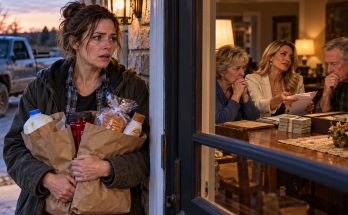
By the time I reached home, I had stopped rehearsing what I wanted to say to Ranata.
Every version sounded wrong.
One was too angry.
Another made me sound as though I were begging her to explain herself.
And the calmest version still began with an accusation.
I parked my pickup and shut off the engine.
For a while, I stayed in the driver's seat.
The grocery bags were on the passenger side, exactly where I had put them outside my parents' house.
The milk had tipped slightly.
The loaf of bread was pressed against the coffee.
Mom's cinnamon creamer was still upright.
I looked at those things and felt a strange disappointment.
I had not even managed to deliver groceries.
That should have been the simplest part of my afternoon.
Instead, I had driven away without speaking to anyone.
I carried the bags into my kitchen.
The milk went into the refrigerator.
So did the creamer.
I left the coffee on the counter and set the bread beside it.
For a moment, I considered calling Mom.
I could tell her something had come up.
I could apologize for not bringing the groceries.
I could promise to deliver them another day.
But that would mean pretending the afternoon had been ordinary.
And I was tired of pretending.
I placed my phone on the kitchen table.
The message from my accountant was still there.
The paperwork from the sale was ready.
Three days earlier, that news would have been the most important thing on my mind.
Now it seemed almost beside the point.
I had thirty-nine million dollars from selling the farm.
My parents apparently believed I owed them money.
Those two facts did not belong together.
Yet there they were.
I sat down and tried to remember every word I had overheard.
Not what I thought Ranata meant.
Not what I feared she had done.
Only what I had actually heard.
That distinction was important.
I had learned over fifteen years of managing property that guessing was not the same as knowing.
A machine could make a terrible noise without having the problem you expected.
A repair could seem obvious until you examined the damaged part.
I had wasted money before by assuming I understood something too quickly.
I did not want to make that mistake with my family.
So I took a piece of paper and wrote down the questions.
How much money?
When had it been given?
Who had received it?
What had Ranata told them?
And why had nobody spoken to me?
I looked at the list.
It was shorter than I expected.
Five questions.
Five ordinary questions that should never have been difficult for a family to answer.
I picked up my phone again.
Ranata's name was in my contacts.
I could call her.
I could ask directly whether she had been collecting money from our parents on my behalf.
But I already knew what she had told them.
What I did not know was whether she would tell me the truth.
I imagined hearing her familiar confident voice.
She might say I misunderstood.
She might insist she was only trying to help.
She might turn the entire conversation toward my supposed pride.
I could almost hear it.
I hated that I could imagine her responses so easily.
Then I realized something else.
Even if Ranata explained everything, I would still need to hear from my parents.
They were the people who believed they had provided assistance.
They were the people who apparently expected repayment.
Their understanding mattered.
I could not settle this by allowing my sister to explain things for them again.
That was exactly how the problem seemed to have developed.
I put the phone down.
The kitchen was quiet.
For fifteen years, that quiet had been one of the things I valued most about living on the farm.
After a difficult day, I could come home without having to explain every decision.
I knew what needed attention.
I knew which responsibilities could wait until morning.
I knew where everything belonged.
Now I was sitting in that familiar room, wondering how much of my life had been discussed without my knowledge.
I thought about my father's voice.
He had asked whether I had returned any of the earlier money.
That question bothered me more than the others.
He had sounded as though repayment was overdue.
As though he had already been patient.
As though I had disappointed him.
I remembered all the times I had visited and found him quieter than usual.
I had never thought much about it.
He was not a man who explained every mood.
Neither was I.
But now I wondered whether some of those silences had involved money.
Perhaps he had expected gratitude.
Perhaps he had expected me to mention what he believed he had given.
Perhaps he had looked at my old truck and wondered why I was not doing better despite his assistance.
I could not know.
That was the worst part.
I could imagine an entire history, but I could not verify any of it.
My mother was different.
She asked questions more often.
She noticed small things.
That afternoon, she had questioned whether I really needed another payment.
I kept hearing the uneasiness in her voice.
It suggested she was not completely comfortable with the arrangement.
But she had not challenged its basic existence.
She believed there had been help.
She believed Ranata knew why I needed it.
And she had not asked me.
I looked toward the refrigerator.
The creamer was sitting inside.
Such a small thing.
Mom could ask me to bring her favorite creamer without hesitation.
She could tell me exactly which one she wanted.
But when it came to money supposedly being given to me, she apparently accepted someone else's explanation.
I found that harder to understand than I expected.
It was not the amount that hurt.
I still did not know the amount.
It was the distance between what she could ask me and what she would not.
I thought about driving back.
For a moment, I almost did.
The groceries were still fresh.
The afternoon was not over.
I could put everything back into the bags, return to the house, and knock.
I could ask my parents to sit down with me.
Maybe that would have been the most straightforward choice.
But Ranata might still be there.
And I did not want another conversation in which she answered for me.
I wanted to speak for myself.
I wanted my parents to tell me what they believed, without my sister deciding which parts I should hear.
So I stayed home.
I went to the kitchen sink and washed my hands.
There were faint red marks across my fingers where the plastic handles had pressed into them.
I rubbed one with my thumb.
It was a small injury.
Nothing important.
But it brought back the moment I had stood outside the door, listening.
I remembered wanting to laugh after reading the accountant's message.
The irony had been enormous.
I was wealthier than my family could have imagined, yet they were discussing me as though I could not manage my bills.
But I did not feel amused anymore.
I felt exposed.
Not because they knew too much about my finances.
Because they knew almost nothing.
And someone had apparently filled that absence with lies.
I sat down again.
My phone was within reach.
I opened the message from my accountant and read it carefully.
The final paperwork was ready for my files.
There were things I still needed to organize following the sale.
Documents.
Records.
Decisions about what came next.
I had been preparing to spend time on those matters.
They concerned money I had earned and a property I had spent years managing.
I understood that part of my life.
The family situation was different.
There were no records in front of me.
No agreement I remembered signing.
No payments I could identify.
I could not even say how much money was missing.
That frustrated me.
I liked knowing what I was dealing with.
I liked facts.
And I had almost none.
I thought about the first time someone in my family had commented on the truck.
I could not remember the exact occasion.
There had been too many remarks over the years.
Sometimes they were presented as concern.
Sometimes as jokes.
Sometimes as suggestions that I ought to make different choices.
I had usually let them pass.
I believed people were entitled to misunderstand my priorities.
But I had never imagined those misunderstandings could become the basis for financial requests.
Looking back, I wondered whether I had confused privacy with silence.
They were not the same thing.
Privacy meant keeping my personal affairs to myself.
Silence meant allowing other people to describe those affairs without correction.
There were times when silence had protected my peace.
This time, it had apparently protected someone else's story.
I did not know whether Ranata had taken money.
I was careful about that.
All I knew was that she had asked my parents for assistance supposedly intended for me.
I knew she had said earlier money had not been repaid.
I knew I had received none of it.
Those facts were serious enough.
I did not need to add anything.
That evening, I made something simple to eat.
I was not very hungry.
I stood in the kitchen longer than necessary, trying to decide whether I should call my father.
The house felt different without the daily worries of operating the farm.
I had spent so many evenings thinking about the next morning's work.
Now the sale had taken those responsibilities away.
At least the ones connected to owning the property.
I had expected that change to bring relief.
Instead, I had brought home another kind of responsibility.
One I had not chosen.
I needed to correct a story about myself.
And I needed to understand what had happened to money my parents believed had reached me.
After dinner, I returned to the kitchen table.
The paper with my five questions was still there.
I read it again.
Then I added one more.
What did my parents believe about me?
I stared at that question for a long time.
It was larger than the others.
More personal.
The financial details could eventually be established.
Amounts could be identified.
Dates could be checked.
But I did not know how to measure the damage caused by years of believing something false about your own daughter.
I had no idea whether my parents would believe me when I told them the truth.
That thought made me uncomfortable.
I was their daughter.
I had worked hard.
I had kept my promises.
I had never borrowed from them.
Those things should have mattered.
But Ranata had been telling them something different.
And they had apparently accepted it.
I put the paper away where I could find it again.
I did not call anyone that night.
It was not because I had decided to forget what I heard.
Quite the opposite.
I had decided the conversation needed to happen properly.
Without shouting.
Without announcing my fortune.
Without allowing Ranata to distract everyone from the money.
I wanted my parents to answer for themselves.
I wanted to know what they had given, what they had been promised, and why they had believed it was going to me.
Only then would I decide what to say to my sister.
Before going to bed, I opened the refrigerator.
The milk was there.
So was Mom's creamer.
I closed the door again.
I had spent the entire day carrying things that were supposed to belong somewhere else.
The groceries were one thing.
The debt was another.
The groceries were easy to understand.
The debt was not.
I turned off the kitchen light.
For the first time since hearing my name through that closed door, I felt certain about what I needed to do.
I would ask my parents directly.
And I would not allow anyone else to answer in my place.
Source: thknews11.store
Click here to continue reading: PART 6: Before I Could Ask My Parents About the Missing Money, I Had to Face How Many Years I Had Allowed My Sister to Speak for Me
I Arrived at My Parents’ House Carrying Groceries, Never Imagining That a Conversation Behind Their Front Door Would Change Everything I Believed
Part 5 of 15