I had been thinking about the wrong kind of proof.
That realization came while I was looking through the documents connected to the farm sale.
Everything was there.
The completed transaction.
The final records.
The information confirming what had happened three days before that Saturday visit.
I could show those papers to my parents.
They would know the farm had sold for thirty-nine million dollars.
There would be no room for doubt about that.
But the documents could not tell me what Ranata had done.
They could not show whether my parents had given her money.
They could not explain why she had claimed I needed help.
They could not establish what my father believed I owed.
I set the papers down.
For the first time, I saw clearly how easy it would be to lose sight of the real problem.
I had become focused on the enormous difference between my financial situation and the one my family believed existed.
It was an understandable reaction.
My sister had described me as someone unable to keep up.
I had just completed a sale worth millions.
The contradiction was almost impossible to ignore.
But proving my success was not the same as finding the missing money.
I needed to remember that.
I returned to the kitchen.
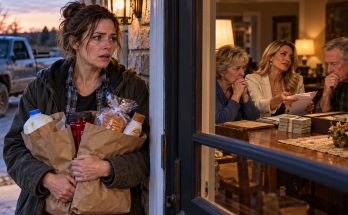
Mom's groceries were still waiting.
The coffee was on the counter.
The milk and creamer were in the refrigerator.
The bread had been placed carefully where it would not get crushed.
I looked at the bags.
They seemed to belong to a different afternoon.
One in which I could walk up to my parents' front door without worrying about what was being said inside.
I thought about the simple conversation I had expected.
Mom would thank me.
Dad might ask about work.
Ranata might make a comment about the truck.
I would answer briefly.
Then I would leave.
That was how I had imagined the visit.
And perhaps that was how many of our visits had gone.
The ordinary details had covered things nobody discussed openly.
I had not known there was another story being told.
Now I could not pretend otherwise.
I took the creamer from the refrigerator and looked at the label.
Cinnamon.
The one Mom liked.
I remembered reaching for it at the store.
I had done that without hesitation because I knew her preference.
There was a time when such small knowledge had made me feel close to my family.
Now I wondered why we knew so many ordinary things about one another and so little about the matters that could damage our relationships.
I knew what Mom put in her coffee.
She apparently did not know I had never borrowed money.
I knew which vehicle Dad drove.
He apparently did not know that I was not waiting for help.
I knew Ranata preferred a comfortable life.
She apparently believed she could speak about my finances without my permission.
Those differences were painful.
But they did not mean every part of my family history had been false.
I reminded myself of that.
Mom had still asked me for groceries.
Dad was still my father.
Ranata was still my older sister.
The years we had known one another did not disappear because I overheard a troubling conversation.
But neither did those relationships excuse what I had heard.
I could care about my family and still demand an explanation.
I could love my parents and still question why they had trusted someone else to describe my life.
I could remember growing up with Ranata and still recognize that she had made claims about me that were not true.
That balance was harder than I expected.
Anger encouraged simple conclusions.
It was tempting to decide that everyone had deliberately treated me badly.
It was tempting to imagine that every comment about the farm had been part of some larger plan.
But I did not know that.
I knew what I had heard.
I knew what I had lived.
The distance between those two things was already serious.
I did not need to invent more.
I sat at the table and unfolded my list again.
The paper was creased now.
I ran my thumb along the fold.
Six questions.
I had written them because I needed something solid to hold on to.
Now I began thinking about how I would ask them.
I did not want to begin by saying Ranata was a liar.
Even though I knew her statements about my finances were false, I wanted my parents to explain their understanding first.
If I began with an accusation, they might feel obliged to defend her.
They might see the conversation as another disagreement between sisters.
I did not want that.
This was not a disagreement about lifestyle.
It was about money.
Real money my parents believed had been given to me.
Money I had never received.
That was the point I needed to keep clear.
I imagined sitting across from Dad.
I would ask whether he believed I owed him anything.
I would ask how that belief began.
Then I would ask whether he had given money to Ranata for me.
It seemed straightforward.
But I knew the answers could be difficult.
If he admitted giving money, he might feel embarrassed.
If Mom had agreed to it, she might feel foolish.
If they had trusted Ranata for years, they might resist accepting that something was wrong.
I did not want to hurt them.
But I could not protect them by remaining silent.
That was something I had to accept.
For years, I had avoided correcting small misunderstandings because I did not want arguments.
Now I understood that avoiding every uncomfortable conversation could allow a much larger problem to continue.
I looked at my phone.
The message requesting a private conversation was still there.
I thought about sending another message.
Something more specific.
Something that would make my parents understand the seriousness of the matter.
But I stopped.
I had already asked to speak.
I did not need to explain everything through a screen.
There were things I wanted to say while looking at them.
Things I wanted them to answer without anyone else interpreting my words.
The same went for Ranata.
I knew I would eventually have to ask her what she had been doing.
But that conversation needed to follow the facts.
Not precede them.
I had allowed her to act as an interpreter of my life for too long.
I was not going to let her become the interpreter of this problem too.
I thought about the farm again.
Fifteen years.
It was difficult to explain how much of myself I had put into those years.
There had been mornings when getting out of bed felt harder than the work itself.
There had been repairs I could not postpone.
There had been expenses I had planned carefully because I did not want to depend on anyone.
There had been days when I wondered whether continuing was the right choice.
But I had continued.
I had made the decisions.
I had accepted the consequences.
That was why the sale meant so much to me.
Not only because of the amount.
Because it represented work I had done without asking my sister to manage my life.
I had not called Ranata when things were difficult.
I had not asked her to explain my problems to our parents.
I had not authorized her to request money.
I had lived through the hard parts myself.
And now someone else was apparently receiving sympathy and assistance because of a false account of those difficulties.
I could not explain away that contradiction.
I tried to imagine how Ranata would react if she learned about the sale.
At first, I pictured surprise.
Then confusion.
Perhaps anger.
Perhaps an attempt to question how I had managed it.
But those were only possibilities.
I did not know what she would say.
I did not want to become so concerned with her reaction that I forgot why I needed answers.
The money from the farm was mine.
The money my parents believed they had given me was a separate matter.
That distinction had to remain clear.
I turned my attention back to the conversation I had overheard.
My mother had questioned whether I needed more.
Ranata had assured her that assistance was still necessary.
My father had asked about previous money.
Ranata had said I had not repaid it.
Those statements formed a simple sequence.
A request.
A concern.
A question about repayment.
An explanation that I was still behind.
I did not need to embellish it.
It was serious enough.
I considered what would happen if I asked my parents directly and they denied everything.
Perhaps they would insist they had never given money.
Perhaps they would say I misunderstood.
If that happened, I would have to listen.
I could not force them to confirm something simply because I had heard part of a conversation.
But I could tell them exactly what I heard.
I could explain why it concerned me.
And I could make one thing unmistakable.
I had never accepted financial assistance through Ranata.
I had never borrowed from my parents.
I did not owe repayment for money I had never received.
Those were facts I could state confidently.
I thought about the possibility that my parents had acted out of genuine concern.
That seemed likely enough to consider.
They had watched me work hard for years.
They knew farming was demanding.
They knew my truck was old.
Perhaps they believed I was too proud to ask for help.
Perhaps Ranata had encouraged that belief.
I did not know.
But if they had wanted to help, they could have asked me.
That was the part I could not overlook.
A person cannot make an informed decision about someone else's needs without speaking to them.
At least not when that person is capable of answering.
I had been capable.
I had been available.
And I had never been consulted.
I found myself returning to that word.
Consulted.
It sounded formal for a family matter.
But it described what was missing.
My parents and sister had apparently made decisions involving my name, finances, and supposed debts.
And I had not been part of any of them.
I was not a child.
I was thirty-seven.
I had spent fifteen years managing a farm.
I had handled responsibilities that required patience, judgment, and financial planning.
Yet my family had apparently treated me as someone who needed arrangements made behind her back.
That was unacceptable.
I said the word quietly.
Unacceptable.
It felt strange to hear it in my own kitchen.
I had spent so long accepting their opinions that drawing a firm boundary felt unfamiliar.
But the boundary was necessary.
I could no longer allow false statements about my finances to go unanswered.
I could no longer allow my sister to speak for me without permission.
And I could no longer let my parents believe I owed them money I had never borrowed.
The decision was simple.
The conversation would not be.
I knew that.
I could already imagine Mom becoming upset.
I could imagine Dad wanting a clear explanation.
I could imagine Ranata insisting she had been misunderstood.
But I could not control those reactions.
I could only be truthful.
I looked at the documents from the farm sale.
For a moment, I considered putting them with my list of questions.
Then I decided against it.
I did not need them for the first conversation.
The sale was not the issue my parents needed to answer.
It might become relevant later.
But I was not going to use it as a distraction.
I put the documents away.
The list stayed on the table.
I wanted to keep the questions where I could see them.
The first question remained the most important.
How much money?
I could not begin to understand what had happened until I knew what my parents believed they had given.
The second was just as necessary.
To whom?
I knew the money had not come to me.
If it had been handed to Ranata, I needed to know that.
If there was some other arrangement, I needed to understand it.
I was not willing to accept vague explanations anymore.
For years, vague remarks had shaped the way my family saw my life.
I had allowed them.
Now actual money was involved.
That required more than assumptions.
I folded the paper again.
I looked around the kitchen.
Everything was ordinary.
The same table.
The same counter.
The same refrigerator.
The same groceries I had carried back from my parents' porch.
I had expected the day after the farm sale to feel like the beginning of something entirely new.
Perhaps it was.
But not in the way I had imagined.
I had gained financial freedom.
And almost immediately, I had discovered that my family believed I had been financially dependent on them.
The irony was obvious.
The damage was not.
I still did not know how much money had been involved.
I still did not know how long the story had continued.
I still did not know whether my parents would believe me when I corrected it.
But I knew what I would do.
I would speak to them directly.
I would ask for the facts.
I would listen before drawing conclusions.
And I would not let the thirty-nine million dollars become the explanation for why I deserved to be heard.
I had deserved that long before the sale.
I had deserved it when I drove an old truck because it still worked.
I had deserved it when I wore clothes marked by a full day's work.
I had deserved it during difficult seasons when I chose to manage expenses rather than ask for help.
And I deserved it now.
I looked toward the refrigerator one last time.
Mom's creamer was still inside.
I would eventually have to decide what to do with those groceries.
But the more important decision had already been made.
The next time my family discussed money supposedly given to me, I intended to be part of the conversation.
Not as the helpless daughter Ranata had described.
Not as the wealthy daughter they did not yet know about.
Just as Fay.
The person whose name they had been using.
The person who had never received their money.
And the person who was finally going to ask where it had gone.
Source: thknews11.store
Click here to continue reading: PART 9: When My Mother Finally Responded to My Message, I Knew I Could No Longer Avoid Asking What My Parents Had Given My Sister
I Arrived at My Parents’ House Carrying Groceries, Never Imagining That a Conversation Behind Their Front Door Would Change Everything I Believed
Part 8 of 15