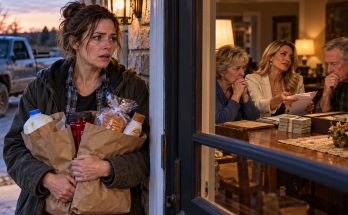
I kept expecting someone inside the house to say there had been a misunderstanding.
That would have made everything easier.
One question.
One correction.
One ordinary explanation.
Then I could have knocked, handed Mom her groceries, and gone about my day.
But nobody corrected anything.
My father had asked about the amount.
Ranata had not sounded surprised.
That troubled me.
If she had been caught making an innocent exaggeration, I thought I might have heard hesitation in her voice.
A pause.
Some effort to clarify.
Instead, the conversation continued as though everyone understood what was happening.
Everyone except me.
I stood on the porch with my fingers wrapped around the grocery bags.
The plastic had begun to hurt.
I moved one handle to a different finger.
Then another.
It was a ridiculous thing to focus on.
But I remember the sensation clearly.
The pressure.
The warmth in my hands.
The way I kept adjusting the bags because I did not know what else to do.
Inside, Mom spoke.
Her voice sounded uncertain.
She asked Ranata whether I really required more assistance.
More.
That word settled heavily in my mind.
It was not just that my mother thought I might need money.
She apparently believed I had needed it before.
I had spent years believing my parents judged my lifestyle because they misunderstood my choices.
I had never imagined those judgments were connected to money they thought they had paid on my behalf.
Ranata answered Mom without sounding particularly troubled.
She said that if my situation had improved enough for me to manage independently, there would be no reason for her to ask.
It was a simple explanation.
Almost reasonable.
That made it worse.
She was not speaking like someone trying to persuade strangers.
She was speaking like a daughter discussing an ongoing family responsibility.
A problem that had become familiar.
A problem named Fay.
I felt anger beginning to rise.
But it was mixed with confusion.
I knew I had never asked for financial help.
I knew I had never asked Ranata to do it for me.
I knew I had never authorized her to collect money in my name.
Those things were certain.
Everything else was suddenly unclear.
How long had she been telling them this?
What exactly had she said?
How often had they given her money?
And why had nobody ever asked me about it?
I thought of the way my family saw my farm.
To them, it was hard work.
Constant maintenance.
A property that required more effort than they thought it was worth.
To me, it was my life.
I understood the difference because I lived it every day.
I knew how much effort went into keeping things operating.
I knew what a repair could cost.
I knew what it meant to delay buying something new because the old one still had useful years left.
Those decisions were deliberate.
But they were not glamorous.
When someone saw me wearing work clothes beside an aging pickup, they could draw whatever conclusion they wanted.
My sister had always seemed particularly willing to draw conclusions.
I did not deny that running a farm was difficult.
There had been mornings when I wondered whether I was tired of the work.
There had been expenses that required careful planning.
There had been equipment I would have liked to replace sooner.
There had been plenty of moments when spending less was the sensible choice.
But difficulty was not the same as dependence.
And being careful with money was not the same as having none.
I had thought that distinction was obvious.
Apparently, it was not.
Or perhaps it had been made deliberately unclear.
I hated that thought.
Ranata was my sister.
We had grown up with the same parents.
I knew the difference between us had been visible for years.
She had her comfortable home.
Her husband.
Her newer SUV.
I had my farm and my old pickup.
Those details made it easy for people to compare us.
I had never especially enjoyed the comparisons.
But I had learned to live with them.
There was no prize for proving that one sister's life was better than the other's.
At least, that was how I had always thought about it.
I was not trying to win anything.
I wanted to do my work.
Pay my bills.
Keep my property in order.
And have enough quiet at the end of the day to feel that the effort meant something.
I did not need my parents to admire every decision.
I did not need Ranata to approve of the truck I drove.
But I did expect them to understand one basic fact.
I was responsible for myself.
That afternoon, it became clear they did not understand it at all.
I kept listening.
I could hear movement inside the house.
A chair.
A faint sound I could not identify.
Then my father's voice came again.
He wanted to know whether I had repaid any of the earlier money.
I nearly lost my grip on the groceries.
Earlier money.
Repayment.
Those two ideas made everything suddenly more serious.
I had not borrowed from my parents.
Ever.
I had not asked them to lend me money for equipment.
I had not asked them to pay for repairs.
I had not approached them after a difficult season.
There was no outstanding debt between us.
Not one I knew anything about.
I searched my memory anyway.
That was what confused me most about my own reaction.
I knew the truth.
Yet I still found myself trying to remember whether there could be some forgotten conversation.
Some misunderstanding about a purchase.
Some moment when I had accepted help without thinking of it as a loan.
But there was nothing.
I had never received the money my father was discussing.
And if it had existed, I had not been told about it.
I stood so still that the only thing moving was the slight stretch of the plastic handles.
The discomfort in my fingers had become a dull ache.
I barely noticed.
My father was asking whether I had returned money.
That meant he believed money had reached me.
It meant he believed I owed him something.
And Ranata was the person being asked to account for it.
I remember feeling embarrassed.
That may sound strange.
I had done nothing wrong.
At least, nothing connected to the money.
But I was hearing my parents talk about me as though I had secretly disappointed them.
As though I had accepted help and failed to honor my obligations.
They were having a conversation about my character.
Without me.
And I had not even known there was an accusation to answer.
That hurt more than I expected.
I thought about all the times I had chosen not to correct Ranata.
The remarks about the farm.
The way she talked about my truck.
The comments that suggested I was always one problem away from trouble.
I had treated those things as irritating but harmless.
Now I was not sure they had been harmless.
Maybe they had prepared my parents to believe something far more serious.
Maybe that was why a story about me needing money seemed believable to them.
I could see how the pieces might fit.
The old vehicle.
The long hours.
The expensive repairs.
My refusal to talk openly about my finances.
All of it could be presented as evidence.
Not proof.
But enough to encourage suspicion.
That was what frightened me.
The details of my real life were being used to support a version of my life that was false.
I did not know whether Ranata had planned that.
I did not know exactly what she had told them.
But I knew she was not speaking from information I had given her.
She was speaking as though she understood my finances better than I did.
I wanted to open the door.
I wanted to interrupt.
I wanted to ask Dad what he believed I owed.
I wanted to turn to Ranata and ask where she had gotten these ideas.
My hand shifted toward the door.
Then stopped.
I was afraid that if I walked in, everyone would begin explaining at once.
Ranata would talk.
Mom would try to calm things down.
Dad would want an answer.
And I would be forced to defend myself before I even understood the accusation.
So I remained outside.
It was not a courageous decision.
It was the decision of someone who knew too little and wanted to know more.
For years, I had avoided arguments because I thought they were unnecessary.
Now I was avoiding one because I needed facts.
That difference mattered.
The silence inside seemed to lengthen.
I could not see their faces.
I could not tell whether Mom was worried or whether Dad was angry.
I did not know how Ranata was sitting.
I could only hear them.
That made every word feel important.
I wondered what my parents thought I had done with the money.
Did they imagine I had spent it on repairs?
Did they believe I was falling behind on property expenses?
Did they think I had been too embarrassed to admit I could not support myself?
Those questions were guesses.
I knew that.
But I could not stop them.
I had spent so long keeping my difficulties private that I had never considered how someone else might describe them.
And Ranata had apparently become the person who did.
I thought of my father's question again.
Had I repaid anything?
He was not asking whether the help had been delivered.
He was not asking whether I knew about it.
He was assuming both.
That assumption was the center of everything.
Somewhere between my parents and me, money had supposedly changed hands.
Except I had never held it.
I did not have a record of receiving it.
I did not have a debt to repay.
And I did not have any idea how much was involved.
For a moment, I wanted to blame my parents completely.
Why had they not called me?
Why had they not simply asked what I needed?
Why would they send money through my sister without telling me?
But I did not have the answers.
I had only heard fragments of a conversation.
I could not know what Ranata had told them to explain my absence.
That was the part I kept returning to.
What would make parents give money to one daughter for another daughter without asking the second daughter first?
I wanted to believe they had acted out of concern.
I wanted to believe they trusted Ranata because she had assured them she was helping me.
But even that possibility hurt.
It meant they had trusted her description of my life more than my ability to speak for myself.
And I had never been invited to correct it.
I shifted my weight.
The porch felt strangely unfamiliar.
This was a house I had visited for years.
A place where I knew where to put the groceries and what coffee Mom liked.
Yet I was standing outside it like someone who did not quite belong.
Inside, my family had a version of me they apparently understood.
A daughter who needed rescuing.
A daughter who would not admit it.
A daughter who accepted money and failed to repay it.
I recognized none of her.
And still, she had my name.
Source: thknews11.store
Click here to continue reading: PART 3: I Had Never Asked My Parents for Money, but My Sister’s Answer Made Me Understand How Much They Believed I Owed
I Arrived at My Parents’ House Carrying Groceries, Never Imagining That a Conversation Behind Their Front Door Would Change Everything I Believed
Part 2 of 15