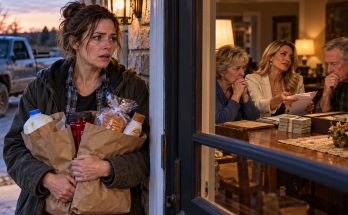
I did not sleep well the night before we spoke with Ranata.
I had expected anger to keep me awake.
Instead, it was uncertainty.
I knew what I had heard.
I knew what my parents had shown me.
But I did not know what my sister would say when she could no longer explain my supposed financial problems without me being present.
That was what worried me.
Ranata had always been confident.
She could describe a situation in a way that made her sound certain.
For years, I had allowed her to do that.
Even when she was describing my life.
Now I intended to ask questions she had never expected me to ask.
The following day, I drove to my parents' house again.
My pickup made the same familiar noises.
I parked beside Dad's sedan.
Ranata's SUV was already there.
For a moment, I remained behind the wheel.
It reminded me of Saturday.
The same driveway.
The same vehicles.
The same house.
But this time, I knew why my sister was inside.
And I knew what I was going to ask.
I got out.
Walked to the porch.
And knocked.
Mom opened the door.
She looked nervous.
I could understand that.
She had spent years trusting Ranata's account of my finances.
Now she was about to hear that account questioned directly.
I stepped inside.
Ranata was seated near Dad.
She looked at me.
"Fay?"
I nodded.
"Hi."
Her expression changed.
I could not tell whether she was surprised or uncomfortable.
I did not try to guess.
I sat down.
Dad had the records on the table.
That mattered.
I wanted the conversation grounded in something more reliable than anyone's memory.
Ranata looked at the papers.
Then at Dad.
"What's going on?"
Dad answered before I could.
"We need to talk about the money."
Ranata frowned.
"What money?"
I watched her carefully.
"The money you said was helping me."
She looked at me.
For a moment, she said nothing.
Then she asked what I meant.
I kept my voice steady.
"I heard you talking to Mom and Dad on Saturday."
Her eyes widened slightly.
I continued.
"You said I couldn't manage my finances. You said you'd been handling things for me."
She shifted in her chair.
"Fay, that's not what I meant."
I had expected that answer.
It did not surprise me.
So I asked the question I had prepared.
"What did you mean?"
She looked toward Mom.
Then Dad.
I waited.
For years, I had filled awkward silences by changing the subject.
This time, I let the silence remain.
Ranata said she had been worried about me.
I nodded.
"Why?"
She mentioned the farm.
The expenses.
The old truck.
The long hours.
All the things I had heard her discuss before.
I listened.
Then I asked how any of those things gave her permission to collect money in my name.
She looked uncomfortable.
"I was trying to help."
I looked at her.
"How?"
She did not answer immediately.
Dad moved the records closer.
He asked where the money had gone.
Ranata looked down.
I could see she had not expected him to ask that question so directly.
I wanted to interrupt.
I wanted to tell her how much I hated hearing her describe my life as a financial problem.
But I stayed quiet.
The money mattered.
The facts mattered.
And I wanted her answer.
Ranata said she had been handling family concerns.
That was vague.
Too vague.
I asked what expenses she had paid for me.
She mentioned problems connected to the farm.
I shook my head.
"I paid my own farm expenses."
She looked at me.
"Fay, you never wanted to admit how difficult things were."
I felt anger rise.
There it was.
The same explanation she had apparently used for years.
My pride.
My refusal to admit trouble.
The idea that my silence was proof of dependence.
I took a breath.
"Being private doesn't mean I needed your money."
She looked away.
"And it doesn't mean I gave you permission to ask Mom and Dad for money."
Dad nodded.
Mom remained quiet.
Ranata looked toward them.
I could see she wanted the conversation to become something familiar.
A discussion about my stubbornness.
My work.
My refusal to accept help.
But the records were on the table.
And I was present.
I asked again.
"What did you do with the money?"
She hesitated.
Then she said some of it had been used to help with family matters.
I stared at her.
"Which family matters?"
She did not give a clear answer.
I looked at Dad.
He seemed to understand the problem.
The money had been given because my parents believed I needed help.
But Ranata was not identifying expenses paid on my behalf.
The difference was impossible to ignore.
I asked whether she had ever sent any money to me.
She shook her head.
Not immediately.
But eventually.
"No."
I felt my chest tighten.
There it was.
A direct answer.
I had known I never received anything.
But hearing her admit she had not passed money to me changed the conversation.
I looked at Mom.
Her eyes were wet.
Dad sat very still.
Ranata began explaining again.
She said she had believed I needed help.
She said she thought she could manage things quietly.
She said she had not wanted me embarrassed.
I listened.
But those explanations did not answer why she had collected money supposedly intended for me.
I asked whether she had told our parents I had agreed.
She looked at the papers.
Then she said she had not explained everything clearly.
I felt a bitter kind of sadness.
Not explained clearly.
That was how she described years of false assumptions.
I looked at her.
"Did you tell them I owed money?"
She hesitated.
Dad answered.
"You told us she hadn't paid anything back."
Ranata looked toward him.
I remembered standing outside the door and hearing those words.
Now Dad was repeating them in front of her.
I waited.
She did not deny having said it.
Instead, she began talking about how difficult things had been.
Her own worries.
Her responsibilities.
The pressure she felt to keep everything together.
I could hear the emotion in her voice.
Perhaps some of it was genuine.
But I could not allow her difficulties to erase what she had done.
I looked at her.
"Whatever problems you had, they weren't my debts."
She went quiet.
I continued.
"You could have asked Mom and Dad for help with your own problems."
My voice was steadier than I expected.
"But you told them the money was for me."
She lowered her eyes.
For a long time, nobody spoke.
I did not feel victorious.
I felt disappointed.
My sister had been willing to let our parents believe I was struggling and failing to repay assistance.
She had allowed them to think their money was reaching me.
And when I asked her to explain where it went, she could not account for it as money spent on my behalf.
That was enough to confirm the central betrayal.
I did not need to invent motives.
I did not need to know every private decision she had made.
I only needed to know that she had used my name to obtain help I never received.
Dad looked at the records.
Then at Ranata.
"You should have told us."
His voice was quiet.
Ranata began to cry.
Mom moved slightly in her chair.
I could see the instinct to comfort her.
I understood it.
She was still their daughter.
But I was their daughter too.
And I had spent years being described as someone who needed rescuing while nobody asked me whether the story was true.
I did not want to make Ranata suffer.
I wanted her to acknowledge what she had done.
I asked one final question.
"Why didn't you ever tell me?"
She looked at me.
Her eyes were red.
She said she did not think I would understand.
That answer hurt more than I expected.
Because it suggested she had known I would object.
She had known I had not agreed.
And she had continued anyway.
I looked down at my hands.
I remembered the grocery bags cutting into my fingers.
The closed blinds.
Dad's question about repayment.
The accountant's message.
Thirty-nine million dollars.
None of those things had prepared me for hearing my sister explain that she had not involved me because she expected I would disagree.
I looked at her again.
"You didn't give me the chance."
She did not answer.
Dad said the records would need to be reviewed carefully.
He wanted to understand every payment.
Ranata nodded.
Mom wiped her eyes.
I knew the practical work was not finished.
There were amounts to reconcile.
There were explanations that needed evidence.
There were decisions my parents would have to make about the money.
But the central truth was no longer hidden.
I had never received the assistance.
Ranata had admitted she had not passed it to me.
And my parents knew they had trusted a story without checking it.
I stood up.
I did not shout.
I did not demand that Ranata apologize immediately.
I did not tell them about the farm sale.
That was still my decision to make.
I looked at my parents.
"I need you to understand something."
They listened.
"I'm not responsible for money I never borrowed."
Dad nodded.
Mom did too.
Then I looked at Ranata.
"And you can't speak for me anymore."
She lowered her eyes.
I had spent years allowing her to describe my life.
I was not going to continue.
I left my parents' house feeling sadder than I expected.
But also clearer.
I had wanted to know where the money went.
I still needed the full records to answer that completely.
But I finally knew something I had only suspected on Saturday.
My sister had accepted money in my name without passing it to me.
And she had allowed my parents to believe I was responsible for repaying it.
That truth hurt.
But it was no longer hidden behind a closed door.
Source: thknews11.store
Click here to continue reading: PART 15: After My Sister’s Lies Came Into the Open, I Finally Told My Family About the Thirty-Nine-Million-Dollar Sale and Chose What Would Happen Next
I Arrived at My Parents’ House Carrying Groceries, Never Imagining That a Conversation Behind Their Front Door Would Change Everything I Believed
Part 14 of 15