The following morning, I reached for my phone before I got out of bed.
I wanted to call Dad.
Then I saw the time and stopped.
It was early.
For years, getting up before most people had been normal for me.
The farm had trained my body to wake before I needed an alarm.
Selling the property had not changed that.
I lay there for a few minutes, looking at the phone.
My father's number was easy to find.
So was Mom's.
So was Ranata's.
I had all three numbers.
That seemed important somehow.
There was no practical reason our family could not speak directly.
We were not separated by an impossible distance.
We were not unable to contact one another.
We simply had not been having the conversations that mattered.
I got up and went to the kitchen.
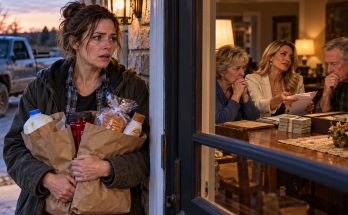
The groceries were still there.
I made coffee.
Not the kind Mom had asked me to bring.
That package was sitting unopened beside the bread.
I left it alone.
I wanted to keep the groceries together until I decided what to do with them.
It was not logical.
Milk and creamer belonged in the refrigerator, and bread would not stay fresh forever.
But I could not bring myself to treat them as ordinary shopping anymore.
They reminded me of why I had gone to my parents' house.
And what had prevented me from going inside.
I sat with my coffee and looked at the list I had written the night before.
Six questions.
The first five concerned money.
The sixth concerned what my parents believed.
I had spent most of my adult life working with problems that could be measured.
A repair cost a certain amount.
A piece of equipment needed a particular part.
A property expense had a due date.
Even when the work was difficult, I could usually identify what needed to happen.
This was different.
I could not repair the past.
I could not force my parents to remember every conversation exactly.
I could not know whether Ranata would tell the truth.
And I could not make them trust me simply by showing them a bank balance.
That last point bothered me.
I had thought about the thirty-nine million dollars so often since Saturday that I had begun to resent the number.
Before hearing Ranata, it represented a completed sale.
A major change.
A measure of what fifteen years of work had produced.
Now it seemed like something I might have to reveal in order to make my own family believe I was capable of supporting myself.
I did not want that.
I wanted them to believe me because I was telling the truth.
Not because I had become wealthy.
Not because a large financial transaction made my version more impressive than Ranata's.
I thought about what would happen if I told them the sale price first.
They might apologize for underestimating me.
They might become excited.
They might congratulate me.
But none of those responses would explain the money they believed I owed.
And I was afraid the conversation would move away from that question.
I needed to keep the two matters separate.
I finished my coffee.
Then I opened the messages on my phone.
I considered writing to Mom.
A simple message.
Something asking when she and Dad could speak privately.
I typed a sentence.
Deleted it.
Typed another.
Deleted that too.
It was embarrassing how difficult it felt.
I was thirty-seven years old.
I had negotiated a thirty-nine-million-dollar sale.
I had handled years of financial decisions without asking my family for guidance.
Yet I was struggling to ask my parents for a conversation.
That told me something about the way I had been living.
I had learned to be independent in practical matters.
But I had not learned to challenge the role my family had assigned me.
For years, I had been the daughter who seemed to need improvement.
The one who should replace her truck.
The one who worked too hard.
The one who had chosen a difficult way to make a living.
Ranata rarely needed to say directly that she considered herself more successful.
The comparison was already there.
Her house.
Her husband.
Her SUV.
My farm.
My old pickup.
My work clothes.
The differences were visible.
And my family seemed comfortable treating them as evidence.
I had not corrected that.
I had told myself it was not worth the effort.
But that morning, I wondered whether the situation had continued because I had always refused to participate in the discussion.
There is a kind of freedom in not caring what people think.
I still believed that.
But there is also a responsibility to correct a false statement when it begins to cause harm.
I had not understood that distinction before Saturday.
Now I could not ignore it.
I thought about the times Ranata had spoken on my behalf.
Not about anything important.
At least, nothing I had considered important then.
Sometimes she offered opinions about my work before I had finished explaining something.
Sometimes she made remarks about how difficult farming must be.
Sometimes she described my life as though my decisions were mostly reactions to problems.
I had rarely argued.
It was easier to let the conversation move on.
But I could see how that pattern might have encouraged my parents to look toward her for an explanation.
She spoke confidently.
I spoke briefly.
She seemed certain.
I did not feel obliged to prove anything.
Over time, the difference could become its own kind of evidence.
I hated admitting that.
Because it felt as though I was accepting responsibility for something I had not done.
I had never authorized a false financial arrangement.
I had never asked Ranata to collect money.
I had never told her I could not manage my property.
Those were her claims, not mine.
If she had deliberately lied, my silence did not make me responsible for the deception.
I knew that.
But I also knew I could not continue behaving as though the family's opinion had no consequences.
It had consequences now.
My parents apparently believed I owed them money.
That was real enough.
I stood and walked to the window.
I had looked across the property from that window more times than I could count.
For fifteen years, the farm had been part of every decision I made.
Its needs determined my schedule.
Its expenses influenced what I bought.
Its responsibilities shaped my habits.
Selling it had changed my future.
But the years of work were still part of me.
I did not suddenly feel like someone who could spend without thinking.
I still noticed things that needed fixing.
I still considered whether an expense was necessary.
I still preferred using what I already owned.
That was why I had kept the pickup.
It worked.
I knew it.
It had carried me through years when owning something more impressive would not have made the work easier.
I had never felt ashamed of it.
Until Saturday, I had not even seriously considered that other people might see it as evidence of a hidden financial problem.
Now I could imagine Ranata pointing toward it.
I could imagine her describing my refusal to replace it as proof that I had no money.
I could imagine our parents believing her.
Those thoughts made me angry.
But I reminded myself that imagining an explanation was not the same as knowing one.
I needed to hear what they actually believed.
I returned to the table.
My phone was still there.
I opened a message to Mom again.
This time, I kept it simple.
I told her I wanted to talk with her and Dad about something important.
I asked whether we could speak without anyone else present.
I read the message before sending it.
It did not mention Ranata.
It did not mention money.
It did not mention the farm sale.
That was deliberate.
I wanted my parents to hear the questions from me.
Not through my sister.
I sent it.
Then I put the phone down.
The message did not answer anything.
But sending it changed how I felt.
I had begun.
Not by accusing anyone.
Not by announcing what I knew.
By asking for a direct conversation.
I looked at the list again.
How much money had they given?
When?
To whom?
For what?
Why had they not spoken to me?
And what did they believe about my life?
I had no intention of beginning with the sale.
That could wait.
The accountant's paperwork could wait too.
It was important, but it was not urgent in the same way.
There were records I needed to organize.
There were decisions about my future that I would eventually make.
I had been given an opportunity to choose what came next.
But I did not want those decisions tangled up with my family's misunderstanding.
I wanted to settle what had happened before making any announcement.
I did not know how long that would take.
I did not know whether my parents would react calmly.
I did not know whether they would defend Ranata.
I had to accept that.
For once, being prepared did not mean having every possible answer.
It meant knowing which questions mattered.
I thought again about my father's voice.
He had not sounded surprised that money might be needed.
He had sounded concerned about the amount.
That suggested the subject was familiar.
But I still did not know whether the previous assistance had been large or small.
I did not know whether it had been given once or repeatedly.
My sister had said I was falling behind.
That suggested an ongoing story.
Yet I had never discussed repayment with anyone.
The more I considered it, the more important it became to ask my father what he meant by earlier money.
I wanted him to tell me in his own words.
I wanted to hear what he expected from me.
And I wanted to explain that I had never accepted any such obligation.
My phone remained on the table.
I glanced at it several times.
I was not waiting for an apology.
Mom had no reason to know what I had overheard.
As far as she understood, I had simply failed to arrive with her groceries.
I wondered whether she had noticed.
Whether she had called my name from inside the house after I left.
Whether Ranata had stayed for coffee.
Whether Dad had agreed to give more money.
Those questions had no answers yet.
I stopped myself from building another imagined conversation.
That had become a habit since Saturday.
I kept replaying what I heard and adding things I feared might have happened.
But I had promised myself I would deal with facts.
So I returned to what I knew.
My parents believed they had helped me.
I had never received the help.
Ranata had been speaking for me.
I had just sold the farm.
And I had not told my family.
Those facts were enough.
I did not need to make them more dramatic.
I did not need to invent a larger betrayal before understanding the one already in front of me.
I went through the rest of the morning doing ordinary things.
The routine helped.
But I noticed how often my thoughts returned to the same question.
Why had nobody asked me?
It was such a simple thing.
If Dad had called and said he heard I needed money, I would have corrected him immediately.
If Mom had asked whether Ranata was helping with my bills, I would have told her no.
The misunderstanding could have ended in a single conversation.
Instead, the story had apparently continued long enough for repayment to become an issue.
I did not understand how that could happen between people who knew one another so well.
Then I realized that maybe we did not know one another as well as I had believed.
They knew the version of me they saw during visits.
They knew I worked hard.
They knew I drove an old truck.
They knew I did not discuss my finances.
But they did not know the sale was complete.
They did not know how successful the farm had become.
And they apparently did not know that I had never asked my sister for help.
That was a painful collection of things not to know about your own daughter.
I could accept that they did not know my account balance.
That was private.
I could accept that they did not understand every detail of my business.
That was complicated.
But I could not accept that they had made financial decisions in my name without speaking to me.
That crossed a line.
It removed me from my own life.
I had spent fifteen years making difficult choices because I wanted to remain responsible for myself.
Now I was going to have to insist on something even more basic.
The right to explain my own circumstances.
By the time I returned to the kitchen, I no longer felt tempted to call Ranata first.
I understood why that would be a mistake.
She had been the person explaining things for years.
If I wanted the truth, I could not begin by handing her control of the conversation again.
I needed my parents.
I needed their account.
I needed to know what they believed they had done for me.
I looked at the message I had sent.
It was still there.
Short.
Plain.
Nothing dramatic.
I did not send another.
I had made the first move.
And this time, I intended to speak for myself.
Source: thknews11.store
Click here to continue reading: PART 7: I Had Thirty-Nine Million Dollars in My Account, but the Question That Kept Me Awake Was Why My Parents Trusted My Sister Instead of Me
I Arrived at My Parents’ House Carrying Groceries, Never Imagining That a Conversation Behind Their Front Door Would Change Everything I Believed
Part 6 of 15