I had expected relief after speaking with my parents.
Instead, I felt tired.
The conversation had been necessary.
I knew that.
But hearing them acknowledge that they believed they had given me financial assistance had made the situation real in a way overhearing it had not.
Before, I had fragments of a conversation.
Now I had their admission.
They had believed I needed help.
Ranata had been involved.
They had not confirmed that the money reached me.
And they had expected repayment for assistance I had never received.
Those facts were difficult enough.
What troubled me more was how naturally the arrangement had seemed to them.
They had not believed they were doing something unusual.
They thought they were helping their daughter.
Their intentions may have been kind.
But the result was that I had been excluded from decisions made in my name.
I sat in my pickup after leaving their house.
The engine was off.
My hands rested on the steering wheel.
For a moment, I looked toward the front door.
The same door I had stood outside on Saturday.
I had walked through it this time.
I had asked the questions.
And I had heard answers I had spent days trying to imagine.
But I still did not know the amount.
I still did not know where the money had gone.
I still did not know exactly what Ranata had told them.
I looked at my hands.
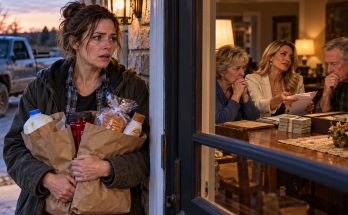
The red marks from the grocery bags were gone.
It seemed strange that such a small physical reminder could disappear before the larger problem had even begun to make sense.
I started the truck.
The familiar sound settled around me.
For years, I had driven that vehicle without thinking much about what it suggested to other people.
Now I understood how easily appearances could be turned into conclusions.
My parents had looked at my life and believed I was struggling.
They had looked at Ranata's life and believed she was capable of helping.
Those impressions had apparently influenced decisions involving money.
I drove home slowly.
I was not thinking about confronting my sister.
Not yet.
I was thinking about the records Dad had mentioned.
He said there were records of money they had provided.
That was the first practical detail I could work with.
I needed to see them.
Dates.
Amounts.
The form in which the money had been given.
Anything that could show what had actually happened.
I did not want to accuse Ranata based only on the fact that she had lied about my circumstances.
That lie was serious.
But I still needed to know what happened to the money.
There might be records that explained part of the arrangement.
There might be details my parents had forgotten.
There might be things they believed were obvious but had never told me.
I had to keep an open mind long enough to examine them.
That was difficult.
I was angry.
I had been angry since Saturday.
But anger did not tell me where money had gone.
Evidence might.
When I reached home, I put my keys on the kitchen table.
The groceries were still there.
I looked at the coffee package.
The creamer was in the refrigerator.
I had been meaning to decide what to do with them.
Instead, I had spent my time trying to understand a financial story I had never participated in.
I thought about Mom's expression during our conversation.
She had looked distressed when I told her I had never received anything.
I believed her distress was genuine.
I also believed she had been too willing to accept Ranata's explanation.
Both things could be true.
That was something I needed to remember.
My parents could have acted out of concern and still made a serious mistake.
They could have trusted my sister and still failed to protect me from a false claim.
They could have wanted to help while never asking whether help was needed.
I did not have to choose between seeing them as entirely innocent or entirely responsible.
Real families were rarely that simple.
I sat down.
The list of questions was still on the table.
Some now had partial answers.
My parents believed they had provided help.
Ranata had been involved.
They had not verified that it reached me.
But the amount remained unknown.
So did the full history.
I took another sheet of paper and began writing what I had learned.
I was careful.
I did not write that Ranata had stolen money.
I could not prove that.
I wrote that she had represented my financial condition falsely.
I wrote that my parents had acted on her account.
I wrote that I had never received the assistance.
Those statements were accurate.
I wanted them in front of me because I knew how easy it was to let emotions change the way I remembered a conversation.
I had spent years managing a farm.
There were times when a difficult day made a problem seem larger than it was.
There were times when frustration tempted me to replace equipment before checking whether it could be repaired.
Experience had taught me to separate the feeling from the facts.
I needed that discipline now.
I looked at the documents from the farm sale.
They were organized.
Every important detail had been recorded.
The transaction had not depended on anyone's memory of what they intended.
There were signatures.
Dates.
A completed closing.
Confirmation that the money had arrived.
That was why I trusted the sale.
It had been documented.
The arrangement my parents described seemed to have relied on something very different.
Trust.
Assumptions.
Conversations with Ranata.
And an understanding of my life that had never been confirmed with me.
I found that contrast difficult to ignore.
A business transaction involving thirty-nine million dollars had been handled with records.
A family arrangement supposedly meant to help me had apparently continued without anyone checking whether I knew about it.
I wondered whether my parents saw the problem as clearly as I did.
I hoped they did.
But I could not assume it.
I remembered Dad asking why I had not told them I was doing better.
That question had hurt.
It suggested he still believed my financial condition was central to the issue.
Perhaps he thought I had been struggling until recently.
Perhaps he believed I had improved and simply failed to tell them.
But even if that were true, it would not explain money I had never received.
I needed him to understand that.
Whether I was poor or wealthy did not determine whether the arrangement was legitimate.
If I had been struggling, Ranata would still have needed my permission to speak for me.
If I had needed help, my parents should still have asked whether I wanted it.
If I had accepted a loan, there should have been a conversation about repayment.
None of those things had happened.
I thought about saying that to Dad again.
But I had already said enough for one conversation.
He needed time to consider what I told him.
So did Mom.
I could not force them to understand everything immediately.
I knew that.
Still, waiting was uncomfortable.
I had spent days wanting answers.
Now I had finally asked the questions, and the most important details remained unresolved.
I wanted to see the records.
I wanted to know whether the money had been given once or repeatedly.
I wanted to know whether it had been presented as a loan or a gift.
Dad's question about repayment suggested he expected some of it back.
But I did not know what terms he believed existed.
I had agreed to none.
That was clear.
I wrote another note.
No loan agreement with me.
I underlined it once.
Not because I needed to prove the obvious to myself.
Because I wanted to remember that the burden of explaining the supposed debt did not belong to me.
I had not borrowed the money.
I had not received it.
I was not responsible for inventing a repayment arrangement after the fact.
My parents would need to examine what had happened.
And Ranata would need to explain her role.
I thought about the possibility that she would be angry when she learned I had spoken to Mom and Dad.
She might see it as going around her.
The idea almost made me smile.
For years, she had apparently been going around me.
Speaking about my finances.
Explaining my supposed problems.
Receiving questions about repayment.
All without my knowledge.
Now I had finally spoken directly to the people involved.
That was not a betrayal.
It was long overdue.
I looked toward the window.
The old truck sat outside.
I had no intention of replacing it simply to change my family's opinion.
I liked the truck.
It worked.
It had served me through years of difficult work.
I did not need to turn the farm sale into a display of wealth.
And I did not need to compete with Ranata's SUV.
I wanted my choices to remain my own.
That had always been the point of working toward independence.
Not to impress anyone.
To have control over my life.
The situation with my parents threatened that sense of control in a different way.
They had allowed someone else to describe my needs.
I had not agreed to it.
Now I needed to establish that it would not continue.
I thought of the moment I asked Dad whether he had ever confirmed I received the money.
His hesitation had been telling.
I did not need him to confess that he had been careless.
I needed him to recognize the consequence.
He had believed a story.
He had acted on it.
And he had not checked with the person supposedly receiving the help.
That was a mistake.
A serious one.
I could forgive a mistake.
But I could not accept continuing it after the truth had been raised.
I wanted my parents to examine the records.
I wanted them to ask questions.
I wanted them to stop relying on Ranata's explanations until those explanations could be verified.
They had agreed not to provide more money in my name for now.
That was important.
It meant the arrangement had been interrupted.
Whatever had been happening, it would not simply continue unquestioned.
I felt some relief when I thought about that.
Not enough to make me comfortable.
But enough to recognize that speaking up had mattered.
I had not solved everything.
I had not recovered money.
I had not confronted my sister.
But I had corrected the most important false statement.
I was not financially dependent on Ranata.
I had never asked her to handle my obligations.
I had never received the assistance my parents described.
Those facts were now known to my parents.
What they did with that knowledge would matter.
I looked again at the thirty-nine-million-dollar sale documents.
I thought about telling Mom and Dad.
Perhaps after they had examined the records.
Perhaps after we understood what had happened.
I did not want to keep the sale secret forever.
It was too significant a change in my life.
But I wanted them to hear the truth about the supposed debt before learning the size of my bank balance.
That remained important.
I wanted to know whether they trusted me without needing proof that I was wealthy.
I wanted to know whether they could accept my word.
And I wanted to understand how much trust they had placed in Ranata.
I put the documents away.
Then I looked at the paper containing my notes.
There was still a blank space beside the question about the amount.
I left it blank.
I would not guess.
I would wait for the records.
The question about where the money went was also unanswered.
I left that blank too.
It was tempting to fill it with my suspicion.
But suspicion was not proof.
I had spent years making practical decisions based on what I could establish.
I owed myself the same care now.
I stood up and put the papers together.
The kitchen was quiet.
I could hear the familiar sounds of the house.
There was no dramatic moment.
No sudden revelation.
Only a woman looking at the facts and realizing that her family had allowed a false story to shape financial decisions.
I had never imagined that would be the problem I faced after selling the farm.
But it was.
And I knew what I needed next.
Not another argument.
Not another explanation from Ranata.
Not an apology based on incomplete information.
I needed the records.
Because my parents' intentions could explain why they gave money.
But only the facts could show what happened to it.
Source: thknews11.store
Click here to continue reading: PART 12: I Refused to Reveal My Thirty-Nine-Million-Dollar Sale Until My Parents Understood That the Money They Had Given Was Never Mine to Repay
I Arrived at My Parents’ House Carrying Groceries, Never Imagining That a Conversation Behind Their Front Door Would Change Everything I Believed
Part 11 of 15