I had kept the farm sale private because I wanted time to understand what it meant for my life.
Now I was keeping it private for a different reason.
I did not want the news to change the conversation before the truth was established.
That decision felt harder each day.
I could imagine how my parents would react.
They had spent years believing I was struggling.
They had apparently given money because of that belief.
And I had just sold my farm for thirty-nine million dollars.
The contrast was enormous.
It would be easy to let that number become the center of everything.
But I had learned something important since Saturday.
A surprising fact was not always the most important fact.
The sale was surprising.
The missing money was important.
I needed to keep those things separate.
I sat at the kitchen table with the paperwork from my accountant nearby.
Everything connected to the sale was organized.
The transaction was complete.
I knew what had been sold.
I knew what had been paid.
I knew the money had arrived.
There was no mystery about that part of my life.
The mystery was the supposed financial help from my parents.
I still did not know the total amount.
I still did not know exactly when the arrangement had begun.
I still did not know what Ranata had told them.
But I knew the story about me needing assistance was false.
And now my parents knew I disputed it.
That mattered.
I thought about how easily I could have allowed the conversation to end there.
I could tell Mom and Dad that I had never received any money.
They could apologize.
We could agree there had been a misunderstanding.
Then everyone could avoid the uncomfortable details.
For a moment, that possibility was appealing.
I did not enjoy conflict.
I never had.
I preferred dealing with practical problems.
Things that could be measured.
Things that could be repaired.
Things that did not require questioning the intentions of someone I loved.
But I knew an apology would not answer where the money had gone.
If my parents had given money believing it was for me, that money had gone somewhere.
Someone had received it.
Someone had decided how it would be used.
And someone had allowed my parents to believe I owed repayment.
Those facts could not be erased by calling the situation a misunderstanding.
I needed to see the records Dad had mentioned.
Not because I wanted to punish anyone.
Because I wanted the truth.
I had spent too many years allowing vague statements to stand.
Ranata said I struggled.
I said nothing.
My family saw an old truck.
I did not explain.
They assumed my work clothes meant I had little money.
I let them believe it.
Those things had seemed harmless.
But now I understood how a collection of assumptions could become the foundation for something much more serious.
I had allowed people to misunderstand my appearance.
I had never allowed them to borrow money in my name.
Those were not the same thing.
I wanted to make that distinction clear to my parents.
The next time we spoke, I intended to explain it plainly.
I could accept that they had worried about me.
I could accept that they had wanted to help.
I could even accept that they had trusted Ranata because she seemed more comfortable discussing money.
But I could not accept being treated as someone who had agreed to a financial arrangement without my knowledge.
That was not concern.
That was exclusion.
Perhaps it had not begun that way.
Perhaps everyone believed they were doing the right thing.
But good intentions did not change what had happened.
I had been left out of decisions involving my name.
And the person explaining those decisions had been my sister.
I thought of Ranata's confident voice through the door.
She had said I could not keep up.
She had said I had not repaid previous help.
She had made those statements sound ordinary.
As though she had repeated them many times before.
I still did not know how much of that story my parents had accepted.
But I knew enough to understand why they had looked at me differently.
For years, they may have believed I was receiving assistance while refusing to acknowledge it.
That possibility hurt.
I imagined Dad watching me drive away after a visit.
Perhaps he wondered why I never thanked him.
Perhaps he thought I was too proud to admit he had helped.
Perhaps Mom believed every difficult season on the farm meant another payment would be necessary.
I could not know.
And I did not want to accuse them of thoughts they might never have had.
But those possibilities explained why I needed the truth.
Without it, every memory could become a question.
I did not want to spend the rest of my life wondering what my family had believed when they looked at me.
I wanted to ask.
I wanted to hear the answers.
And I wanted to correct what was false.
I looked at the paperwork from the sale.
Thirty-nine million dollars.
The number still seemed enormous.
I had worked fifteen years.
I had made sacrifices.
I had chosen not to replace things simply because they were old.
I had managed expenses carefully.
I had learned to be patient.
All of that had contributed to the life I built.
But I had never worked for the purpose of proving Ranata wrong.
I had not kept the farm through difficult years so I could one day embarrass my family.
I had worked because it was my responsibility.
Because I wanted independence.
Because I believed I could make something of the property.
The sale was the result.
It was not a weapon.
I did not want to use it like one.
That was why I kept the documents private.
I wanted my parents to understand what happened to their money before learning what happened to mine.
Those were separate questions.
They deserved separate answers.
I looked at my phone.
I considered contacting Dad about the records.
Then I decided I should ask clearly.
I sent a short message.
"Can we look at the records of the money you mentioned? I want to understand the amounts and where it went."
I did not accuse Ranata.
I did not mention the sale.
I did not demand an immediate explanation.
I asked for the information.
Then I put the phone down.
It was a small action.
But it felt different from the way I had handled family problems in the past.
Before, I would have allowed the subject to disappear.
I would have told myself there was no point arguing.
I would have returned to work.
I would have accepted that my family misunderstood me.
Now I was asking for facts.
I was refusing to let the matter fade.
I was taking responsibility for my own name.
That felt important.
I thought about the question of repayment again.
My father had believed I owed something.
That belief had existed before I knew about it.
I had not agreed to repay money I had never received.
I had never negotiated terms.
I had never even been told the amount.
There was no reason for me to accept the debt simply because my parents believed it existed.
I knew that.
Still, the idea of telling my father he had been mistaken was painful.
I had wanted his respect for years.
I had wanted him to see that my work mattered.
I had wanted him to understand why I chose a modest lifestyle even when I could have spent more.
Now I was asking him to reconsider something much more personal.
His belief that he had been helping his daughter.
I could see how difficult that might be.
He might feel deceived.
He might feel embarrassed.
He might become defensive.
But those feelings did not make the truth less necessary.
I thought of Mom.
She had asked whether I was all right.
She had looked distressed when I told her I had never received the assistance.
I believed she cared.
I believed Dad cared too.
But caring was not enough.
They needed to ask questions.
They needed to examine what they had been told.
And they needed to stop allowing my sister to speak for me.
I had spent years treating family peace as something that could be preserved by avoiding difficult subjects.
Now I understood that silence could preserve the appearance of peace while allowing distrust to grow underneath.
That was what had happened to us.
At least, that was how it felt.
My parents believed I had been struggling and failing to repay help.
I believed I had been supporting myself.
Ranata apparently stood between those versions.
And none of us had discussed the difference.
I could no longer accept that arrangement.
I stood up and walked to the refrigerator.
The cinnamon creamer was still there.
I took it out and placed it on the counter beside the coffee.
I looked at the two items.
They were small things.
Ordinary things.
The kind of things that should never carry emotional weight.
Yet they reminded me of the moment I first understood how little I knew about my family's conversations.
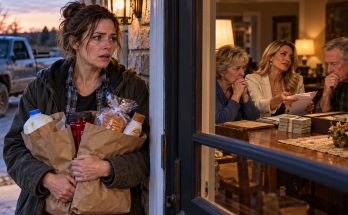
I had gone to deliver them.
I had not knocked.
I had overheard my name.
And I had driven away.
That choice had changed everything.
I wondered what would have happened if I had entered immediately.
Perhaps Ranata would have stopped talking.
Perhaps Dad would have changed the subject.
Perhaps Mom would have thanked me for the groceries.
And I would never have known.
That thought still unsettled me.
But I no longer regretted staying long enough to hear the conversation.
I did not feel proud of listening.
I could admit that.
But I was grateful I had learned something I needed to know.
The discovery had forced me to stop accepting the role my family had assigned me.
For years, I had been the daughter who seemed less successful.
Now I understood that they had apparently seen me as someone financially dependent on them.
I had not known that.
I had not agreed to it.
And I would not continue living under that false assumption.
I returned to the table.
My phone was there.
The message to Dad had been sent.
I did not know what records he would provide.
I did not know whether Ranata would explain herself.
I did not know whether my parents would ever fully understand how much their assumptions had hurt me.
But I had decided how I would proceed.
I would examine the facts.
I would ask direct questions.
I would refuse to accept responsibility for money I had never received.
And I would not reveal the farm sale simply to prove I was worthy of being believed.
The thirty-nine million dollars could remain private until I was ready to discuss it.
My life had been mine before the sale.
My decisions had been mine.
My responsibilities had been mine.
And my name had been mine.
I was not going to allow someone else to keep using it as an explanation for money I had never asked for.
I looked at the list of questions one last time.
The first two remained unanswered.
How much?
To whom?
I knew the answers would matter.
But something else had already changed.
I had stopped allowing my family's version of me to go unchallenged.
That was not the end of the problem.
It was the beginning of dealing with it properly.
For the first time, I understood that protecting my independence meant more than paying my own bills.
It meant making certain nobody else could claim to be paying them without my knowledge.
Source: thknews11.store
Click here to continue reading: PART 13: When My Father Agreed to Show Me the Records, I Finally Began to Understand How My Sister Had Used Our Family’s Trust Against Us
I Arrived at My Parents’ House Carrying Groceries, Never Imagining That a Conversation Behind Their Front Door Would Change Everything I Believed
Part 12 of 15